
Oseltamivir Oral Suspension in the Treatment of Influenza InfectionDear colleagues, in these days when the disease we define as influenza or the flu is on the rise, the medication whose active ingredient is Oseltamivir is known by the trade names Enfluvir and Tamiflu in our country. I would like to remind you that this vitally important medication, which is particularly difficult to procure in syrup form, can be easily prepared under laboratory conditions.
The medication, which is used in the treatment of influenza infection in adults and in influenza prophylaxis in individuals aged 1 year and older, is also used when necessary in children older than 2 weeks and in adults who have difficulty swallowing capsules.
Oseltamivir phosphate (C16H28N204.H3P04, MW 420.40) is an ethyl ester prodrug available as an antiviral (influenza) capsule containing 75 mg of oseltamivir for oral use.
It is produced in capsule form and as a powder for oral suspension. The suspension contains 12 mg / mL oseltamivir. Oseltamivir phosphate is a white crystalline solid. The capsules also contain pregelatinized starch, talc, povidone K30, croscarmellose sodium, and sodium stearyl fumarate; the capsule shells contain gelatin and colorants.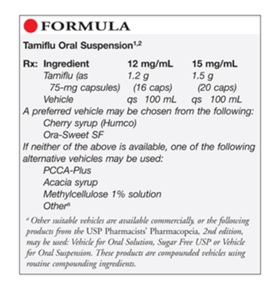 Below, we can see the table detailing how the syrup form of the drug should be prepared starting from Oseltamivir capsules.
The table demonstrates that it can be prepared by dissolving the capsule contents containing the required amount of Oseltamivir in a calculated amount of water and mixing it with a choice of Cherry syrup, Ora-Sweet, or simple syrup.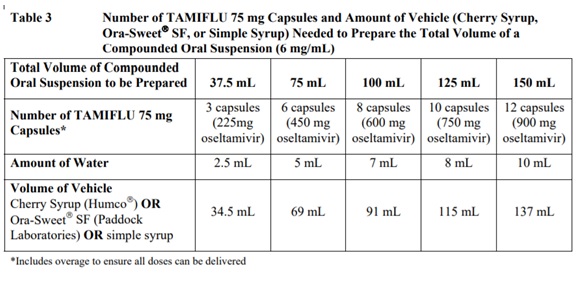 sample preparation;
The following procedure is followed to prepare an oral suspension (6 mg / mL) from the capsule form of the medication.
75 mg:
1. Place the specified amount of water into a polyethylene terephthalate (PET) or glass bottle (see Table 3).
2. Carefully separate the capsule body and cap and pour the contents of the required number of TAMIFLU
75 mg capsules into the PET or glass bottle.
3. Gently swirl the suspension to ensure adequate wetting of the TAMIFLU powder for at least 2 minutes.
4. Slowly add the specified amount of your chosen syrup to the bottle.
5. Close the bottle using a child-resistant cap and shake well for 30 seconds to completely dissolve the active ingredient.
6. Place an auxiliary label on the bottle stating “Shake well before use”.
7. Place an appropriate expiration date on the label according to the following storage conditions.
Stability:Cherry syrup (Humco) and Ora-Sweet SF formulations;2 0C to 80C (360F to 460F), stable for 5 weeks (35 days) when stored in a refrigerator. Room temperature: (250C- 770F), cherry syrup is stable for 5 days when stored at room temperature.Ora-Sweet SF;is stable for 35 days when stored at room temperature.PCCA-Plus, acacia syrup, and methylcellulose 1% solution formulations; 20C to 80C (360 F to 460F), stable for 90 days when stored in a refrigerator. Room temperature: (250C- 770F) it is stable for 90 days when stored at room temperature. The required viscosity can be achieved by adding 1% methylcellulose to ensure a homogeneous distribution of the dissolved drug within the suspension. (Note: the active drug, oseltamivir phosphate, dissolves readily in the specified vehicles. Viscosity is required for the homogeneous distribution in the solution of the inert ingredients of TAMIFLU capsules that do not dissolve in these vehicles, and it must be shaken vigorously before use.)
Note: Storage conditions are based on stability studies of compounded oral suspensions using the vehicles specified above.
The prepared medication should be stored in glass and polyethylene terephthalate (PET) bottles. Stability studies have not been conducted with other vehicles or bottle types.
A pharmacy label containing the patient’s name, dosing instructions, and drug name must be placed on the bottle.
Compounded Suspension Dosing (6 mg / mL)
Wishing you a good week…References:1. Tamiflu.com. Dosing, administration and storage: extemporaneous preparation.
www.tamiflu.com/hcp/dosing/extprep.aspx. Accessed November 13, 2009.
2. Ford SM, Kloesel LG, Grabenstein JD. Stability of oseltamivir in various extempor-aneous liquid preparations.IJPC.2007;11:162-174.
3.Physicians’ Desk Reference. 63rd ed. Montvale, NJ: Thomson Reuters; 2009:2649-2654.
4. Allen LV Jr. Standard operating procedure for performing physical quality assessment of oral and topical liquids.IJPC.1999;3:146-147.
Specialist Pharmacist Ahmet Nezihi Pekcan
Pekcan Pharmacy – Konya
[email protected]
Tel: (332) 3520657http://www.majistralformul.com/