
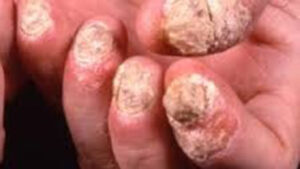
Dear Colleagues, this week I will share with you a formula used in the treatment of nail psoriasis. Before reviewing this formula prepared in pharmacies in Portugal together, let us briefly review nail psoriasis.
Nail psoriasis; Psoriatic nail: In some psoriasis patients, the nails may also be affected. This condition occurs in 10-78% of people with psoriasis. Nail psoriasis may present along with psoriasis lesions located elsewhere on the body, or it may be limited strictly to the nails. If psoriasis only affects the nails and skin lesions are absent, diagnosis is difficult. In psoriasis, fingernails are involved in 50% of cases and toenails in 35%. Pinhead-sized pitting on the nails, nail thickening and subungual hyperkeratosis (thick scaling beneath the nail), separation of the distal nail from the nail bed, and yellow or brown discolorations may be observed. It can cause ridges or pitting on the nails. Factors that exacerbate nail psoriasis include long nails, artificial nails, picking at cuticles, removing subungual debris (shedding, breakdown debris, waste), irritants, and fungal infections. Psoriatic nail is a persistent and difficult-to-treat form of psoriasis that causes distress for both patient and physician. Before initiating treatment, a differential diagnosis between psoriatic nail and fungal nail infection must be performed.
Rp.
| 5-Fluorouracil 2%
Clobetasol propionate 0.05% Propylene glycol q.s. 30 g |
|
|
Substances included in the formula 5-Fluorouracilo – Fluorouracil – Fluorouracilum – WR 69596; Fluorouracil is a white or off-white, practically odorless crystalline powder. It is sparingly soluble in water; slightly soluble in alcohol; practically insoluble in chloroform, benzene, and ether. The pH of its 1% solution is around 4.5-5.0. The pH of its injectable solution varies between 8.6-9.4 according to USP and 8.5-9.1 according to BP. Fluorouracil (5-FU) is a cell cycle phase-specific antineoplastic agent that acts as an antimetabolite, derived from fluorinated pyrimidine. Although fluorouracil is generally administered intravenously, it is also applied topically in cases of premalignant/malignant keratoses of the skin. Fluorouracil was approved by the FDA in 1962. In October 2000, the FDA approved a new cream formulation of 5-FU prepared in a microsponge delivery system. This new topical delivery system enables once-daily application by providing sustained release of fluorouracil. Topically, it is included in formulas at concentrations of 1-5%. 5-Fluorouracil is a cytostatic agent with antimetabolite activity. Due to its structural similarity to the thymine (5-methyluracil) molecule found in nucleic acids, it blocks the formation and utilization of thymine. Thus, it inhibits both DNA and RNA synthesis. It is used in keratoses (including senile, actinic, and arsenical forms), keratoacanthoma, Bowen’s disease, and superficial basal cell carcinoma cases. Treatment should be continued until a marked inflammatory response is obtained in the applied area and, preferably in premalignant conditions, until some erosions are observed. Severe discomfort may be alleviated using a topical steroid. Its use is contraindicated during pregnancy and in breastfeeding mothers. It should not be used in infants. There are no data regarding its efficacy and safety in children. It must not be used in dihydropyrimidine dehydrogenase enzyme deficiency. The dihydropyrimidine dehydrogenase (DPD) enzyme plays a crucial role in the breakdown of 5-fluorouracil. Deficiency, inhibition, or decreased activity of this enzyme may lead to the accumulation of 5-fluorouracil. For external use only. Side effects: Very common: Erythema, inflammation, burning sensation, irritation, pain, pruritus, Common: Bleeding, erosion, crusting, Uncommon: Dermatitis, edema, ulceration. Clobetasol propionate – Clobetasol propionate – Clobetasol 17alpha-propionate; Clobetasol propionate is a cream-to-white crystalline powder. It is practically insoluble in water; slightly soluble in alcohol; soluble in acetone, dimethyl sulfoxide, chloroform, methyl alcohol, and dioxane; slightly soluble in ether. Clobetasol is a topically administered, synthetic fluorinated corticosteroid. It is used in the treatment of inflammatory and pruritic manifestations of moderate to severe corticosteroid-responsive dermatoses and psoriasis. Clobetasol is the most potent topical corticosteroid and is only used for short-term treatment. Like all topical corticosteroids, clobetasol exhibits anti-inflammatory, antipruritic, and vasoconstrictive effects. Clobetasol is applied topically as a cream, gel, ointment, or topical solution. Clobetasol propionate should be stored at room temperature below 30°C and in airtight containers. It should be protected from light. Propylene glycol – Methylethylene glycol – Methyl glycol – Propylene glycol; It is an excipient used for various purposes in pharmaceutical preparations. It is used as a vehicle for cosmetic products. Due to its moisturizing properties, it is used instead of glycerin in topical moisturizing preparations. Propylene glycol may cause local irritation to the skin and mucous membranes. It is miscible with water, acetone, alcohol, and chloroform; soluble in ether; immiscible with fixed oils, but sometimes dissolves essential oils. It should be stored in a cool place and in airtight containers. It should be protected from light and moisture. Directions for use Apply onto and around the nail twice daily. Allow to dry. Hands should not be washed for at least 2 hours after application. Wishing you a good week…
Exp. Pharm. Ahmet Nezihi Pekcan |