

“US pharmaceutical and cosmetic manufacturer Johnson&Johnson has been ordered to pay $72 million in damages to the family of a woman who allegedly died from cancer caused by using its baby powder product. According to the BBC, a Missouri state court in the US ruled that compensation be paid to the family of Jackie Fox, who developed ovarian cancer and died at the age of 62 after using the famous American pharmaceutical and cosmetic company’s baby powder for decades.”
Dear Colleagues, this news report has brought the careful selection and meticulous application of topical preparations, especially those used in infants, to the forefront. In this week’s article, we will review the differences between the physiological characteristics of neonatal and adult skin, and examine appropriate topical treatment methods and skin care for newborns. A dermatological approach in the neonatal period is of vital importance. During this period, a wide variety of dermatological problems are frequently experienced, including iatrogenic conditions (adverse effects caused by medication or surgical intervention). The main reason for this is that, along with other organ systems, the skin has not yet completed its maturation despite its anatomical integrity. A thorough knowledge of neonatal skin physiology will contribute to anticipating potential skin deficiencies and problems that may arise during this period, choosing appropriate topical treatments, and preventing unnecessary or potentially harmful topical applications.Neonatal Skin PhysiologyThe epidermis is the barrier layer of the skin that prevents transepidermal water loss and toxic substance absorption, while providing resistance against physical and chemical damage as well as infections. The ability of the epidermis to carry out these protective functions depends on two factors, both of which are related to the newborn’s gestational age. These are: Epidermal thickness and the lipid content of the epidermis. Skin barrier formation begins between 20-24 weeks, and epidermal cell layers thicken as gestational age progresses. In an infant of 37-42 weeks, epidermal thickness is almost at the adult level. However, barrier function is not complete in term (full-term) infants. In preterm (premature) infants younger than 34 weeks, the epidermis and stratum corneum are anatomically inadequate as well. In preterm infants, the epidermal structure possessed by term infants is acquired in the 2nd to 3rd postnatal (after birth) weeks. Therefore, the risk of toxicity and microbial invasion via percutaneous absorption at birth is significantly higher in preterm infants.Percutaneous AbsorptionIn newborn infants, the rate of percutaneous absorption through the immature epidermis is high. This allows even substances that accidentally and unintentionally come into contact with the skin to be easily absorbed and demonstrate local or systemic toxic effects. Skin permeability is inversely related to gestational age. Percutaneous absorption in preterm infants is much higher than in term infants. Another factor determining the level of percutaneous absorption is the ratio of body surface area (BSA) to body weight. In term infants, this ratio is 2-3 times that of adults and children. In newborns, low-molecular-weight substances (<800 Da) readily undergo percutaneous absorption. Percutaneous absorption is at a much higher level in preterm infants compared to term infants. Table 2 summarizes the adverse events reported to have developed in newborns due to the percutaneous absorption of various active ingredients, some of which were applied topically to the skin for medical purposes. However, the high epidermal permeability present during the 2-3 week period required for preterm infants to reach the epidermal capabilities of their term peers allows for the topical use of certain drugs such as theophylline and diamorphine.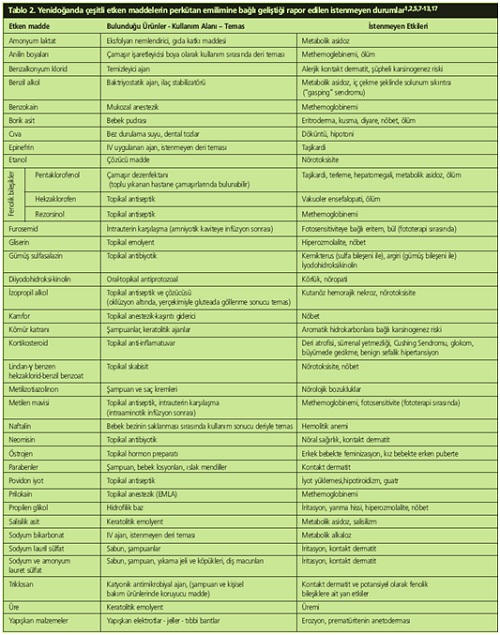
To be continued…
Source: Ayşe Anıl Karabulut
Kırıkkale University Faculty of Medicine, Department of Dermatology and Venereology, Kırıkkale, Turkey
Tel: (332) 3520657
Fax: (332) 3512816[email protected]