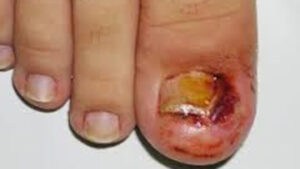
Dear Colleagues, this week, citing the book “Majistral Reçeteler” (Compounded Prescriptions) by Specialist Pharmacist Anooshirvan Miandji, we will examine together a formula used for ingrown toenail complaints. Before moving on to our formula, let us briefly learn about ingrown toenails.
What is an ingrown toenail?
Due to a congenital mismatch between the nail bed and the nail, an ingrown nail can develop, especially on the big toenails. Inappropriate footwear choices and incorrect nail trimming can make this problem even more pronounced. An ingrown nail can occur on one or both sides of the same nail.
Those who are prone to ingrown toenails should keep their nails as long as feasible and trim them straight across. When choosing shoes, it will be more appropriate to select blunt-toed footwear that does not pinch the foot.
The most common incorrect treatment approach for an ingrown toenail is the complete avulsion of the nail. Although complete nail removal may be unavoidable in certain cases, since the extracted toenail will regrow in approximately eight months, this treatment will only provide relief during that period. However, once the nail grows back, the ingrown toenail will inevitably recur because the problem causing the ingrowth still persists.
In patients who have recurrent ingrown toenail problems despite following general precautions, the procedure of treating nail disorders and ingrown nails—accompanied by oral antibiotic therapy—by either completely removing the nail or partially removing it and destroying the nail matrix (the germinal layer producing the nail) with phenol is called phenol matrix cauterization. In phenolization therapy, usually only the ingrown section of the nail is excised, and the germinal layer (matrix) is destroyed so that the nail does not regrow and embed again.
In the phenol matrix cauterization procedure, allocating half an hour for the patient under outpatient clinic conditions is generally sufficient. After medical antisepsis of the area is achieved, local anesthesia is administered first. Then, after removing the parts of the nail embedded in the flesh, the germinal matrix in the ingrown area is destroyed with 80% phenol using a cotton-tipped applicator. Following the procedure, oral antibiotics are taken, and wound dressings are applied every two days for approximately one week.
As a result, recurrence of ingrown toenails with this method is very rare. However, pain, bleeding, infection, and allergic reactions associated with the administered anesthetic agent may rarely be observed at the procedure site.
Rp
Liquid phenol 80 g
Purified water 100 g
Substances included in the formula;
Phenol – Phenic acid – Phenyl alcohol – Carbolic acid – Phenyl hydrate – Hydroxybenzene;
Phenol exists as colorless, light pink, or pale yellow, hygroscopic crystals or crystal clusters with a characteristic odor, which darken upon standing. Its freezing point is approximately 39.5°C. According to the British Pharmacopoeia (BP): Soluble in water; very soluble in alcohol, dichloromethane, and glycerol. According to the United States Pharmacopeia (USP): Soluble 1:15 in water, 1:70 in liquid paraffin; very soluble in alcohol, chloroform, ether, glycerol, and volatile oils. A 1 g solution of phenol in water is clear and gives a neutral or acidic reaction to litmus. It is incompatible with alkali salts and non-ionic surfactants. It is active against mycobacteria and certain fungi. It also has a local anesthetic and analgesic effect. Phenol is one of the oldest antiseptic-disinfectants. Nowadays, it is rarely used as an antiseptic. It also exhibits local anesthetic and analgesic actions. It is included in the composition of preparations used as topical analgesics for toothaches. In combination with benzocaine and ethanol, it is applied topically for toothaches, aphthous ulcers (it has not been found safe on its own in the treatment of aphthous ulcers), herpes labialis, minor dental surgical procedures, and mild abrasions and irritations caused by dentures and fillings on the mouth and gums. Its 0.5%–1% solutions are used against pruritus. Camphorated phenol (kafurlu fenol) is a preparation with a local anesthetic effect containing phenol, camphor, and liquid paraffin, and is used for toothaches. Phenol combined with camphor is effective against mild pain and itching seen in insect bites, minor burns including sunburn, minor skin lesions, and other skin irritations. Its low-concentration solutions are also used for topical disinfection. Its 5% solution has been used in the disinfection of bodily secretions. It exhibits antiseptic and disinfectant activity against Gram-positive and Gram-negative bacteria, mycobacteria, and certain fungi. Its effect against spores is very slow and inadequate. It is also active against certain viruses. Its efficacy increases in acidic solutions. Aqueous solutions up to 1% concentration exert bacteriostatic action, while more concentrated solutions exert bactericidal action. Phenol exerts its effect by increasing the permeability of the cytoplasmic membrane of bacteria and fungi. Phenol is administered topically only. It is absorbed from the gastrointestinal tract, skin, and mucous membranes. Phenol is a severely corrosive poison when ingested. It must never be swallowed. Phenol must be stored below 15°C and in airtight containers. It must be protected from light.
Wishing you a great week…
Source
Majistral Reçeteler / Specialist Pharmacist Anooshirvan Miandji
Assoc. Prof. Dr. Emel Erdal ÇALIKOĞLU
Specialist Pharmacist Ahmet Nezihi Pekcan
Pekcan Pharmacy – Konya
[email protected]
Tel: (332) 3520657
http://www.majistralformul.com/