Dear Colleagues, this week, citing the book titled Compounded Prescriptions by Specialist Pharmacist Anooshirvan Miandji, we will examine together a formula used for allergy complaints that start on the skin due to bites, particularly from mosquitoes and other insects.
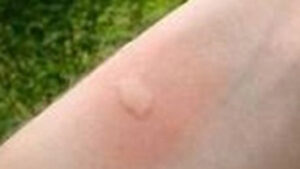
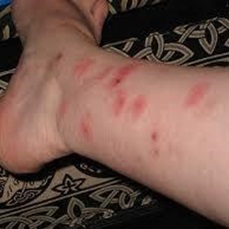
Insect Bite: It is an allergic skin reaction resulting from an insect puncturing the skin with its mouthparts or inserting its stinger, injecting its venom and other secretions into the tissues. Certain substances found in insect secretions trigger allergic reactions, leading to skin lesions ranging from small itchy pimples or skin welts to extensive blistering and crusting inflammations. Flying insects such as flies, mosquitoes, and sandflies attack exposed parts of the body and, with each bite/sting, usually produce a single itchy welt that resolves within a few hours. The clinical importance of painful swellings resulting from insect stings varies depending on the site of the sting and the species of the insect.
Rp
Menthol ………..… 0.25 g
Liquid phenol ………..… 1 g
Talc …………..……… 15 g
Zinc oxide ………… 15 g
Glycerin ………..…… 35 g
Rose water …………… 35 g
Substances in the formula
Menthol-levomenthol: An antiseptic substance that induces a sensation of cold when applied to the skin and exhibits a mild analgesic effect; due to this property, it is used against urticaria. It produces a cooling effect by dilating blood vessels on the skin.
Phenol-Phenic acid-Phenyl alcohol-Phenolum-Acid carbolique: Phenol occurs as colorless, light pink, or pale yellow, hygroscopic, needle-like crystals or crystalline clusters with a characteristic odor that darken upon standing. It is soluble in water; very soluble in alcohol, dichloromethane, and glycerol. It is active against mycobacteria and certain fungi. It also has local anesthetic and analgesic effects. Phenol is one of the oldest antiseptic-disinfectants. Nowadays, it is rarely used as an antiseptic. It also exhibits local anesthetic and analgesic effects. It shows antiseptic and disinfectant activity against Gram-positive and Gram-negative bacteria, mycobacteria, and certain fungi. Its action against spores is very slow and inadequate. It is also active against certain viruses. Its efficacy increases in acidic solutions. Aqueous solutions up to a concentration of 1% exhibit bacteriostatic activity, whereas more concentrated solutions exhibit bactericidal activity. Phenol exerts its effect by increasing the permeability of the cytoplasmic membrane of bacteria and fungi. Phenol is applied topically only. It is absorbed from the gastrointestinal tract, skin, and mucous membranes. Phenol should be stored below 15°C in airtight containers. It must be protected from light.
Talc-Talcum-Purified talc: Talc is a natural hydrated magnesium silicate. Its approximate chemical formula is “Mg6Si2O54OH4“. It may contain varying amounts of aluminum silicate and iron. It is a very fine, light, homogeneous, white or near-white or grayish-white, odorless crystalline powder. When it comes into contact with the skin, it readily coats the contacted surface. Purified talc must be free from microscopic asbestos particles. Talc is practically insoluble in water and dilute solutions of mineral acids and alkali hydroxides.
Zinc oxide-zinci oxide-oxyde de zinc: It is an active substance with astringent properties known for its weak antiseptic properties. It is used in eczema, burns, diaper rash, and friction-related skin damage. Zinc oxide ointment contains 20% zinc oxide, and zinc oxide paste contains 25% zinc oxide. Zinc oxide is not absorbed through the skin, and since it is insoluble in water, it is applied in the form of powder, ointment, or paste.
Glycerol-Glycerine-Glycerol 85% : Glycerin is a clear, colorless or very pale, hygroscopic, syrupy, odorless or very faintly scented liquid with a sweet taste. It is miscible with water and alcohol; slightly soluble in acetone; practically insoluble in chloroform, ether, fixed oils, and essential oils. Its aqueous solutions give a neutral reaction to litmus. According to the United States Pharmacopeia (USP), the pH of Glycerin Oral Solution, USP is between 5.5 and 7.5. Strong oxidizing agents form explosive mixtures with glycerin.
Aqua Rosae T.K. rose water: Obtained by steam distillation of the petals of fresh flowers of Rosa damascena Miller or Rosa gallica L. It is a clear, colorless liquid with a distinct rose fragrance. As soon as it is obtained, it should be filtered if necessary, loosely stoppered with cotton in amber one-liter bottles, and stored in a cool place away from light. The German Pharmacopoeia states that it should be prepared by adding 4 drops of essence to 1 liter of water.
Preparation of the formula
Menthol is finely powdered in a glass mortar. Zinc oxide and talc are added to the powdered menthol and mixed thoroughly in the mortar. The formula is softened by adding glycerin, and the preparation is completed by sequentially adding liquid phenol and rose water.
Wishing you a pleasant week…
Spec. Pharm. Ahmet Nezihi Pekcan
Pekcan Pharmacy – Konya
[email protected]
Tel: (332) 3520657