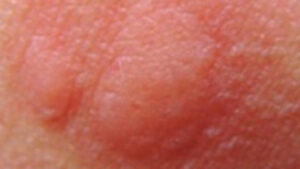
Dear Colleagues, this formula published by the American Pharmacists Association is in gel form and can be used to soothe irritation and itching caused by poison ivy, mosquito bites, bedbug bites, or sunburn.
Formula
Summer Gel
(for poison ivy, mosquito bites, chigger bites, and sunburn)
Diphenhydramine Hydrochloride 2 g
Pramoxine Hydrochloride 1 g
Menthol 500 mg
Camphor 500 mg
Benzyl Alcohol 2 mL
Carbomer 940 500 mg
Trolamine qs
Alcohol 20 mL
Purified Water qs 100 mL
Optional: Hydrocortisone Acetate 500 mg
Preparation
Perform the necessary calculations for the total quantity to be prepared. Accurately weigh or measure all ingredients. Dissolve menthol, camphor, and benzyl alcohol in the alcohol. Dissolve diphenhydramine hydrochloride and pramoxine hydrochloride in 77 mL of purified water and add to the alcoholic solution. While stirring rapidly, sprinkle carbomer 940 (Carbopol 940®) to ensure uniform dispersion. Slowly add trolamine (triethanolamine) until the desired viscosity is achieved. Package and label.
Indications: Used in the treatment of mild itching and irritation caused by insect bites, sunburn, and poison ivy.
Packaging: Store in a tightly closed, light-resistant container.
Labeling: For external use only. Keep out of reach of children in a cool place.
Stability: The shelf life of this preparation is 6 months.
Discussion
During the summer season, skin irritations increase due to exposure to the sun, insects, and poison ivy. This gel can be customized according to patient preferences and its viscosity can be adjusted. The alcohol concentration can be modified based on the patient’s desired drying rate. A small amount of oil can also be added to the preparation by dissolving it in alcohol before incorporating it into the gel.
Diphenhydramine hydrochloride is a white, odorless crystalline powder that darkens upon exposure to light. One gram dissolves in 1 mL of alcohol and 2 mL of water. It is used topically in the treatment of mild local allergic reactions resulting from insect bites and stings.
Pramoxine hydrochloride is a white to off-white crystalline powder with a numbing taste. It is freely soluble in water and alcohol. It is a topical surface anesthetic with low sensitization and toxicity, chemically unrelated to ester or amide-type agents.
Menthol occurs as colorless, hexagonal needle-like crystals or a crystalline powder. It has a pleasant mint odor and dissolves very well in alcohol, but has low solubility in water. It is used topically in concentrations between 0.1% and 2%.
Camphor occurs as colorless or white crystals, granules, or crystalline masses. It has a penetrating, characteristic odor and a pungent, aromatic taste. One gram dissolves in approximately 800 mL of water and 1 mL of alcohol. It is used topically at 1–3% to prevent itching caused by insect bites.
Benzyl alcohol is a colorless liquid with a sharp, burning taste and a faint, aromatic odor. Its specific gravity is between 1.042 and 1.047. One gram dissolves in 30 mL of water and 1.5 mL of diluted alcohol, and it is miscible with alcohol in all proportions. It is used topically to relieve cutaneous pruritus.
Carbomer 940 is a white, fluffy, acidic, and hygroscopic synthetic polymer of high molecular weight with a faint characteristic odor. Carbomers are used as gelling agents at concentrations between 0.5% and 2%. The pH of a 0.5–1% dispersion is between 2.5 and 3.5. It dissolves in water and, following neutralization, in ethanol and glycerin. When carbomers are dispersed in water, a low-viscosity colloidal solution forms. Viscosity increases when an alkaline substance such as trolamine (triethanolamine) is added. To accelerate dispersion initially, carbomer may be sprinkled into rapidly stirred water; care should be taken to prevent clumping. Efforts should be made to minimize the formation of air bubbles in the gel. Maximum viscosity is generally achieved between pH 6 and 11. Carbomer gels should be protected from light and contain an antimicrobial preservative.
Trolamine (triethanolamine) is an alkalizing and emulsifying agent. It is a variable mixture of alkanolamines. It is a clear, colorless to pale yellow viscous liquid with a slight ammonia odor. The specific gravity of its 0.1 N aqueous solution is 1.120–1.128 g/mL and its pH is 10.5. It is highly hygroscopic and miscible in all proportions with water and 95% ethanol. It turns brown upon exposure to air and light. At temperatures below 15°C, it separates into layers; this condition can be rectified by warming and stirring. Trolamine should be stored in airtight containers protected from light in a cool place. Because it can exert an irritant effect on the skin, eyes, and mucous membranes, appropriate precautions should be taken during handling.
Hydrocortisone acetate is a white to off-white, odorless crystalline powder. It is insoluble in water, but 1 gram can dissolve in 230 mL of alcohol; it can be suspended in the gel. It is generally used topically at concentrations between 0.5% and 1% in the treatment of inflammatory conditions.
Wishing you a good week…
Source: Compounding Articles Book / Pharm. Ahmet Nezihi Pekcan
Tel: (332) 3520657
Fax: (332) 3512816