
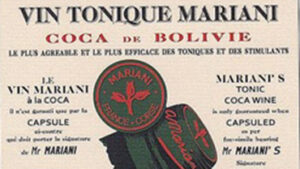
The world’s most famous medicinal wine
From Mariani wine to Coca-ColaIndigenous people living in the Andes Mountains believed that God had gifted them the coca plant so that they could endure the harsh conditions of these mountains. The use of the coca plant dates back as far as 8,000 years. It is known that nobles, clergy, and shamans during religious ceremonies chewed coca leaves to enter trances and communicate with spirits.
In ancient times, the greatest reward a ruler could bestow upon his people was granting the privilege of chewing coca leaves. After the Inca civilization was destroyed by the Spanish, the Spaniards initially wanted to ban the public from chewing coca leaves; however, upon realizing that the natives could not work without them, they abandoned this idea. Mine and land owners understood that by giving coca leaves to the indigenous people, they could make them work harder and longer with less food.
The stimulant effect of the coca leaf began to gain recognition in Europe during the 19th century. Angelo François Mariani (1838–1914), a French pharmacist of Corsican descent, developed a preparation by infusing coca leaves imported from Peru with Bordeaux wine. “Vin Mariani” (Mariani wine) was launched in France in 1871 as a tonic and stimulant specialty.
Angelo Mariani was born in Corsica into a large family. Deciding to become a pharmacist, he moved to Paris and began working as an apprentice in a pharmacy. As an ambitious prospective pharmacist, he was searching for a commercial specialty that would make him a fortune. To this end, he turned his attention to tonic preparations. When an opera singer who used the tonic preparation he formulated with coca leaves was so pleased that she ordered an entire crate, he seized the opportunity he had been waiting for. Mariani wine became the most renowned pharmaceutical specialty in Europe and America during the 1890s and the early 20th century. Promoted as a tonic and stimulant for the body, brain, and nerves, although its indications varied over the years, Mariani Wine was generally used for influenza, nervousness, anemia, insomnia, fatigue, melancholia, and various stomach, throat, and lung ailments. It was recommended to take a glass before or after meals, or between breakfast and lunch. As the demand for the preparation, which he initially produced in his pharmacy’s laboratory, increased, Mariani established a factory near Neuilly, where he also created a coca garden. Coca wine was officially included in the French Codex for the first time in 1884.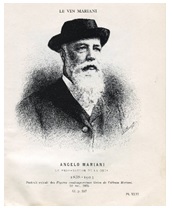 Angelo Mariani’s idea of creating his own tonic began to take shape in 1863 after reading a study on the effects of the coca leaf written by Paolo Mantegazza (the first man to extract cocaine from coca leaves). The result was a Bordeaux wine containing 10% alcohol and 8.5% cocaine. This wine is recognized as the first cocaine-infused product introduced to the market. Today, the alcohol content of wines on the market ranges between 8% and 14%, so this wine was not very different in terms of alcohol, but when it comes to the cocaine extract, this is where the secret of its uniqueness lies. What mattered here was not just the proportion of alcohol or cocaine in the wine, but their combined use. Specifically, “when cocaine is consumed alone, two primary metabolites are produced: ecgonine methyl ester and benzoylecgonine. These two metabolites have no significant psychoactive effect. However, when cocaine is combined with alcohol, an extraordinarily potent metabolite is formed: cocaethylene. Cocaethylene uniquely facilitates the formation of an ethyl ester instead of a methyl ester in the liver, which increases euphoria by inhibiting dopamine transfer. In other words, those drinking coca wine were consuming three potent drugs at once.”
Considering all of this, it is no surprise that when the tonic hit the market, it caused a massive sensation. Angelo Mariani used celebrities as a marketing technique. He promoted his product as “restorative, invigorating, nutritious, fortifying, and refreshing,” and this tactic proved remarkably successful. Having launched his coca wine in the mid-1860s, Mariani became Europe’s largest importer of coca leaves by the mid-1880s. Among the figures he used for advertising were remarkably famous personalities: the Prince of Wales, the Russian Tsar and Tsarina, the Kings of Norway and Sweden, the Chief of the General Staff of the British Army, and Pope Leo XIII. In fact, Pope Leo XIII declared Mariani a “benefactor of humanity” and honored him with a gold medal.
Around 8,000 physicians provided sworn testimonies on the benefits of coca wine. Leonard Corning, the New York physician who first used cocaine in spinal anesthesia, stated that among all the tonics he knew, this wine was the medicine with the greatest benefit to the central nervous system.
Alexandre Dumas, Jules Verne, Émile Zola, Henrik Ibsen, and many others could not praise Vin Mariani enough. Bartholdi, the sculptor of the Statue of Liberty, remarked: “This wine gave me incredible energy for my other projects.”
Thomas Edison, who slept only four hours a day, became an avid consumer of this wine. Driven by the popularity of Mariani wine, numerous imitation products subsequently emerged, though none could match its success. One of these was the famous Pemberton’s French Wine Coca.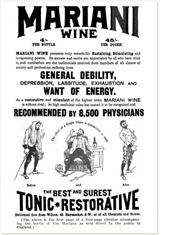 Awarded the Vatican Gold Medal by Pope Leo XIII, Mariani’s success was closely linked to his advertising prowess and the art of product promotion. Mariani effectively advertised his wine by capitalizing on testimonials from famous figures who used it and were satisfied. Among these notables were renowned artists, writers, politicians, kings, aristocrats, clergymen, scientists, and physicians of the period. He requested all these celebrated individuals to write down and send him their thoughts on Mariani wine, publishing these signed documents in a series titled ‘Contemporary Figures’. Thus, the Mariani Album came into being. It was published regularly in 13 volumes from 1891 to 1913. The 14th and final volume, which was being prepared when he died in 1914, could not be published due to World War I. It was published after the war in 1925 by his son. Today, this 14-volume album is a source containing very important information. The album contains the biography, portrait, handwritten thoughts on Mariani wine, and signature of many famous personalities. We also see two Ottomans included in this album: Pharmacist Joseph Zanni and Dr. Mavrogeny Pasha.
Mariani’s advertising campaigns were an innovation for his era. Mariani asked the famous poster artist Jules Chéret to create a poster. Mariani wine began being exported to the United States in 1894. Angelo Mariani published a book titled ‘Coca and Its Therapeutic Applications’, which was also translated into English. However, the harmful effects of coca are not mentioned in this book. Following Mariani’s death in 1914, his product continued to be sold for years. In 1954, its name was changed to ‘Tonique Mariani’. According to information provided by the French pharmacist Louis Cotinat, it was still being sold in 1963, although it no longer contained coca leaves. Inspired by Mariani wine, American pharmacist John Pemberton launched ‘Pemberton’s French Coca Wine’ in Atlanta in 1884. This preparation was recommended for the treatment of nervous disorders, indigestion, mental and physical fatigue, constipation, headaches, neurasthenia, and impotence. It was also proposed for treating morphine addiction. When alcohol prohibition was introduced in Atlanta in 1886, alcohol was removed from the formula and replaced with syrup, caffeine-containing kola nuts were added to coca leaves, and it was turned into a carbonated drink with carbon dioxide. This new beverage, named ‘Coca-Cola’, began to be sold as a patent medicine in pharmacies and at soda fountains. In 1887, another American pharmacist, Asa Candler, purchased the formula for Coca-Cola from Pemberton and established the Coca-Cola factory in 1888. In 1904, coca leaf extract was removed from the formula, but the product’s name was not changed.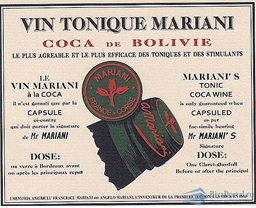 Coca-Cola was first produced in 1886 by John S. Pemberton, a pharmacist. John S. Pemberton, who was an officer in the Confederate army during the American Civil War and was wounded in battle, was addicted to morphine due to continuous pain. He discovered Coca-Cola as part of his search for a potent painkiller. Coca-Cola was produced from coca leaves, which are also the raw material for highly addictive cocaine. When first produced, it was sold for 5 cents a glass. Following Pemberton’s death in 1888, Asa Candler acquired the rights and formula to Coca-Cola through rather suspicious purchases.
With a tremendous marketing strategy, by 1895, Coca-Cola came to be sold in every state of the USA.
Wishing you a great week…
Source:
FORGOTTEN GALENICAL FORMS AND MEDICINES/ Afife Mat
Pharm. Spec. Ahmet Nezihi Pekcan
Pekcan Pharmacy – Konya
[email protected]
Tel: (332) 3520657http://www.majistralformul.com/