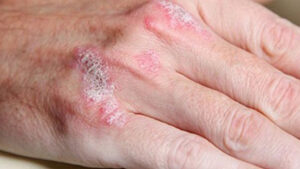
In the treatment of psoriasis, since the exact cause of the disease remains unknown and etiology-targeted therapy cannot be performed, there is no definitive method to achieve a radical cure and eliminate the disease completely. However, if existing symptoms are treated and necessary precautions are taken to prevent new ones from emerging, patients’ quality of life can be improved. The typical manifestations that give the disease its name (‘Sedef’ / Mother-of-pearl in Turkish) are white, prominent, silvery-shiny, and dry scales situated on a pink-to-red, slightly elevated base. These lesions can range in size from 1–2 mm to 30–40 cm, present in varied shapes, and appear as single or multiple lesions. Rarely, there are subtypes that cover extensive areas of the body. It is less common in children. Typical lesions are predominantly seen on the trunk, arms, and legs, and these are easily recognized even by non-physicians. Those located on the scalp, palms, soles, and flexural folds closely mimic fungal infections, eczema, and similar conditions, and sometimes even physicians may have difficulty differentiating them. However, the experience of dermatologists is sufficient for an accurate diagnosis. Nail involvement may also occur and can even present solely in the nails. Thickening, discoloration, and pitting may be observed in the nails.
The exact etiology of the disease is not clearly known. Genetic predisposition is accepted to account for 60–70% of cases. Whether hereditary or not, there is an underlying susceptibility upon which environmental factors act. Among these factors, the most well-known are psychological triggers. Acute shock, distress, tension, emotional deprivation, and disturbances in mother-child relationships are significant triggering factors; they may initiate or exacerbate the disease. Foci of infection such as dental caries, tonsillitis, and urinary tract infections, as well as mechanical trauma such as friction, impact, and scratching, can also trigger flare-ups. Other than these, there are no known major triggers.
The goal of treatment is to achieve the best possible improvement with minimal adverse effects and to sustain clinical remission for an extended period. There is no standard treatment modality that fits every patient. The physician must determine the most suitable individualized treatment for each patient. Mutual trust and compliance between the patient and the physician are essential.
Above all, the patient must be motivated to get better and adhere to the treatment. Any concerns or hesitations regarding therapy should be discussed with the physician; decisions should not be based on hearsay or neighborly advice, and treatment should not be discontinued prematurely. To treat active symptoms, therapy is initiated with locally applied (topical) agents that carry fewer side effects. In these regimens, the surface is first cleared with desquamating (keratolytic) agents to enhance the penetration and efficacy of other medications. Favorable results are generally obtained within 20–30 days.
In cases where lesions are widespread, specialized phototherapy treatments with ultraviolet light (UVB, PUVA, etc.) are applied. With these modalities as well, results begin to be seen after one month, and they have been utilized in our country for at least 15 years. Natural sunlight is also beneficial in various ways.
Regardless of the treatment applied, efforts are made to eliminate triggering factors. Placing the patient under psychiatric supervision from the onset of therapy significantly improves outcomes and reduces relapses. Regular use of moisturizers after bathing helps prevent xerosis, pruritus, and skin trauma, thereby reducing the likelihood of recurrence. Because psoriasis is prone to frequent relapses, patients often seek alternative solutions. Non-medical treatments and sites considered sacred or therapeutic are among these options.
Due to its psychosomatic component, psoriasis is highly susceptible to suggestion, and patients may respond to such procedures in proportion to their belief in them. Consequently, patients are vulnerable to exploitation. There are renowned regions for psoriasis treatment and an associated ‘psoriasis tourism.’ The Dead Sea in Israel and the Kangal Fish Spring in our country are examples of such locations. However, these places have no definitive curative properties.
While topical medications account for 70% of psoriasis prescriptions, systemic agents are incorporated in 30% of patients due to the severe progression and prognosis of the disease.
Studies have demonstrated that topical treatments (corticosteroids, vitamin D analogues, or tazarotene in combination with systemic therapy) provide additional benefits in such patients, ensure rapid lesion clearance in the patient’s favor, and allow systemic medications to be utilized at lower doses.
In systemic psoriasis treatment, drug dosing must be determined by taking into account the type of psoriasis and the affected body surface area; in addition, topical treatment should be planned, ensuring diseased areas are adequately hydrated and appropriate topical formulations are selected to prevent cutaneous inflammation.
In recent years, ammonium lactate 12% applications—which contribute to systemic therapy by hydrating and softening the skin to reduce the adverse impact of psoriatic plaques on the patient—have drawn significant attention among moisturizers. The combination of ammonium lactate with topical corticosteroids and urea demonstrates a synergistic effect; in addition to these active ingredients, Vitamin B12 included in the formulation is recognized as an effective, highly safe, and ideal vitamin for plaques in psoriasis patients.
Hyperhomocysteinemia constitutes an independent risk factor for atherosclerotic cardiovascular disease, stroke, peripheral arterial occlusive disease, and venous thrombosis. Psoriasis is a chronic inflammatory skin disease associated with atherothrombosis and an elevated cardiovascular risk profile. Plasma homocysteine levels have been found to be elevated in psoriasis patients. A significant relationship between hyperhomocysteinemia and vitamin B12 levels has been demonstrated. Vitamin B12, which lowers homocysteine levels, is utilized in patients with psoriasis.
During disease flare-ups, Vitamin B12 at a concentration of 0.07% in combination with corticosteroids is sufficient. In addition, tacrolimus may be used at concentrations of 0.3% or 0.1%.
Formula;
Rp.
Vitamin B12 0.07%
Ammonium lactate 12%
Urea 10%
Triamcinolone acetonide 0.1%
Lanette base cream CSP, 100 g
Substances included in the formula;
Vitamin B12 – Cobalamin – Cyanocobalamin;
Vitamin B12 (Cyanocobalamin) is a complex vitamin. It is found in fish, shellfish, meat, and dairy products. Although the terms cyanocobalamin and vitamin B12 are used interchangeably, vitamin B12 is also available as hydroxocobalamin. Vitamin B12 occurs as dark red crystals or an amorphous powder. The anhydrous form is highly hygroscopic and absorbs approximately 12% water upon contact with air. It is soluble 1:80 in water; according to the British Pharmacopoeia (BP), it is sparingly soluble in alcohol. According to the United States Pharmacopeia (USP), it is soluble in alcohol; practically insoluble in acetone, chloroform, and ether. According to the BP, the pH of its parenteral solutions should be between 3.8 and 5.5. According to the USP, injectable solutions should have a pH of 4.5–7.0. Vitamin B12 is an essential vitamin for thymidylate synthesis, and is therefore necessary for DNA synthesis and cellular division. It is also involved in lipid and carbohydrate metabolism as well as protein synthesis. Vitamin B12 is related to myelin synthesis and hematopoiesis. Rapidly dividing cells (epithelial cells, bone marrow, myeloid cells) have the highest requirement for vitamin B12.
Ammonium lactate – Lactato de amonio;
Ammonium lactate 12% is a topical agent combining lactic acid and ammonium hydroxide, used internationally for pruritus. Ammonium lactate also moisturizes the outer layer of the skin, keeping it soft and hydrated for an extended period, thereby preventing hyperkeratinization. The FDA approved ammonium lactate in April 1985. Ammonium lactate 12% is available in cream and lotion forms. While ammonium lactate cream should be stored below 30 °C, the lotion form should be stored below 15 °C. While ammonium lactate provides relief through its moisturizing action in pruritic dermatoses, it is also indicated for scaly skin and ichthyosis vulgaris. It is applied twice daily to affected areas in adults and children aged 2 years and older.
Urea – Urea – Carbamid – Karbamid;
It occurs as colorless, transparent, slightly hygroscopic (Hygroscopy, in general chemistry, is the term given to the ability of any substance to take up water molecules from its surrounding environment through diffusion or surface condensation) odorless or almost odorless prismatic crystals. It is freely soluble in water (1 part water); although soluble in alcohol (5 parts alcohol), it is insoluble in chloroform and ether. If urea is stored for a long period, it may develop a slight ammonia odor. Internally, it is used as a diuretic at doses of 15–30 g. As seen in this formula, it is used externally for hydrating (water-retaining, moisturizing) purposes. When applied topically, it enhances the water-retaining capacity of the stratum corneum (the outermost layer of the epidermis; the horny layer consisting of dead cells). Thus, it restores hydration in conditions where skin dryness is problematic. On hyperkeratotic skin, it exerts a mild keratolytic effect.
Triamcinolone acetonide – Acétonide de triamcinolone – Triamcinolonum acetonidum;
Triamcinolone acetonide is a white or cream-white, practically odorless, crystalline powder. 11 mg of triamcinolone acetonide is equivalent to approximately 10 mg of triamcinolone. It is practically insoluble in water; sparingly soluble in alcohol, chloroform, or methyl alcohol; very slightly soluble in ether. According to the British Pharmacopoeia (BP) and the United States Pharmacopeia (USP), the pH of the sterile suspension is between 5.0 and 7.5. Triamcinolone is rapidly absorbed when administered orally. Peak action occurs within 1–2 hours after oral administration. With parenteral suspensions, the onset and duration of effect vary depending on the route of administration and local blood flow at the injection site. When applied topically, bioavailability depends on the specific characteristics of the cutaneous tissue in the application area. Absorption from topical preparations is higher in damaged, inflamed, or occluded skin, or in areas where the stratum corneum is thin, such as the eyelids, genitalia, and face. Absorption from topical solutions into the systemic circulation is minimal and becomes especially significant when applied to the oral mucosa. Topical triamcinolone preparations are metabolized in the skin. Corticosteroid dosage must be individualized. The dose varies widely based on the nature and severity of the condition, route of administration, and patient response. An absolute maximum dose has not been defined.
Lanette base cream;
In this formula, it is an O/W cream serving as a carrier/vehicle.
Formula;
Lanette (cetostearyl alcohol) 15 g
Acidum sorbicum 150 mg
Cetiol V 20 g
Sorbitolum liquidum cristallisabile 4 g
Aqua purificata 60.85 g
Wishing you a good week…
References;
1-Compounding as a Current Therapeutic Option in Dermatology_
M. Sánchez-Regaña,a,∗ F. Llambí-Mateos,b M. Salleras-Redonnet,a M. Iglesias Sancho,a
H. Collgros Totosaus,a P. Umbert-Milleta
a Servicio de Dermatología, Hospital Universitari Sagrat Cor, Barcelona, Spain
b Profesor UT Galénica, Facultad de Farmacia, Universidad de Barcelona, Presidente de APROFARM, Barcelona, Spain
Received 10 October 2011; accepted 9 March 2012
Available online 4 October 2013
2-Turkderm – Arch Turk Dermatol Venerology
3- Formularium der Nederlandse Apothekers 2009 (FNA)
Pharm. Specialist Ahmet Nezihi Pekcan
Pekcan Pharmacy – Konya
[email protected]
Tel: (332) 3520657
http://www.majistralformul.com/