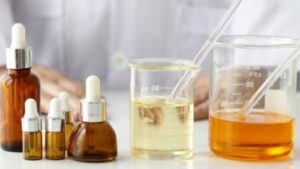
This water-based O/W base containing an anionic emulsifier may be irritating to sensitive atopic skin. Together, we will examine this emulsion-type base, which exhibits widely applicable and extremely durable properties. This ointment base, with an emulsifying anionic O/W effect, is known as a highly preferred vehicle abroad.
Formula
Rp.
Alcohol cethylicus 15 g
Cera alba 1 g
Propyleneglycolum 10 g
Natrii laurylsulfas 2 g
Aqua 72 g
Substances in the formula;
Cetyl alcohol – Lanette 16 – Alcohol cetylicus – Palmityl alcohol – Hexadecyl alcohol;
Cetyl alcohol is used in topical pharmaceutical preparations as an emollient, water-absorbing agent, stiffening agent, and emulsifier. Cetyl alcohol is actually a mixture of solid aliphatic alcohols, consisting mainly of cetyl alcohol. The United States National Formulary (USNF) states that it must contain not less than 90% cetyl alcohol, with the remainder consisting of related alcohols. It occurs as a white, unctuous mass, powder, flakes, small granules, or pellets. It has a characteristic faint odor. It is practically insoluble in water; freely soluble in alcohol (95%) and ether. When melted, it is miscible with vegetable and animal fats, liquid paraffin, and melted lanolin.
White beeswax – Cire blanche – White wax – Beeswax – Wax – Wachs – Cire T.K.;
These are honeycombs produced by bees (Apis mellifica L.). It is a soft mass with a characteristic odor. It is yellow in color. It is partially soluble in alcohol and ether, and completely soluble in oils. White beeswax is obtained by bleaching yellow beeswax in sunlight. In pharmacy, it is used as a base for cerates. White beeswax is included in creams and ointments as a thickening/stiffening agent and as a stabilizer in water-in-oil emulsions. It occurs as tasteless, white or slightly yellowish sheets or fine granules. It is soluble in chloroform, ether, warm carbon disulfide, fixed and volatile oils; sparingly soluble in ethanol (95%); practically insoluble in water. It should be stored in tightly closed containers, protected from light. When heated above 150°C, white beeswax undergoes esterification, its acid value decreases, and its melting point rises. It is incompatible with oxidizing agents. It is also included in the composition of pomades and suppositories. As a stiffening agent in ointments, it constitutes 1% to 10% of the total mass. It melts at 65°C.
Propylene glycol – Methylethylene glycol – Methyl glycol – Propylene glycol;
It is an excipient used for various purposes in pharmaceutical preparations. It is used as a vehicle for cosmetic products. Due to its humectant properties, it is used instead of glycerin in topical moisturizing preparations. Propylene glycol may cause local irritation on skin and mucous membranes. It is miscible with water, acetone, alcohol, and chloroform; soluble in ether; immiscible with fixed oils, but can dissolve essential oils. It should be stored in a cool place and airtight containers, protected from light and moisture.
Sodium lauryl sulfate – Natrii laurilsulfas – Sodium monolauryl sulfate – Laurilsulfato de sodio;
Sodium lauryl sulfate is used as an anionic surfactant in pharmaceutical formulations and cosmetic products. It is an effective detergent and wetting agent in acidic and alkaline media. It is also used in medicated shampoos, toothpastes, and skin cleansing preparations. It is not used in parenteral preparations. It may cause irritation to the skin, eyes, mucous membranes, upper respiratory tract, and stomach. Prolonged exposure to dilute sodium lauryl sulfate solutions may cause dryness and cracking of the skin; contact dermatitis may develop. If inhaled for prolonged periods, it can damage the lungs. Sodium lauryl sulfate is a mixture of alkyl sulfates. According to the British Pharmacopoeia (BP), it is a mixture containing not less than 85% sodium alkyl sulfates, with a maximum of 8% sodium chloride and sodium sulfate. It occurs as a white or pale yellow powder or crystals with a faint characteristic odor. It dissolves in water (1:10) giving an opalescent solution; partially soluble in alcohol; practically insoluble in chloroform and ether. Sodium lauryl sulfate is a stable substance under normal conditions. However, in solutions of pH 2.5 or below, it hydrolyzes to form lauryl alcohol and sodium bisulfate. It reacts with cationic surfactants, resulting in reduced activity. Its aqueous solutions with a pH between 9.5 and 10 can corrode steel, copper, brass, bronze, and aluminum. It is incompatible with polyvalent metal salts such as aluminum, lead, tin, or zinc, certain alkaloidal salts, and acids with a pH below 2.5. It precipitates with lead and potassium salts.
Preparation of the formula;
Cetyl alcohol and white beeswax are melted in propylene glycol in a water bath heated to 650 C. Sodium lauryl sulfate is dissolved in distilled water brought to the same temperature. The preheated distilled water solution containing dissolved sodium lauryl sulfate is added to the propylene glycol solution, stirred, and allowed to cool. Any water loss due to evaporation is compensated with distilled water.
Wishing you a good week.
Specialist Pharmacist Ahmet Nezihi Pekcan
Pekcan Pharmacy – Konya
[email protected]
Tel: (332) 3520657
http://www.majistralformul.com/