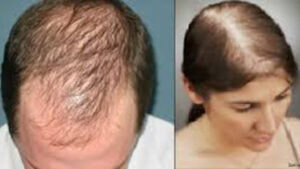
This week’s formula contains rosemary essence and progesterone hormone. It is preferred for preventing hormonal hair loss.
Hair follicles contain DHT receptors, and DHT binds to these receptors to miniaturize the follicle, leading to hair loss. Conversely, other body hair experiences proliferation and thickening. In men, the estrogen/testosterone ratio is 1/20. With advancing age, testosterone production decreases, while xenoestrogens increase due to an unhealthy diet and environmental toxins; if the progesterone hormone that balances the effects of estrogen is insufficient, DHT production increases, leading to miniaturization in hair follicles and causing hair loss. The conversion of testosterone to DHT is mediated by the 5-alpha reductase enzyme. In treatment, medications that block the 5-alpha reductase enzyme are used. Finasteride blocks type 1 receptors, while Dutasteride blocks both type 1 and type 2 receptors. Consequently, DHT production is halted. At the same time, BPH in men is also prevented. However, DHT is a crucial hormone in men, and its deficiency leads to numerous complications. Therefore, these treatments carry many drawbacks, including gynecomastia (breast enlargement), erectile dysfunction, and vocal thinning. In both women and men, Progesterone Hormone therapy represents the safest and most harmless approach for treating hair loss associated with excess DHT.
Formula:
Esencia romero 5 %
Progesterona 5 %
Emulsión O/W lavable c.s.p. 100 g
Ingredients in the formula:
Rosemary (Rosmarinus officinalis L.) essence – Essence de romarin – Rosmarino essenza:
Rosemary oil (Oleum Rosmarini) is obtained by steam distillation of the plant’s leaves. The composition of this essential oil, also known as rosemary essence, varies depending on the species and other factors. As primary components, it contains 1,8-cineole (20–50%), α-pinene (15–25%), camphor (10–25%), bornyl acetate (1–5%), borneol (1–6%), camphene (5–10%), and α-terpineol (12–24%). It also contains limonene, β-pinene, β-caryophyllene, and myrcene. Other compounds of the drug include phenolic diterpenes such as carnosol (up to 4.6%), carnosic acid, rosmanol, isorosmanol, epirosmanol, and rosmaridiphenol; rosmaroquinone; rosmarinic acid; flavonoids such as nepetin and nepitrin; and triterpenes such as oleanolic acid, ursolic acid, α-amyrin, and roficerone. It is a colorless or light-yellow oil with a characteristic odor and a slightly pungent, camphoraceous taste. It dissolves in 90% alcohol at a 1:1 ratio. Rosemary oil possesses carminative and mildly irritant effects. In perfumery, it is incorporated into hair lotions, inhalation preparations, and liniments. Medicinally, it is used externally for hypotension and circulatory disorders. It is also used as a bath additive for muscle aches and rheumatic complaints. Rosemary has no known contraindications. No drug interactions have been reported. There is no sufficient data regarding its use during pregnancy and lactation.
Progesterone – Progesteronum – Corpus-luteum-Hormon – Progesterone:
Progesterone is a natural hormone. Progesterone occurs as colorless crystals or as a white or slightly yellowish-white, odorless, crystalline powder. According to the British Pharmacopoeia (BP), it is insoluble in water; freely soluble in anhydrous alcohol; very soluble in chloroform; and sparingly soluble in acetone, ether, and fixed oils. Progesterone exhibits minimal estrogenic and androgenic activity.
Emulsión O/W lavable (Washable O/W Emulsion):
A pharmaceutical dosage form consisting of heterogeneous systems with a homogeneous appearance, containing dispersed particles of one liquid within another immiscible liquid under normal conditions. The droplet diameter is typically greater than 0.1 µm. During preparation, natural emulsifying agents (emulsifiers) such as gum arabic, gum tragacanth, gelatin, and carboxymethyl cellulose must be added to the medium as a third component. Their purpose is to maintain the integrity of each dispersed liquid droplet. Emulsification can enhance the solubility and stability of the drug, prolong the drug’s duration of action, mask unpleasant tastes, and improve the formulation’s aesthetic appearance. In pharmaceutical applications, one phase of the emulsion is generally water, and the other is an oily or oil-like phase. If water forms the internal phase, the emulsion is designated as a water-in-oil emulsion and denoted as water/oil (W/O). If water is the external phase, it is an oil-in-water emulsion and denoted as oil/water (O/W). In this formula, an oil-in-water emulsion has been selected as the vehicle. Being washable, this emulsion is well-suited for application to the scalp.
Preparation of the formula:
The emulsion contains 25% oil and 75% water. As preservatives, 0.04% nipasol and 0.1% nipagin should be added to the emulsion. Progesterone and rosemary essence should be incorporated into the prepared emulsion base and shaken well. It should be stored in an amber glass bottle at room temperature, protected from light.
Wishing you a pleasant week…
Source: La Formulación Magistral en la Oficina de Farmacia Valencia, 1981
Spec. Pharm. Ahmet Nezihi Pekcan
Pekcan Pharmacy – Konya
[email protected]
Tel: (332) 3520657
http://www.majistralformul.com/