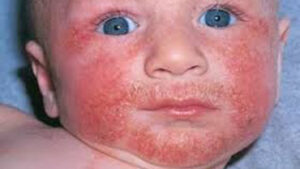
Dear Colleagues, this week we will examine together a formula prescribed for dermatoses in France that exhibits local anesthetic and cicatrizing effects. Dermatosis refers to any non-inflammatory disease or disorder of the skin. It should be distinguished from dermatitis, as these two terms, although related, are not identical.
Formula;
Oxyde de zinc 2.50 g
Procaine chlorhydrate 0.50 g
Eau distilée d’hamamélis 2.00 g
HE lavande X (10) gouttes
Lanoline 15.00 g
Vaseline qsp 50.00 g
Ingredients in the formula;
Zinc oxide – Zinci oxidum – Oxyde de zinc;
It is an active ingredient with astringent properties known for its mild antiseptic qualities. It is used in eczema, burns, diaper rash, and skin damage caused by friction. Zinc oxide ointment contains 20% zinc oxide, while zinc oxide paste contains 25%. Zinc oxide is not absorbed through the skin, and since it does not dissolve in water, it is applied in the form of powder, ointment, or paste.
Chlorhydrate de procaine – Novocainum – Procainum hydrochloricum – Allocaine – Syncaine;
Procaine hydrochloride is a short-acting ester-type local anesthetic used for local and regional anesthesia. It does not exhibit a superficial topical anesthetic effect. Its toxicity is considered the benchmark standard for other local anesthetics. However, it causes more hypersensitivity reactions compared to amide-type local anesthetics.
Extrait fluide d’hamamélis – Witch hazel (Hamamelis virginiana L.) leaf – Hamamelis leaf – Hamamelis virginiana e foliis;
Witch hazel leaf (Hamamelidis folium) consists of the dried leaves of witch hazel (Hamamelis virginiana L.) from the Hamamelidaceae family, containing at least 7% tannins. It is prepared by extracting the used part of the plant with a water+alcohol mixture using the percolation method. The drug is defined in the European Pharmacopoeia. Hamamelidis folium contains tannins, the bitter substance gallic acid, and a very small amount of volatile oil. As main chemical compounds, it contains catechins such as (+)-catechin, (+)-gallocatechin, (-)-epigallocatechin gallate, and cyanidin and delphinidin-type proanthocyanidins. The drug also contains flavonoids (kaempferols along with cyanidin and delphinidin-type proanthocyanidins). Witch hazel leaf (Hamamelidis folium) has astringent and hemostatic effects. It has local vasoconstrictive properties. Its ointments and suppositories are used in the treatment of hemorrhoids. Due to its astringent and cooling effects, its aqueous distillate is incorporated into creams used against burning and itching of the skin. It promotes healing in minor skin wounds; it relieves stinging pain in dry and cracked skin. It is used for diaper rash in infants and young children, mild burns, and sunburns. Hamamelis virginiana aqueous distillate has also been used for its hemostatic effect. Hamamelidis Folium has also been used internally for the symptomatic treatment of varicose veins such as varices and hemorrhoids.
Witch hazel leaf has no known contraindications. Its use does not require special warnings or precautions. No interactions with other drugs have been reported.
English lavender (Lavandula angustifolia) – Lavender (Lavandula angustifolia) – Lavender;
Lavender (Lavandula angustifolia) is a perennial aromatic shrub-like plant of the Lamiaceae (Labiatae) family, reaching an average height of about 1 m. Its leaves are silvery-green, and the parts close to the ground are woody. Its flowers are tubular, the calyx is bluish, and the corolla, which has a distinct strong scent, is dark purple and hairy. The characteristic scent of lavender originates from the oil cells located at the base of the fine hairs covering its flowers, leaves, and stems. In our country, it grows naturally in Istanbul, the Mediterranean, and Aegean regions. Lavender oil is a colorless, light yellow, or yellowish-green essential oil obtained by distillation from the fresh flowering tops of Lavandula officinalis (=L. spica = L. vera = L. angustifolia) or Lavandula intermedia, reminiscent of the characteristic pleasant aroma of lavender flowers. Lavender oil has carminative effects; it is also used as a coloring and flavoring agent. It is sometimes used as a repellent to keep insects away from the body. However, its primary field of application is the perfume industry. In pharmacy, it is used to mask unpleasant odors in ointments and other pharmaceutical preparations. It has been suggested that lavender oil exhibits a sedative effect when inhaled. Adverse effects such as nausea/vomiting, headache, and chills accompanied by shivering have been reported following inhalation or absorption through the skin. It may cause contact dermatitis and photosensitivity. Lavender flowers and leaves are indicated for hypotension, hypertension, dyspepsia, insomnia, and externally for acne. The drug is used orally and in the form of baths. Its primary indications are hypotension, indigestion, cardiac complaints, and insomnia. The volatile (aromatic) oils contained in the lavender flower drug stimulate the endings of the olfactory nerve, reflexively stimulating respiration and circulation. Lavender oil is used externally in bath form as an insect and mosquito repellent.
Lanoline – Graisse de laine – Adeps lanae – Refined wool fat – Lanae cera – Lanolinum T.K.;
It is obtained from sheep’s wool. It is pale yellow in color and has an ointment consistency. It is soluble in ether, petroleum ether, chloroform, and boiling absolute alcohol. It absorbs twice its weight in water. It is an emulsifier. It forms water-in-oil emulsions. In its anhydrous state, its consistency is quite stiff. With the addition of water, a pasty texture is formed. It absorbs water by its weight. It is easily absorbed by the skin and is odorless. It is used as an ointment base.
The base listed under the name lanolinum in the Turkish Pharmacopoeia (T.K.) contains 13 parts lanolin, 3 parts liquid paraffin, and 4 parts water.
Vaseline – Vaseline blanche;
It is an emollient ointment base known as white petrolatum (white vaseline). It is not easily absorbed through the skin. It is obtained by bleaching yellow petrolatum. It is odorless and tasteless.
Preparation of the formula;
Hamamelis virginiana aqueous distillate (witch hazel distillate) is placed into a mortar. Procaine hydrochloride is added and dissolved. Zinc oxide is added and mixed thoroughly. After adding the calculated amount of lavender essence, lanolin is added until it absorbs this mixture. Petrolatum is added using geometric dilution, and the formula is finalized by continuing to mix in the mortar until a homogeneous mixture is obtained.
The point to consider in this formula is how much petrolatum should be added to the mixture. To briefly summarize this calculation, which our student colleagues may frequently encounter as a question in laboratory practice:
1 g of lavender essence corresponds to 56 drops. Since 10 drops are used in the formula;
X (10) drops = 1/56 x 10 = 0.18 g.
In this case, the amount of petrolatum that needs to be taken is:
50 – (2.50 + 0.50 + 2 + 0.18 + 15) = 29.82 g.
Wishing you a pleasant week…
References:
1- Cahiers du préparateur en pharmacie
Travaux pratiques de préparation et de conditionnement des médicaments
Jean-Marie FONTENEAU Philippe KLUSIEWICZ
2- RxMediaPharma® 2016 Interactive Drug Information Resource
Specialist Pharmacist Ahmet Nezihi Pekcan
Pekcan Pharmacy – Konya
[email protected]
Tel: (332) 3520657
http://www.majistralformul.com/