.jpg)
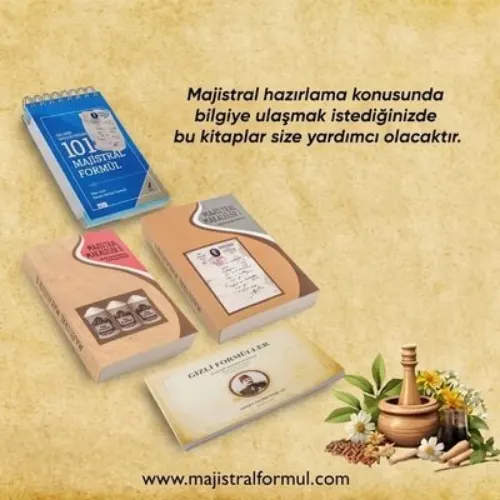
“Secret Formulas” meets its readers…It is known that our knowledge regarding Ottoman-era Pharmacists and the Art of Pharmacy is limited today. Especially prior to Sultan Mehmed the Conqueror, we do not have many documents regarding medicine and pharmacy. I am very pleased to contribute to the translation into modern Turkish of the book titled ‘’Gizli Terkipler’’ (Secret Formulations), written in Ottoman Turkish by an intellectual and unconventional Ottoman Pharmacist named ‘’Avanzade Mehmet Süleyman’’, which I came across by chance and which will shed light on late Ottoman pharmacy.
In the public eye, the term Ottoman creates the perception of a different language, yet the fact remains that Ottoman is defined as Turkish written in the Arabic alphabet. We are not talking about a new language. In other words, what we call Ottoman is actually Turkish itself. Ottoman Turkish is not a separate language, but the name of a period in the historical development process of the Turkish language used within the borders of the Empire. It has become customary to name the period between the 15th and 20th centuries of today’s Turkish of Turkey, also referred to as Western Oghuz/Western Turkish, as Ottoman Turkish. By general tendency, the period starting with the conquest of Istanbul and extending to the Republic is called Ottoman Turkish. We can also include the early years of the Republic in this process. In fact, the most accurate naming is “Turkish Language of the Imperial Era”. It has become established in scientific circles as “Ottoman Turkish”. The fact that it is deliberately referred to as “Ottoman language” by some people does not change this reality.
The author of the book “Gizli Terkipler” (Secret Formulations), which constitutes the source of the book “Secret Formulas”; Avan-zâde, Mehmet Süleyman (1871-1922) He was born in Beşiktaş, Istanbul in 1871. He passed away in Istanbul in 1922. He was the son of Avanzade Süleyman Bey of Karahisar. After graduating from the Beşiktaş Military Middle School in 1890, he graduated from the pharmacy department of the School of Medicine in 1893. He worked for a time at Haydarpaşa and Yıldız hospitals. He began writing articles for various journals and publishing books. Because the coverage of the Russo-Japanese War in the journal Musavver Terakki, which he began managing towards the end of 1902, drew backlash from Russia, he was exiled to Jerusalem in 1903. Mehmet Süleyman, who stayed there for about four years, fled to Cairo in 1907. Following the proclamation of the Second Constitutional Era in 1908, he returned to Istanbul and was subsequently appointed with the rank of captain to the Military Medical Translation and Statistics Department. In 1912, Mehmet Süleyman became a major and began serving as a pharmacy inspector at the Medical Department of the Ministry of War.
During the Constitutional Era, he became one of the most influential figures of the period through his original works and translations not only in literary genres such as short stories and novels, but also in his professional field of pharmacy and other scientific disciplines; through the journals and newspapers he published; and through his diverse works covering an extensive spectrum ranging from physiognomy and interpreting an individual’s life path based on their name, birth date, and personality traits, to gastronomy, history, and literary history..jpg) He drew attention as one of the prominent intellectual figures of that era; alongside his literary translations from leading European authors such as François Coppée, Ponson du Terrail, Alexandre Dumas, and Victor Hugo, he also translated numerous scientific and literary works by unknown authors.
He drew attention as one of the prominent intellectual figures of that era; alongside his literary translations from leading European authors such as François Coppée, Ponson du Terrail, Alexandre Dumas, and Victor Hugo, he also translated numerous scientific and literary works by unknown authors.
Possessing multiple identities—compiler, historian, literary historian, pharmacist, author, translator, journalist, and more—Mehmet Süleyman (Avanzade) filled a significant void in his time through his works aimed at the public. He contributed over one hundred and thirty works to the Turkish language, both original and translated.
The author’s son, Halit Avan, made the following observation about his father in an encyclopedia published in 1948:“The positive role of his publications in this field against the misunderstandings regarding health and well-being, trapped within the superstitiousi itibeliefs and antiquated traditions içiof the era he lived in, is quite evident. Carrying ai great ideal such as being of benefit to the public, elevating it in every sphere, and in the light of modern positive si cience illuminating society, Avanzade Mehmet Süleyman is one of our fortunate writers who succeeded in applying this idealini across a wide readershipitlesi inde tatbik etmeye muvaffak olan bahti.”Writers of the period made praiseful remarks about him, such as“He has no translation without a reason or purpose. His greatest aim is to serve his homeland, his fellow citizens, and his colleagues,”(for example, “A Multi-Identitied Translator in the Constitutional Era,” p. 61), thereby implying that the author was not an entrepreneur and businessman like Ahmet Midhat Efendi, but solely and purely a patriotic idealist. Likewise, Beyhan Kanter characterized him as “A Traditionalist Author in the Defense of Women’s Rights in the Constitutional Era: Avanzade Mehmet Süleyman.”.jpg) The book, which contains examples of the healing art of the late Ottoman period, consists of sections including Cosmetic Formulas, Mouthwashes/Toothpastes, formulas used in the treatment of various diseases, and recommendations for daily life. In the book, which includes 303 formulas, alongside formulas that are used even today such as cold cream and lime liniment, I believe that the commentary and practices regarding healthy living in the section on daily life recommendations should be evaluated by taking into account the medical level of that period. Undoubtedly, we must not forget the possibility that much of the knowledge and treatment methods we characterize as modern medicine today may also be met with a smile by future generations after some time.
The book, which contains examples of the healing art of the late Ottoman period, consists of sections including Cosmetic Formulas, Mouthwashes/Toothpastes, formulas used in the treatment of various diseases, and recommendations for daily life. In the book, which includes 303 formulas, alongside formulas that are used even today such as cold cream and lime liniment, I believe that the commentary and practices regarding healthy living in the section on daily life recommendations should be evaluated by taking into account the medical level of that period. Undoubtedly, we must not forget the possibility that much of the knowledge and treatment methods we characterize as modern medicine today may also be met with a smile by future generations after some time.
The positive impact of his publications in this field against the misconceptions regarding health and well-being, which were trapped in the superstitions and outdated traditions of the era he lived in, is indisputable. Embracing a great ideal such as being beneficial to the public, elevating it in every field, and enlightening society in the light of contemporary positive science, “Avanzade Mehmet SÜLEYMAN” lived approximately 100 years ago under the conditions of that era, fit more than two hundred works into a brief life of 51 years, and was one of our fortunate authors who succeeded in putting this ideal into practice for a wide readership.
I consider it a duty to express my gratitude to Pharmacist Kadir Sedat SOFUGİL, whose knowledge I consulted from time to time during the writing of the book; to my daughter, Pharmacist Elif Sezgi PEKCAN, and my wife, Prof. Dr. Sevgi Demirbaş PEKCAN, who contributed to the organization of my book; to Prof. Dr. Levent ÜSTÜNES and Asst. Prof. Dr. Murat ZOR for their valuable support; and to İbrahim Şeref KAYA, who made a great contribution by translating the book, written in what we call Ottoman Turkish—which is actually the ”Imperial Period Turkish Language”—into today’s Turkish of Turkey.
While bowing with respect before the memory of this extraordinary, patriotic elder whose greatest aim was to serve his country, his fellow citizens, and his colleagues, I believe that his soul has found peace…
Spec. Pharm. Ahmet Nezihi Pekcan
Pekcan Pharmacy – Konya
[email protected]
Tel: (332) 3520657http://www.majistralformul.com/