Ethanolhaltige Ammoniumbituminosulfonat-Zinkoxidschüttelmixtur 2.5% / 5% / 10%
( NRF 11.4.)
Ammoniumbituminosulfonat ..2.5 g ..5% ..10 %
Zinkoxid …………………… 20.0 g
Talkum ……………………… 20.0 g
Glycerol 85 % ……………30.0 g
Ethanol 90 % (v/v) ……… 20.0 g
Gereinigtes Wasser …… ad …100.0 g
Dear colleagues, this week I will share a formula used in Germany as a topical antiseptic for certain skin conditions such as eczema, furunculosis, psoriasis, and acne.
While writing about this preparation, which has a notably high therapeutic efficacy especially in cases of Endogenous Eczema, let us briefly review the concept of eczema.
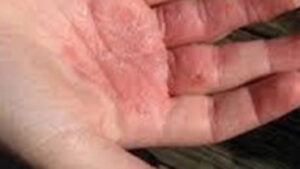
Eczema is a predominantly psychosomatic skin condition that arises from various causes and presents with symptoms such as erythema, swelling, vesicles, and pruritus. Its primary characteristic is the appearance of vesicles on erythematous skin. It has types such as acute, chronic, wet, and dry eczema.
Eczema can also occur due to an inappropriately administered drug (powders or ointments prepared with sulfur, mercury, antihistamines, sulfonamides, penicillin, etc.). Eczema seen in housewives (hand eczema) is associated with potassium dichromate in bleach, various laundry products, and even rubber gloves.
One of the most common contact eczemas stems from cosmetics and hair dyes (para-group). Cosmetic preparations, especially when fragranced, can cause numerous facial eczemas. Nail polish holds a unique place; it does not cause eczema on the nails, but rather on the eyelids. Eczemas caused by clothing generally originate from rubber and synthetic textiles (whereas the actual culprit is the dye, particularly black, blue, and green dyes, rather than the fabric itself as commonly believed). Eczema on the neck is often caused by wearing high-collared knitwear. Foot eczema may stem from shoes (leather dye, polish, or adhesive). Metals (especially nickel) can cause contact eczema (watch bracelets, chains, etc.). Patch tests can sometimes identify the cause of contact eczema.
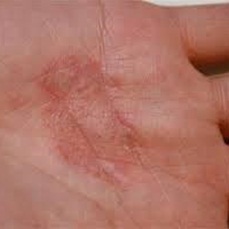
Infectious eczemas are of bacterial or fungal origin. However, it is difficult to determine whether the infection caused the eczema, or whether the infection is the consequence of eczema that became secondarily infected.
Eczema is not a severe disease that could be considered dangerous; however, it can cause significant discomfort. Chief among the precautions that eczema patients must take for comfort is to avoid scratching the lesion.
Chronic eczema tends to recur from time to time. Avoiding stress, preventing sleep deprivation, and keeping the face clean will be beneficial.
Although the terms dermatitis and eczema have been used synonymously in recent years, some authors still designate any cutaneous inflammatory process as dermatitis. The general consensus is that the term dermatitis encompasses all clinical presentations associated with cutaneous inflammation, and consequently every type of eczema is dermatitis; however, not every dermatitis is eczema. Today, the term dermatitis is used for acute, rapidly resolving cutaneous inflammation, whereas eczema or eczematous dermatitis is used for chronic inflammation with a lower tendency for spontaneous resolution.
Classification;
1. Exogenous Eczemas: irritant contact dermatitis, allergic eczematous contact dermatitis, and phototoxic and photoallergic contact dermatitides.
2. Endogenous Eczemas: Atopic dermatitis, seborrheic dermatitis, neurodermatitis (lichen simplex chronicus), nummular eczema (discoid eczema), vesicular eczema of the hands and feet (dyshidrotic eczema-pompholyx), stasis eczema (varicose eczema), and xerotic eczema (asteatotic eczema)
Substances in the formula
Ammonium sulfobituminate-ichthammol-ichthyol; Ichthyol exerts a weak antiseptic effect due to the sulfur present in its sulfone form. Its 10% ointments are used as topical antiseptics in certain skin diseases such as eczema, furunculosis, psoriasis, and acne. Soluble in water; partially soluble in alcohol and ether. Solubilities according to the USP: Soluble 1:10 in water; miscible with glycerin, fixed oils, and fats; partially soluble in alcohol and ether.
Zinc oxide-zinci oxidum-oxyde de zinc; It is an active ingredient with astringent properties known for its weak antiseptic action. It is used in eczema, burns, diaper rash, and friction-induced skin damage. Zinc oxide ointment contains 20% zinc oxide, while zinc paste contains 25%. Zinc oxide is not absorbed through the skin, and since it does not dissolve in water, it is applied in the form of powder, ointment, or paste.
Talc-Talcum-Purified talc; Talc is natural hydrated magnesium silicate. Its approximate chemical formula is “Mg6Si2O54OH4“. It may contain varying amounts of aluminum silicate and iron. It is a very fine, light, homogeneous, white or off-white, or grayish-white, odorless crystalline powder. When applied to the skin, it readily adheres to the contact surface. Purified talc must be free from microscopic asbestos particles. Talc is practically insoluble in water, mineral acids, and dilute solutions of alkali hydroxides.
Glycerol-Glycerine-Glycerol; – 85%; Glycerin is a clear, colorless or very pale, hygroscopic, syrupy, odorless or nearly odorless liquid with a sweet taste. Miscible with water and alcohol; slightly soluble in acetone; practically insoluble in chloroform, ether, fixed oils, and essential oils. The pH of its aqueous solutions is neutral to litmus. According to the United States Pharmacopeia (USP), the pH of Glycerin Oral Solution, USP is between 5.5 and 7.5. Strong oxidizing agents form explosive mixtures with glycerin.
Preparation of the formula; Ichthyol is weighed on a watch glass over paper coated with liquid paraffin, dissolved by stirring into the distilled water specified in the formula, and 90% ethanol is added. Zinc oxide and talc are mixed in a mortar and levigated with the gradual addition of glycerin. The ethanolic ichthyol solution is added to the mixture in the mortar, and the formula is completed by adding the calculated quantity of distilled water. Care should be taken to ensure the final total mass of the formula is 100 g.
Administration and storage conditions; Applied 3 times daily using a spatula. It can be stored for 6 months in a glass bottle, whereas it can be stored for 3 months in a plastic bottle.
Wishing you a good week…
Tel: (332) 3520657
Fax: (332) 3512816
http://www.majistralformul.com/