
Treatment options for hair loss caused by androgenetic alopecia in women (Part I)Androgenetic alopecia in women is the most common cause of hair loss observed in female patients. In genetically predisposed women, it is characterized by a diffuse reduction in hair density in the vertex (crown) and frontal regions, where the frontal hairline is preserved and a characteristic pattern distribution is observed.
As in men, the frequency and severity of androgenetic alopecia in women increase with age. The role of androgens in the pathogenesis (disease development) is not as clear as it is in men. For this reason, the concept of female pattern hair loss (FPHL) is considered more accurate in defining the disease.
It is observed in women with hyperandrogenemia. However, hyperandrogenemia is not mandatory. Women with hyperandrogenemia may exhibit male-pattern hair loss. In these patients, other signs of hyperandrogenism, such as hirsutism and menstrual irregularity, are also observed.
To briefly discuss hyperandrogenemia here;Hyperandrogenemia (excess of male hormones)Overproduction of male hormones (in other words, hyperandrogenemia) can disrupt the delicate hormonal balance of the female cycle. Cortisone treatment may be required due to adrenal causes (adrenal glands). One of the most common causes of hyperandrogenemia or hyperandrogenism (increased peripheral effect of normal androgen levels and excessive hair growth in atypical areas in women, acne) is excess weight. In adipose tissue, androgens (male hormones) that interfere with the menstrual cycle are produced from estrogen. Therefore, patients are advised to lose weight (diet, exercise). PCOS (polycystic ovary syndrome), which frequently runs parallel to this, exacerbates the findings.
FPHL usually presents with complaints of slow and progressive hair thinning.
Three distinct patterns of hair loss can be observed:
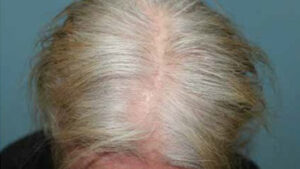
1. Diffuse thinning of the crown area, with preservation of the frontal hairline (Ludwig type). It is graded as Ludwig 1, 2, 3 according to the severity of the loss (Figure 1, 2, 3).
2. Recession of the frontal midline and widening of the central part of the scalp without diffuse hair loss was described by Olsen and named the ‘Christmas tree pattern’.
3. Bitemporal recession accompanied by thinning (Figure 4A, 4B). It exhibits the same distribution pattern as male-pattern (Hamilton type) hair loss. Thinning is more prominent at the vertex and the lateral-frontal region..jpg) Figure 1. Ludwig: Pronounced widening of the midline hair parting, decrease in hair density at the crown.
Figure 1. Ludwig: Pronounced widening of the midline hair parting, decrease in hair density at the crown.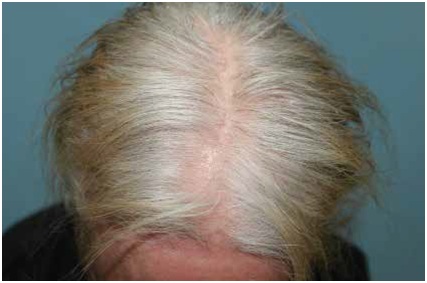
Figure 2. Ludwig 2: Pronounced widening of the midline hair parting and moderate
decrease in hair density at the crown of the scalp.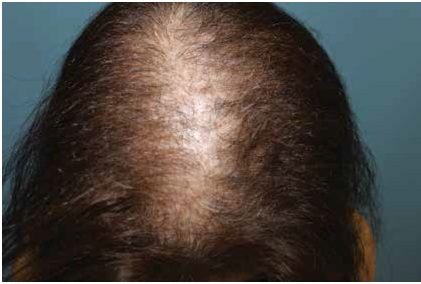
Figure 3. Ludwig 3: Marked decrease in hair density at the crown of the scalp.
Preservation of the frontal hairline is noteworthy.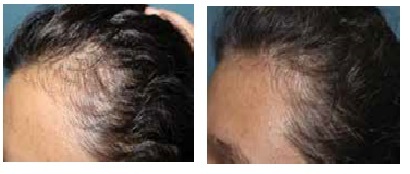
Figure 4. Temporal recession and temporal thinning in daughter (A) and her mother (B).Treatment:Pharmacological options can be categorized into androgen-dependent and androgen-independent
mechanisms of action.Androgen-independent treatments:
Minoxidil: Currently, the only approved androgen-independent treatment method
is topical minoxidil solution. Minoxidil exhibits effects that slow down and can halt hair loss. It is also an antihypertensive vasodilator medication that promotes hair growth. Today, it is used off-patent as an over-the-counter treatment for androgenetic alopecia. It is thought to affect the hair cycle by inducing premature termination of the telogen phase and prolonging the anagen phase. It has a potassium channel opening effect, and its mechanism of action is still not entirely clear. It has been found to stimulate hair follicles by virtually acting as a hair growth stimulant around the follicle. It has properties that increase hair count and hair weight. The FDA recommends its use at a 2% concentration in women. Only the 2% form is approved for FPHL (female pattern hair loss). In a study comparing the 5% solution with the 2% concentration, statistically significant superiority was observed with the 5% solution at week 48, but findings of local irritation were detected more frequently. It has been concluded that applying minoxidil 2% topical form twice daily provides the same efficacy as applying minoxidil at a 5% concentration once daily. Minoxidil is applied as 1 ml twice daily to the affected areas. It should be used for at least 12 months to evaluate its effectiveness. Once efficacy is achieved, it should be continued without interruption. It should be noted that telogen effluvium may be triggered following discontinuation. Also, a temporary increase in shedding may occur during the first months of treatment. Its side effects are frequently the development of allergic and contact dermatitis to the propylene glycol contained in the formulation. Since the 5% foam form does not contain this ingredient, there is a lower likelihood of side effects. It has been demonstrated that there is no difference in efficacy between once-daily use of the 5% foam form and twice-daily use of the 2% solution. Another side effect is facial hypertrichosis, which is generally possible with incorrect application and contact of the medication with the face.Minoxidil hair spirit 2 % / 5 % (NRF 11.121.)
2% 5%
Minoxidil 2.0 g 5.0 g
Isopropyl palmitate 1.0 g 1.0 g
Macrogol-40-glycerol hydroxystearate 2.5 g 2.5 g
Propylene glycol 7.5 g 15.0 g
Ethanol 70 % (v/v) ad 100.0 g ad 100.0 gWishing you a good week…
To be continued…
References:
1- Türkderm 2014; 48: Special Issue 1: 31-5 İdil Ünal Androgenetic alopecia in women.
2- Standardisierte Rezepturen (NRF/SR)
Specialist Pharmacist Ahmet Nezihi Pekcan
Pekcan Pharmacy – Konya
[email protected]
Tel: (332) 3520657http://www.majistralformul.com/