
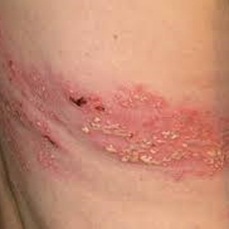
Shingles (Herpes Zoster) is a viral infection caused by the herpes virus (varicella-zoster virus). Its clinical manifestations vary considerably. It is usually seen in adults, and frequently in the elderly. By causing inflammation in the ganglia (nerve nodes) and the dorsal roots of the spinal cord, the virus causes rashes in the form of painful and erythematous bumps in the skin areas innervated by that nerve ganglion. It is usually the result of the reactivation of the varicella-zoster virus, which resides latently in the body and is not contagious in this dormant state. However, there are also cases of infection originating from outside the body. The pain caused by shingles often appears before the cutaneous symptoms. The pain is constant and exacerbates at night. Shingles usually resolves by conferring immunity, but recurrences are occasionally observed. One of the common complications of shingles is postherpetic neuralgia, namely postherpetic pain, which can be long-lasting and is associated with scar tissue left by inflammatory lesions in the nerves. The shingles virus nests and replicates in the roots of nerve cells, causing severe pain and burn-like redness and itching on the skin during this replication phase. In some patients, this virus may not be cleared for a long time. Over time, through the blood supply in hair follicles, this virus can reactivate and recur with the same discomforts. Although shingles resolves spontaneously within 2-3 weeks, it may leave behind adverse outcomes such as neuritis, paresthesia, and sensory loss.
If we examine our formula;
Rp
Acide acetylsalicylique …1 g
Ether éthylique …………30 ml
Substances included in the formula
Acetylsalizylsäure-Aspirin-salicylic acid acetate-Acetylsalicylic acid:
Acetylsalicylic acid occurs as odorless or faintly odored, colorless or white crystals, or as a white crystalline powder. Its solubilities according to the British Pharmacopoeia (BP): Slightly soluble in water; freely soluble in alcohol; soluble in chloroform and ether. Its solubilities according to the United States Pharmacopeia (USP): Soluble in water 1:300; in alcohol 1:5; in chloroform 1:17; and in ether 1:10-15. Aspirin, also known as acetylsalicylic acid, is the salicylic ester of acetic acid and was first introduced into clinical use in 1899. Aspirin exhibits analgesic, anti-inflammatory, antipyretic, and antithrombotic effects. When introduced into the body, it is hydrolyzed into salicylate, which is also active. In terms of its anti-inflammatory and analgesic effects, it is generally equivalent to most Nonsteroidal Anti-inflammatory Drugs (NSAIDs). The analgesic effect of aspirin is thought to be primarily due to its peripheral actions, but it is also possible that it exerts direct effects on the central nervous system.
Aetheris-Ether-Diethyl ether:
It is a clear, colorless, volatile, highly flammable, highly mobile liquid with a characteristic odor. Its boiling point is 34-35°C. It dissolves in water between 1:12 and 1:15; it is miscible with alcohol, chloroform, methylene chloride, petroleum ether, fixed oils, and essential oils. Ether is the first general anesthetic agent used to prepare patients for surgical procedures. In this formula, it is used as a solvent.
Preparation of the formula
After crushing the acetylsalicylic acid in a glass mortar, it is dissolved with ether, placed in an amber glass bottle protected from light, tightly closed, and stored at 8-15°C.
The formula is used for its analgesic effect.
Wishing you a great week…
Specialist Pharmacist Ahmet Nezihi Pekcan
Pekcan Pharmacy – Konya
[email protected]
Tel: (332) 3520657
http://www.majistralformul.com/