Dear Colleagues, together we will examine an ear wash formula used for cerumen (earwax) cleaning in France.
According to experts, earwax should be considered a normal fluid tasked with protecting the ear, and the cleaning process should be left to the ear itself. Otherwise, severe disorders leading up to hearing loss may be encountered.
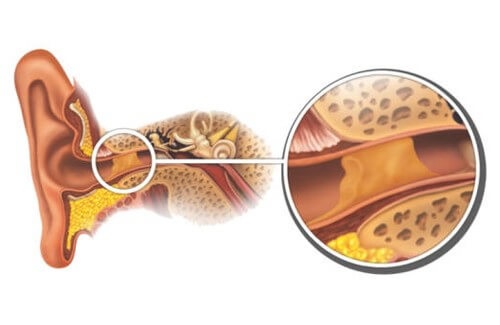
Produced by the sebaceous glands in the external auditory canal and containing epithelial debris, earwax is a beneficial secretion that forms a protective layer shielding the external ear skin from water and inflammation, and preventing dust and other particles from the external environment from penetrating deeper into the ear. The composition and quantity of earwax vary from person to person; underproduction increases the risk of infection, while overproduction may lead to impaction (plug formation) and associated hearing loss. Furthermore, using cotton swabs to clean the ears can be harmful.
Normally, earwax is transported from the inside out by hairs located in the skin of the external auditory canal and expelled from the body; however, in individuals who have the habit of cleaning their ears with cotton swabs and similar objects, this mechanism may be disrupted. Cotton swabs can push the wax inward, causing it to accumulate and form a plug (cerumen impaction). When a plug forms; complaints such as hearing loss, pain, abnormal sounds or tinnitus, a foreign body sensation, and ear blockage after swimming or bathing may occur. In addition, these patients may be exposed to external auditory canal infections, tympanic membrane perforations, and the chronic middle ear infections they cause. The decision for an ear cleaning procedure must be made by a physician, not by the patient.
Rp.
Resorcinol 0.06 g
Polysorbate 80 0.50 g
Glycerin 45.00 g
Alcohol 95% v/v 11.53 g
Purified water 40.46 g
Substances in the formula;
Dibromsalicylii- Resorcine- Dioxybenzene- Resorcinol;
It is a white crystalline substance with a characteristic odor. Its color turns red under the influence of air and light. It has a burning taste. It is soluble in 1 part water and 1 part alcohol, as well as in ether, glycerin, and benzene, but insoluble in chloroform. It is incompatible with acetanilide, camphor, chloral hydrate, menthol, and phenol. Today, Resorcinol is used externally as an antiseptic and disinfectant. It is used externally (ointment 10–20%, solution 0.1%) in psoriasis, acne, seborrhea, eczema, and other skin diseases. Application over very large surface areas should be avoided. M.D. is 0.50–1.5 g.
Polyoxyethylene 80 sorbitan monolaurate- Tween 80- Polyoxyethylene 20 sorbitan monostearate;
Polysorbates are non-ionic surfactants used as emulsifiers in the preparation of stable oil/water pharmaceutical emulsions. They are used as solubilizing agents for various substances, including essential oils and fat-soluble vitamins (such as vitamins A, D, and E). They are also used as wetting agents in oral and parenteral suspension formulations. The estimated acceptable daily intake expressed as total polysorbate esters for polysorbate 20, 40, 60, 65, and 80 has been reported as 25 mg per kg of body weight. Polysorbate 80 is a mixture of partial stearic esters of sorbitol and its anhydrides. Each mole of sorbitol and its anhydrides is copolymerized with approximately 20 moles of ethylene oxide. It has a faint characteristic odor. It is miscible with water, alcohol, ethyl acetate, and methyl alcohol. It is practically insoluble in liquid paraffin and fixed oils.
Polysorbates are stable in the presence of electrolytes and weak acids and bases. Strong acids and bases can cause saponification.
Glycerol- Glycerine- Glycerol- 85%;
Used for its solvent, carrier, preservative, and viscosity-increasing properties. It is an important moisturizing agent. Glycerin is a clear, colorless or very pale, hygroscopic, syrupy liquid that is odorless or has a very faint odor, and has a sweet taste. It is miscible with water and alcohol; slightly soluble in acetone; practically insoluble in chloroform, ether, fixed oils, and essential oils. Its aqueous solutions show a neutral reaction to litmus. According to the United States Pharmacopeia (USP), the pH of Glycerin Oral Solution, USP is between 5.5 and 7.5. Strong oxidizing agents form explosive mixtures with glycerin.
Alcohol- Ethanol- Ethyl alcohol- Spiritus vini- Weingeist- Ethanolum- Alcoholum;
Alcohol is a mixture of ethyl alcohol and water. In the British Pharmacopoeia (BP), alcohol is referred to as “Ethanol (96 per cent)” and is defined as not less than 96% and not more than 96.6% v/v. It is a clear, colorless, mobile liquid with a characteristic odor and a burning taste; it is volatile and ignites readily, burning with a smokeless blue flame. It is miscible with water; during mixing, the temperature of the mixture increases and its volume decreases. It is miscible with chloroform, ether, glycerol, and most other organic solvents. According to the BP, dehydrated ethanol (Ethanol, BP 1993; absolute alcohol; dehydrated alcohol) must contain not less than 99.4% v/v or 99% w/w of C2H5OH (density 788.16 to 791.2 kg/m3). According to the United States Pharmacopeia (USP), dehydrated alcohol (Dehydrated Alcohol, USP 23) contains not less than 99.5% v/v or 99.2% w/w of C2H5OH (specific gravity should not exceed 0.7964 at 15.56°C). According to the BP, dilute alcohol (Dilute Ethanols, BP 1993) is available in several different concentrations. One of these is 90% ethanol, also known as “Rectified Spirit”. Dilute Ethanol is a mixture of ethyl alcohol and water. It must contain not less than 69.1% v/v and not more than 71.0% v/v, and not less than 61.5% w/w and not more than 63.5% w/w of C2H6O. Alcohol strength is expressed as percentage by weight at a specific temperature.
Although Ethyl Alcohol is effective at concentrations of 60–90%, a 70% concentration (vol/vol) exhibits optimal efficacy for skin antisepsis. In contrast, when the concentration drops below 50%, it largely loses its activity. 70 Degree alcohol effect is clearly stated in the English explanation on the hand sanitizer page: “70 degree alcohol is the most antiseptic concentration and kills 99.9% of bacteria in one minute”.
Preparation of the formula;
In a calibrated and tared 90 ml bottle, the calculated amount of alcohol (95% volume/volume by weight) is placed and the resorcinol is dissolved. The formulation is completed by sequentially adding glycerin, polysorbate 80, and distilled water, followed by filtration.
Ear baths (ear drops) should be administered with 30 drops three times a day for six days.
Wishing you a good week…
References;
1- Cahiers du préparateur en pharmacie
Travaux pratiques de préparation et de conditionnement des médicaments
Jean-Marie FONTENEAU Philippe KLUSIEWICZ
2- RxMediaPharma®2016 Interactive Drug Information Source
Exp. Pharm. Ahmet Nezihi Pekcan
Pekcan Pharmacy – Konya
[email protected]
Tel: (332) 3520657
http://www.majistralformul.com/