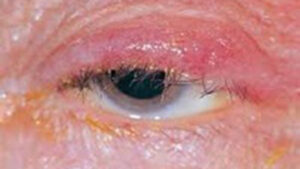
UNGUENTUM OPHTHALMICUM IIIDear Colleagues, this week we will examine together a formula found in the German standard formulas (DRF) with local anesthetic action, which is also used in the treatment of conjunctivitis and blepharitis.
First, let us briefly recall the conditions of conjunctivitis and blepharitis.
In general terms, inflammation of the membrane protecting the eye; inflammation of the conjunctiva. It is the most common condition among eye allergies. Smoking, using perfume, and engaging in strenuous tasks can cause eye fatigue, inflammation, or an increased risk of allergy. In addition, actions irritating to the eyes (rubbing the eyes, scratching, unhealthy makeup products, etc.) and secondary causes such as wearing contact lenses also increase the likelihood of catching such disorders.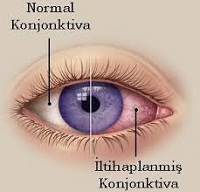 Blepharitis, on the other hand, is a chronic inflammatory disease of the eyelid. It is very common in both children and adults.Rp.
Acidi borici
Novacaini hydrochlorici aa/ 0.2 g
Solutions suprarenini 1: 1000 1.0 g
Vaselini alba ophtalmici ad 10.0 g
Substances in the formula
Boric acid – Acido borico – Borsaure – ACIDUM BORICUM TK. 1974 (Pages 16-17)Boric acid occurs as odorless white crystals or lustrous scales, or as a white crystalline powder that has a smooth, slippery feel to the touch. It is soluble in water (1:20), boiling water (1:3.6), alcohol (1:16), boiling alcohol (1:6), and glycerol (1:4, 85%). Boric acid forms a more acidic complex with glycerol than it does on its own. Boric acid is a medication with weak bacteriostatic and fungistatic actions. The exact mechanism of the antibacterial and antifungal effects of boric acid is unknown. Boric acid exhibits a slow bacteriostatic effect against staphylococci and streptococci. It dissolves in 25 parts of water, 3 parts of boiling water, 16 parts of ethanol (95%) R, and 5 parts of glycerol (85%) R. While its 5% aqueous solutions show a phagocytic effect, its 2-4% solutions prevent the proliferation and growth of bacteria.Novocaine T.K.- Procaine hydrochloride- Allocaine- Chlorhydrate de procaine- Procainum hydrochloricum
p-Aminobenzoyl diethylaminoethanol hydrochlorideIt is a colorless, odorless powder. It is soluble in 1 part water, 8 parts alcohol, and 30 parts anhydrous alcohol. It is slightly soluble in chloroform and insoluble in ether. Procaine hydrochloride is a short-acting ester-type local anesthetic used for local and regional anesthesia. It does not exhibit a superficial topical anesthetic effect. Its toxicity is accepted as the standard for other local anesthetics. However, it causes more hypersensitivity reactions compared to amide-type local anesthetics. Even a dose as small as 10 mg can lead to death. In ophthalmology, 5-10% solutions are used.Adrenaline T.K.- Epinephrine- Adrenalina- L-adrenaline- ParanephrinAdrenaline is a creamy-white, odorless, crystalline powder or granular in structure. It darkens on exposure to air and light. According to the British Pharmacopoeia (BP), it is sparingly soluble in water; practically insoluble in alcohol and ether. Adrenaline dissolves in solutions of mineral acids, sodium hydroxide, and potassium hydroxide; however, it is insoluble in solutions of ammonia and alkali carbonates. According to the United States Pharmacopeia (USP), it is slightly soluble in water and alcohol; insoluble in chloroform, ether, fixed oils, and volatile oils. Its aqueous solutions give an alkaline reaction to litmus. Neutral and alkaline solutions are unstable and rapidly turn red on exposure to light.
Adrenaline (epinephrine) is an endogenous catecholamine with therapeutic applications. Endogenous adrenaline is primarily formed from noradrenaline in the adrenal medulla. Adrenaline is administered by injection, inhalation, or topically to the eye; the effects of exogenous adrenaline are identical to those of endogenous adrenaline. Therapeutically, it is used intravenously to stimulate the heart and for its bronchodilator effect in cases of anaphylactic shock. When applied locally, adrenaline constricts blood vessels, thereby blanching the skin and mucous membranes. For this reason, it is added to local anesthetics. Its effect lasts ½–2 hours.
Metered-dose inhalers are available for use in the treatment of asthma. Its use as a bronchodilator in the treatment of asthma has declined following the introduction of nebulized albuterol. Another use is topical application to the eye for diagnostic purposes. In addition, it is included in the composition of local anesthetic drug solutions to prolong their duration of action.Vaseline – White vaselineIt is an emollient ointment base known as white petrolatum (white soft paraffin). It is not easily absorbed by the skin. It is obtained by bleaching yellow petrolatum. It is odorless and tasteless. Petrolatum is a fatty substance that exerts a soothing effect by softening the skin, smoothing its surface, and acting effectively against disorders causing dryness or flaking. It has a moisturizing effect on the skin, thereby helping to revitalize it.Preparation of the formulaWhile boric acid and novocaine are levigated in a glass mortar with a small amount of white petrolatum to form a smooth paste, adrenaline is added slowly, and the preparation is brought up to 10.0 g with the addition of petrolatum. Strict attention should be paid to sterile preparation conditions while compounding the formula.
Wishing you a good week…
SourcePharmazeutische und pharmakologische Erlauterungen zu den Deutschen Rezeptformeln DRFSpec. Pharm. Ahmet Nezihi Pekcan
Pekcan Pharmacy – Konya
[email protected]
Tel: (332) 3520657http://www.majistralformul.com/