Dear Colleagues, this week, before moving on to the treatment of the disease known as pelade or Alopecia Areata with compounded formulations, let us briefly review this disease.
Alopecias
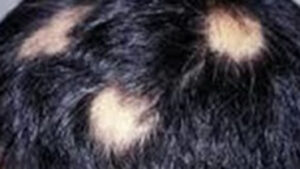
Alopecia areata, commonly known in everyday language as patchy hair loss, is a condition that affects hair follicles and generally causes hair loss in coin-sized, round patches in various areas.
There are different types of alopecia areata, and rarely, it can cause the loss of all scalp hair or even all body hair. When looking at its causes in general, alopecia areata is an immune system disorder. The immune system is designed to protect the body against external threats. However, in some individuals, the immune system attacks the body itself in addition to external threats and diseases. Diseases resulting from these attacks by the immune system against the body’s own tissues are called autoimmune diseases, and alopecia areata is one of them.
Alopecia areata does not discriminate between men and women. Looking at the age range, we frequently witness its onset in childhood. We can say that most patients presenting to a physician with alopecia areata complaints are teenagers. Although it is commonly termed as hair loss among the public, shedding of the beard, eyebrows, and eyelashes can also be observed in addition to scalp hair loss. Alopecia areata can happen to almost anyone, but those with family members having cases of alopecia areata have a slightly higher risk of developing it. Alopecia areata may be hereditary, but it is not a contagious disease. Alopecia areata has been shown to be associated with autoimmune diseases such as autoimmune polyglandular syndrome, thyroid diseases, vitiligo, pernicious anemia, systemic lupus erythematosus, rheumatoid arthritis, ulcerative colitis, lichen planus, myasthenia gravis, and polyendocrinopathy syndrome. The coexistence of thyroid diseases and alopecia areata is frequently seen. Therefore, thyroid autoantibodies should be investigated to determine the etiology in patients with alopecia areata.
In treatment with compounded formulations, the objective is to induce irritation in the plaque without causing vesicles and ulcers.
As an example of preparations applied to plaques on the scalp or beard to induce irritation, we will examine a formula anonymously prepared in our pharmacies.
Rp
Acide Acetique glaciale ……3 g
Choloral Hydrate ……………6 g
Ether Sulphurique ………..37 g
Alcool 90 % ……………… 54 g
Substances used in the formula:
Glacial Acetic Acid-Ethanoic Acid-Concentrated Acetic Acid-Essigsäure-Acétique Acide Glacial [FP]: Glacial acetic acid exists as semi-transparent crystals or as a colorless liquid with a very pungent odor. Its boiling point is between 117-118°C. It is miscible with water, alcohol, methylene chloride, and glycerin. According to the USP, the pH of the irrigation solution is between 2.8-3.4; the pH of the otic solution should be between 2.0-4.0 when diluted with an equal volume of water. Glacial acetic acid is primarily an agent with antibacterial or antifungal activity. Its dilute solutions are used in the treatment of superficial bacterial infections of the external ear. Glacial acetic acid is also used as an escharotic (caustic; corrosive). Its diluted forms have been used as antibacterial (especially against Haemophilus sp. and Pseudomonas sp.), antifungal, and antiprotozoal agents in vaginal gels and douches, irrigation solutions, and preparations formulated for skin and nails. In addition, it has expectorant, spermicidal, and astringent effects. It is also used against warts and corns. It has been reported to be effective against jellyfish stings.
Chloral hydrate- Chloral hydrate- Trichloroethylidene glycol- Chlorali hydras: Chloral hydrate exists as pungent-smelling, colorless, transparent, or white crystals. It slowly volatilizes on exposure to air and melts at 55°C. According to the British Pharmacopoeia (BP), it is very soluble in water; freely soluble in alcohol, chloroform, and ether. According to the United States Pharmacopeia (USP), it is soluble 1:0.25 in water, 1:1.3 in alcohol, 1:2 in chloroform, and 1:1.5 in ether; it is very soluble in olive oil. The pH of its 10% aqueous solution is between 3.5-5.5. When used locally, it exhibits a vasodilatory effect.
Aether-Ether anesthesicus-Diethyl ether-Ether sulfurique-Ether T.K.: Anesthetic ether is diethyl ether with an antioxidant added in an appropriate concentration. It is a clear, colorless, volatile, highly flammable, very mobile liquid with a characteristic odor. Its boiling point is 34-35°C. It is soluble in water between 1:12 and 1:15; miscible with alcohol, chloroform, methylene chloride, petroleum ether, fixed and volatile oils. 93 drops equal 1 g. It exhibits a muscle relaxant effect. Its muscle relaxant effect is due to a mephenesin-like central action.
Aethanolum-Alcoholum-Ethanolum-Spiritus vini: In ancient times, it was called “water of life” and was practically believed to be a cure for almost every illness. An important property of alcohol is that it is an excellent solvent frequently used in most pharmaceutical formulations. Although ethyl alcohol is effective at concentrations of 60-90%, a 70% concentration (vol/vol) exhibits optimal efficacy for skin antisepsis. In contrast, when the concentration falls below 50%, it largely loses its activity.
Alcohol exerts its effect by coagulating proteins and dissolving lipids. Since protein denaturation requires the presence of some water, the antimicrobial effect of absolute (96%) alcohol is weak.
Preparation of the Formula: The calculated amount of chloral hydrate is dissolved in alcohol. Ether and glacial acetic acid are added to the solution to complete the formula. The prepared solution should be stored in airtight containers at 8-15°C. It should be protected from light.
The solution should be applied gently to the pelade plaques morning and evening without causing vesicles or ulcers.
Wishing you a great week…
Spec. Pharm. Ahmet Nezihi Pekcan
Pekcan Pharmacy – Konya
[email protected]
Tel: (332) 3520657
http://www.majistralformul.com/