Dear colleagues, the subject of this week’s article, which I plan to write in two parts, covers the sterilization and disinfection methods applicable in our existing pharmacy laboratories, as well as methods for providing an aseptic working environment.
PART-1
STERILIZATION-DISINFECTION AND ASEPTIC WORK
Sterilization means the definitive destruction of all pathogenic or non-pathogenic microorganisms in a substance or solution.
Disinfection is the process of destroying pathological (disease-causing) microorganisms or their toxins. While chemical substances are used as disinfectants, harmless disinfectant agents such as water can also be used for sterilization.
By the term Aseptic, it is understood that the preparation is obtained without microbial contamination by keeping the number of microorganisms in the environment at the lowest level during the process.
Sterilization is a procedure performed on solutions or substances solely for the purpose of eliminating microbes. Due to this process, no harm should be caused to the preparation or the active substances within the preparation. Taking this into consideration, the most suitable (least damaging) sterilization method must be selected according to the properties of each substance.
STERILIZATION METHODS
- Sterilization by heat
1- Moist heat sterilization (With pressurized steam)
Moist heat sterilization refers to sterilization with saturated water steam under pressure at 116 °C for at least half an hour and at 121 °C ± 1 for at least 20 minutes. As long as the active substance is not damaged by this method, there is no substance that cannot be sterilized and no microorganism that cannot be killed. Devices used for steam sterilization under pressure are called AUTOCLAVES.
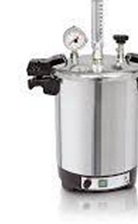
An autoclave performs sterilization in 15-20 minutes at a temperature of 121 degrees Celsius in an environment saturated with pressurized water steam. It was invented in 1879 by Charles Chamberland. The name autoclave is derived from the Greek auto- (self) and Latin clavis (key) words and means “self-locking device”.
It is used in laboratories and operating rooms to destroy microbes. At the same time, because it eliminates microbes, it is also widely used in fruit and vegetable canning.
The primary condition to consider during sterilization in an autoclave is to expel the air from the device and bring the materials into complete contact with steam. If air remains inside the device, the heat energy that the air will transfer to the material to be sterilized will be very low, necessitating a long time for sterilization. It is also known that substances exposed to heat for extended periods deteriorate. Therefore, it is necessary to shorten the time to reach the sterilization temperature and to bring the solutions to room temperature quickly at the end of the sterilization period. For this purpose;
a- Increase steam pressure and consequently raise the temperature,
b- Cool the materials immediately at the end of the sterilization period, that is, do not leave them to cool down on their own, because this process takes a long time and leads to deterioration in certain substances. (For example, glucose solutions left to cool on their own in an autoclave turn yellow.)
To cool bottles quickly after sterilization, modern autoclaves spray increasingly cooler water onto the solution bottles. If solution bottles are removed from the autoclave before the temperature drops to 100 °C and the internal pressure of the bottle equalizes, all the bottles will explode.
Many methods are used for autoclave monitoring. Among these, we can list controls performed with substances that melt at specific temperatures, control with indicators, control with recording thermometers, and control with bacterial cultures.
Autoclaves are divided into two types according to the direction in which they deliver steam:
- Vertical autoclaves that deliver steam from bottom to top
- Horizontal autoclaves that deliver steam from top to bottom
Vertical autoclaves generate steam by boiling the water themselves, while horizontal autoclaves, depending on their construction, either generate steam themselves or receive steam externally, as in modern devices.
The essence of sterilization in an autoclave is that substances come into contact with steam. Accordingly, the air inside the device must be expelled and replaced by steam. The steam itself expels the air inside the autoclave. Steam is lighter than air. In vertical autoclaves, steam rising toward the top of the device carries the air along with it and expels it. In horizontal autoclaves, steam entering under pressure from above compresses the air and pushes it out as it exits from the bottom due to pressure.
Substances that cannot be sterilized by the moist method (in an autoclave):
1- Anhydrous substances; oils, powdered substances
2- Solutions that decompose at 115-120 °C, and plastics that lose their properties at this temperature. (Note: Polyethylene, polypropylene, polyacetal, and PVC can be sterilized in an autoclave.)
Substances sterilized in an autoclave (with moist heat):
All substances, instruments, and aqueous solutions that can withstand 115-120 ± 1 °C and do not deteriorate with water steam.
To be continued…
Wishing you a pleasant week.
Spec. Pharm. Ahmet Nezihi Pekcan
Pekcan Pharmacy – Konya
[email protected]
Tel: (332) 3520657
http://www.majistralformul.com/