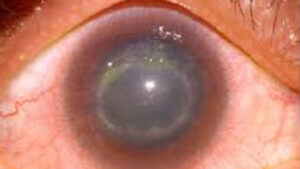
Chlorhexidine 0.04% ophthalmic solution in the treatment of Acanthamoeba keratitisA type of parasite found in soil and tap water,Acanthamoebacan cause very serious infections in humans and animals. Keratitis caused by the Acanthamoeba parasite can lead to outcomes reaching up to blindness, presenting with corneal ulcers, especially in contact lens wearers. The disease occurs when the amoeba known as Acanthamoeba invades the cornea of the eye; it can cause permanent visual impairment or blindness.
This condition is often associated with contact lens use, as Acanthamoeba can live in the space between the lens and the eye. This supports the recommendations that contact lenses should be properly disinfected before insertion and removed before swimming or surfing.
Factors such as not properly washing hands before and after handling contact lenses and multi-purpose lens solutions failing to adequately disinfect lenses increase the risk of infection. The inadequate disinfecting power of some contact lens solutions creates an environment for the Acanthamoeba parasite to spread in the eye. The best preventive measure against the Acanthamoeba parasite is to maintain contact lenses using hydrogen peroxide-based solutions.
How is Acanthamoeba transmitted?
Popularly known as the eye-eating parasite, Acanthamoeba carries a risk of transmission through tap water, swimming pools, dusty environments, public restrooms, gym showers, and any area where hygiene rules are neglected. Although keratitis cases and eye infections caused by the Acanthamoeba parasite are rarely seen worldwide, 75% of cases result in blindness.
What are the ways to protect against the Acanthamoeba parasite?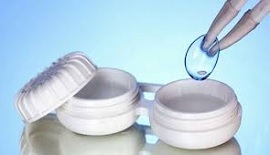 – Do not share your contact lenses (colored lenses) with your friends.
– Wash your hands frequently.
– Wear swimming goggles in the pool and sea.
– Prefer hydrogen peroxide-containing solutions for lens care.
– Keep your contact lenses clean and strictly follow replacement schedules.
– Do not wear expired contact lenses.
– Avoid using public restrooms and showers if possible.
– Remove your lenses before showering and bathing.
– Do not sleep with contact lenses.
If you experience at least two of the following symptoms, be sure to consult an ophthalmologist: persistent itching in the eyes, excessive tearing, extreme sensitivity to light, swelling in the upper eyelids, and a feeling of eye pain. In cases of eye-eating parasites, intensive treatment is carried out using eye drops every 20 minutes for up to three weeks, and corneal transplantation is performed in severe cases.
Pharmacists should also remind contact lens wearers of the following recommendations:
- Always wash your hands before handling contact lenses
- Rub and rinse the contact lens surface before use
- Use only sterile products recommended by physicians and pharmacists to clean and disinfect your lenses
- Use fresh solution for lens care
- Do not wear contact lenses unless prescribed by your doctor, do not sleep in lenses, and never wear them after swimming
- Do not swap lenses with others
- Never put contact lenses in your mouth.
In the treatment of Acanthamoeba keratitis; polyhexamethylene biguanide, propamidine isethionate, and combinations of propamidine, miconazole nitrate, and neomycin along with chlorhexidine are used.
Chlorhexidine was previously used intraocularly at a concentration of 0.1% for bacterial conjunctivitis. 0.1% Chlorhexidine eye drops were discontinued in 1997 due to the availability of adequate treatment alternatives for bacterial conjunctivitis. Today, 0.02% and 0.04% eye drops are still used for Acanthamoeba keratitis.
When preparing eye drops with 0.02% chlorhexidine digluconate, the quantity of the 20% chlorhexidine digluconate solution to be used should be adjusted.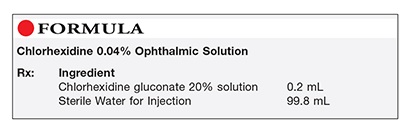
Ingredients in the formula:
Chlorhexidine digluconate – Chlorhexidin digluconat [INN; KVO-EU] – Chlorhexidine digluconate [INCI]:According to the British Pharmacopoeia (BP), chlorhexidine gluconate solution is an almost colorless or pale yellow liquid. It is miscible with glacial acetic acid and with water. It is miscible with anhydrous alcohol up to five times its volume. Soluble in alcohol and acetone; the pH of a 5% aqueous solution is between 5.5 and 7.0. Commercial 5% solutions contain a nonionic surfactant to prevent precipitation upon dilution. Such solutions are not suitable for use in body cavities. For this purpose, dilutions should be prepared from a 20% concentrate solution. Commercial concentrated solutions can be sterilized by autoclaving.
Chlorhexidine salts are incompatible with soaps, other anionic substances, and suspending agents such as alginates and tragacanth. Chlorhexidine acetate is incompatible with potassium iodide. Chlorhexidine salts (0.05%) exhibit incompatibility by forming poorly soluble salts with borates, bicarbonates, carbonates, chlorides, citrates, nitrates, phosphates, and sulfates. These salts are generally soluble at dilutions of 0.01% or lower. Insoluble salts may form in hard water.
Chlorhexidine is a topically used antiseptic and disinfectant with a bisbiguanide structure. It is used as a mouthwash in the treatment of gingivitis and periodontitis, for surgical disinfection, healthcare personnel hand hygiene, preoperative skin preparation, wound cleansing, general cleansing, and the treatment of acne vulgaris. Other indications for chlorhexidine include the treatment of oral infections, denture stomatitis, ulcerative stomatitis, and acute necrotizing ulcerative gingivitis. Mouthwashes containing chlorhexidine are used in the prophylaxis and treatment of mucositis in patients undergoing chemotherapy. Chlorhexidine is also incorporated into intravenous catheters, topical antimicrobial wound dressings, and various surgical materials.
Chlorhexidine gluconate should be stored protected from light.Pyrogen-free distilled water- Wasser für Injektionszwecke [ASK; Ph.Eur.]- Water for injections [BP; USAN; USP]:Water for injections is a pyrogen-free, clear, and colorless liquid with no distinct taste. In the United States Pharmacopeia (USP XXII), it is defined as purified water obtained by distillation or reverse osmosis methods. It contains no added substances. In the British Pharmacopoeia (BP 1993) and the European Pharmacopoeia (Ph. Eur. 1990), it is listed under the heading “Water for Injections” and consists of two parts. These are “Water for Injections in Bulk”, used in the preparation of parenteral formulations, and “Sterilised Water for Injections”, used for dissolving or diluting substances or preparations prior to parenteral administration. Water has a specific gravity of 0.9971 at room temperature, a melting point of 0°C, and a boiling point of 100°C. It is miscible with most polar solvents and is chemically stable in all physical states (ice, liquid, and vapor).Preparation of the formula:This formulation must be prepared under aseptic conditions by a pharmacist using aseptic compounding techniques in a cleanroom laminar airflow cabinet or with isolation barrier technology. This is a high-risk preparation.
Calculate the quantity of each ingredient for the amount to be prepared. Aseptically, accurately calculate and measure the chlorhexidine gluconate, bring to the desired volume by adding sterile water for injection, and mix thoroughly. Filter through a membrane filter into a sterile container. Package and label.Use:This preparation has been used as an alternative to polyhexamethylene biguanide in the treatment of Acanthamoeba keratitis.Packaging:Package in tight, light-resistant containers. Chlorhexidine gluconate must be protected from light and stored at controlled room temperature.Labeling:Keep out of the reach of children. Must be consumed within 10 days after opening. Store at room temperature.Stability:For proper use, refer to the current edition of the United States Pharmacopeia.Quality Control:Quality control assessment should evaluate weight / volume, physical observation, pH, specific gravity, osmolality, assay, color, clarity, particulate matter, and sterility values.Discussion: Although this preparation is approved as a mouthwash and topical disinfectant for the treatment of dental infections and/or inflammatory conditions, its off-label use includes ophthalmic applications in the treatment of Acanthamoeba keratitis.References:1.United States Pharmacopeia 38 / National Formulary 33. Rockville, MD: United States Pharmacopeial Convention, Inc; 2014: 559-611,1928.
2. Allen LV Jr. Standard operating procedure for particulate testing for sterile products.IJPC. 1998; 2: 78.
3. Allen LV Jr. Standard operating procedure: quality assessment for injectable solutions.IJPC. 1999; 3: 406-407.
4. Tirado-Angel J, Gabriel MM, Wilson LA, Ahearn DG. In vitro effects of polyhexamethylene biguanide and chlorhexidine on fourAcanthamoeba species.Curr Eye Res. 1996; 15: 225-228.
5. Awwad ST, Petroll WM, McCulley JP, Cavanagh HD.Acanthamoeba keratitis updates.Eye Contact Lens.2007; 33: 1-8.
6. Dubash D, Shah U. Water. In: Rowe RC, Sheskey PJ, Cook WG, Quinn ME.Handbook of Pharmaceutical Excipients. 7th ed. Washington, DC: American Pharmacists Association; 2012: 880-884.
Exp. Pharm. Ahmet Nezihi Pekcan
Pekcan Pharmacy – Konya
[email protected]
Tel: (332) 3520657http://www.majistralformul.com/