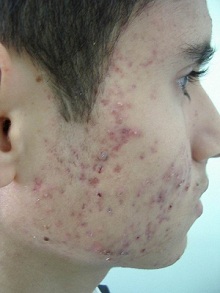
 The alcoholic salicylic acid solution included in the German Standard Formulas is used in concentrations of 5% and 10% in the treatment of acne comedones and papulopustular acne.
Acne vulgaris occurs as a result of the accumulation of keratin, epithelial cell debris, and sebum within a dilated skin sac (follicle) whose opening is blocked.
Papulopustular acne = Acne consisting of papules and pustules. Acne initially begins in the form of blackheads, whiteheads, and roughness on the skin known as comedones. Plugs seen as white lipid spots under the skin are called closed comedones, while those appearing on the surface as black spots are called open comedones. Subsequently, red-pink, firm, elevated inflammatory papules less than 5 mm in diameter begin to form. In the 3rd stage of the disease, bumps filled with yellow-white fluid with inflamed tips (pustules) are added to the clinical picture. In advanced acne disease, nodules-cysts are observed. The diameter of nodules and cysts can reach up to an average of 1 cm, and because they are located deeply, their contents cannot drain to the surface.
In the stages of acne development, there are two distinct types of comedones: open and closed.
Open comedone (blackhead) = Described as a wide-mouthed comedone covered with a black cap composed of epithelial debris on the skin surface, whereas
Closed comedone (whitehead) = Defined as a comedone on the skin surface whose orifice is narrowed or obstructed. Closed comedones can rupture and lead to mild inflammatory skin reactions.
In high concentrations such as 5–10%, salicylic acid exerts a comedolytic effect by alleviating follicular keratosis and through its antimicrobial action against Propionibacterium acnes in the infundibulum. Salicylic acid demonstrates pronounced concentration-dependent keratolytic, anti-inflammatory, antifungal, and antibacterial effects. It penetrates the skin only in its acid form. Alcoholic Salicylic Solution 10% for Acne is applied to the affected skin area several times a day. Prior to application, the skin should be washed with soap and water. The application is performed by wiping with a piece of cotton wool or a clean cloth. The applied solution is left to air dry. Alcoholic Salicylic Solution 10% used in acne treatment is contraindicated during pregnancy and lactation.
| Ingredient | 5% | 10% |
|---|---|---|
| Salicylsäure | 5.0 g | 10.0 g |
| Propylenglycol | 10.0 g | 10.0 g |
| 2-Propanol | 40.0 g | 40.0 g |
| Gereinigtes Wasser | to 100.0 g | to 100.0 g |
Ingredients in the formula:
Salicylic acid is a white or colorless acicular crystalline or white fluffy crystalline powder. Its synthetic form is white and odorless. When prepared from natural methyl salicylate, it has a light yellow or pale pink color and a faint mint odor. It dissolves in water at 1:460, boiling water at 1:15, alcohol and ether at 1:3, and chloroform at 1:45.
Salicylic acid is a keratolytic agent. It is used in the treatment of hyperkeratotic and scaling skin conditions such as dandruff, seborrheic dermatitis, ichthyosis, psoriasis, and acne. Solutions and ointments used for this purpose are available. Salicylic acid accelerates desquamation. It exhibits a mild fungicidal effect. Salicylic acid is rapidly absorbed through the skin and eliminated slowly in the urine. Systemic acute salicylate toxicity (salicylism) may occur due to excessive application of salicylic acid over extensive skin surfaces. Fatalities, predominantly in children, have been reported resulting from such inappropriate applications. To minimize the risk of systemic absorption associated with topical application, salicylic acid should not be used for extended periods or in high concentrations, and its application to extensive body surface areas or to inflamed or broken skin should be avoided.
Salicylic acid is a beta hydroxy acid (BHA) with the chemical formula C6H4(OH)CO2H. This colorless, crystalline organic acid is commonly used as a plant hormone. It is a product of salicin metabolism. It possesses chemical properties similar to acetylsalicylic acid, known as aspirin. It is used in the treatment of fungal infections such as tinea barbae, tinea capitis, and tinea cruris. Due to its sufficiently potent analgesic, antipyretic, and rare antiseptic effects, it is included in formulas and used externally as an analgesic in rheumatic applications. It is preferred against mycotic eczema due to its caustic effect. In dermatology, salicylic acid is frequently used in combination with lactic acid for the treatment of warts and corns. The exact mechanism of action of salicylic acid and lactic acid in wart treatment is not fully understood. It is considered to be related to the mechanical removal of wart-virus-infected epidermal cells as a result of their keratolytic actions. They are also effective against corns through their keratolytic activity. It is used as a gargle in the treatment of tonsillitis. It is used at a dose of 0.50% against fermentation in foods such as beer, wine, meat, etc.
Propylene glycol is a clear, colorless, odorless or faintly odorous, hygroscopic liquid with a slightly characteristic taste. It is miscible with water, acetone, alcohol, and chloroform; soluble in ether; immiscible with fixed oils, but dissolves certain essential oils. It should be stored in a cool place and in airtight containers. It must be protected from light and moisture.
Propylene glycol is an excipient used for various purposes in pharmaceutical preparations. It is used especially as a solvent and vehicle for drugs that are unstable or insoluble in aqueous media. It is a superior solvent to glycerin. It is an excellent solvent for corticosteroids, phenols, sulfa group drugs, barbiturates, vitamins A and D, alkaloids, and local anesthetics. In addition to being used as a stabilizer in vitamin preparations, it is also useful as a plasticizer and preservative. It is used as a carrier for emulsifiers in cosmetic products and the food industry. It is preferred over ethanol in transporting flavoring agents. Due to its moisturizing property, it is used instead of glycerin in topical moisturizing preparations.
Propylene glycol can cause local irritation on the skin and mucous membranes. Hypersensitivity reactions have been reported. Particularly in patients with renal failure, it may cause hyperosmolality, lactic acidosis, and central nervous system depression. The estimated acceptable maximum daily intake of propylene glycol has been reported as 25 mg per kg of body weight.
At elevated temperatures, it tends to oxidize to form degradation products such as propionaldehyde, lactic acid, pyruvic acid, and acetic acid. It is incompatible with oxidizing agents such as potassium permanganate. It is recommended not to be used as a solvent in ear drops containing chloramphenicol.
Isopropyl alcohol is a clear, colorless, mobile, volatile, highly flammable liquid with a characteristic alcoholic odor. It is miscible with water, alcohol, chloroform, and ether. Isopropyl alcohol should be stored at room temperature below 30°C and in tightly closed containers. It must be protected from light.
Isopropyl alcohol is an antiseptic displaying bactericidal properties similar to alcohol in terms of efficacy. In publications of the World Health Organization (WHO) regarding sterilization and disinfection methods effective against HIV, it has been reported that 70% isopropyl alcohol can be used for the disinfection of living tissues. Its 60–70% solutions are used for preoperative skin antisepsis. Furthermore, it is included in the formulation of preparations used for hand and surface disinfection. Its potent degreasing property prevents its preparations from being used at frequent intervals. It is used as a solvent in the cosmetics and perfume industry and as a carrier for other disinfectants. Propyl alcohol can also be used as an antiseptic.
In pharmacy, water should be understood as distilled water. The shelf life of distilled water is limited. In any case, it must be boiled before use. Because additional specific properties are required for water to be used in parenteral preparations, water for injection must be used for this purpose. In addition, deionized water may also be used instead of distilled water in pharmaceutical preparations where its use is permitted, as it is cheaper and more easily obtained.
Distilled water is high-purity water prepared by the distillation of drinking water and used as a solvent or vehicle in many pharmaceutical formulations. It is a clear and colorless liquid without any characteristic odor or taste.
| Ingredient | 5% | 10% |
|---|---|---|
| Salicylsäure | 5.0 g | 10.0 g |
| Propylenglycol | 10.0 g | 10.0 g |
| 2-Propanol | 40.0 g | 40.0 g |
| Gereinigtes Wasser | to 100.0 g | to 100.0 g |
Preparation of the Formula:
Salicylic acid is dissolved in a mixture of 2-propanol and propylene glycol by stirring in a tared beaker containing a glass stirring rod. Heat is not applied during dissolution. Distilled water is then added to this solution. While the shelf life of the unopened stock solution is 1 year in an amber glass bottle, it can be used for 6 months in a glass bottle after opening.
Wishing you a great week…