Dear Colleagues, every week I reach out to you with articles containing magistral formulas under a specific topic. While considering the content of this week’s article, the heavy volume of phone calls and emails I received during the week had already determined this week’s topic. Our colleagues were utterly bewildered by a notice they received from the SSI (Social Security Institution), and while inundating me with emails and phone calls out of concern that similar practices might occur in the future, they were also outraged by what they felt was an injustice. The notice received by our colleagues from the SSI states verbatim…
The notice, where the subject is stated as pantocaine, continues with the following lines;
“Based on the examination report prepared as a result of the investigation carried out by our Institution’s Guidance and Inspection Department and the approval of the Presidency Office regarding the report, taking as a basis the opinion stated in the letter dated … and numbered … from the Faculty of Pharmacy of …… University that ‘the active substance named pantocaine can be used in topical prescriptions at a concentration of 0.5-1% due to its local anesthetic properties, and additionally at a concentration of 4% as a percutaneous local anesthetic in venous cannulation’, it is decided that payments made for compounded medications containing the active substance pantocaine billed to our Institution shall be collected jointly and severally along with legal interest from the physicians who prescribed high concentrations and from the pharmacies that billed them to the Institution due to faulty prescription compositions” it is stated.
Now, we need to address the issue that caused this notice—which will be widely debated and likely taken to court in the coming period—from several perspectives;
From the perspective of our universities;
The opinions expressed by the universities that educated us are, of course, indisputable as they are based on scientific references. Presumably, a question was directed to the university for this opinion obtained from the relevant faculty’s Department of Pharmacology, but the exact content of the question is not clearly understood from this notice. Furthermore, it is of great importance that a scientific committee formed with the participation of various universities begins its duty as soon as possible to evaluate clawbacks, disputes, and objections that may arise in the audit of prescriptions containing magistral formulations.
From the perspective of the Institution;
It is the responsibility of the institution to enter the dosage limits of the active substances in magistral formulations used in the treatment of different diseases into the system and prevent these limits from being exceeded. In other words, a separate Health Implementation Communiqué (SUT) is required for Magistral Formulations. Applying retroactive deductions in this regard does not seem very fair either. To give an example of this practice: imagine a street with no speed limit where drivers can drive at whatever speed they want, then a decision is made to initiate radar speed enforcement, and from retroactive records, fines start raining down on the addresses of drivers who exceeded this limit in the past. This is precisely the summary of the situation.
When it comes to us, the pharmacists;
To be honest, we are quite confused. In the emails I received, examples of proprietary and magistral formulas where different forms of the active substance named Tetracaine are used in varying doses are quite remarkable. If you like, let us first share some information about tetracaine .
Tetracaine – Amethocaine – Pantocaine;
Tetracaine is an ester-type, long-acting local anesthetic. It is considered the most toxic local anesthetic drug compared to other local anesthetics. It has various injectable forms for spinal anesthesia and preparations suitable for topical use. These preparations are typically used for local analgesia and prevention of laryngeal and esophageal reflexes prior to examinations of the larynx, trachea, or esophagus. Additionally, Herpes labialis can also be used for the palliative relief of pain caused by it.
What is topical tetracaine?
Tetracaine exerts its local anesthetic effect by blocking nerve endings in our body.
(Application on the skin) topical tetracaine is used for medical tests or procedures that require skin anesthesia.
Excessively high doses may cause fatal effects as a result of the drug being absorbed through the skin into the bloodstream (for example, during cosmetic procedures such as laser hair removal). If the medication is used without a doctor’s recommendation, overdose symptoms such as irregular heartbeats, convulsions, coma, slowed breathing, or respiratory failure may occur.
If there is an allergy to tetracaine or anesthetic drugs similar to lidocaine, benzocaine, or prilocaine, these medications should not be used.
If tetracaine is to be used safely, it is important for the patient to share the following past or current medical conditions with their doctor;
history of brain or spinal cord injury;
heart disease;
circulatory disorder;
eye problems;
or the doctor must be informed about the presence of open wounds or skin lesions in the area where the drug will be applied.
Pregnancy Category C (FDA). It is unknown whether topical application of tetracaine harms an unborn baby. If you are pregnant or planning to become pregnant while using this medication, you must inform your doctor.
It is unknown whether topical application of tetracaine passes into breast milk.
Now let us give examples of tetracaine forms used throughout the world;
PLIAGLIS™ (lidocaine 7% and tetracaine 7%) is in emulsion form. It has eutectic mixture properties and provides a topical local anesthetic effect. It has a melting point below room temperature, and therefore this formulation containing two local anesthetics exists as crystals rather than a liquid oil form.
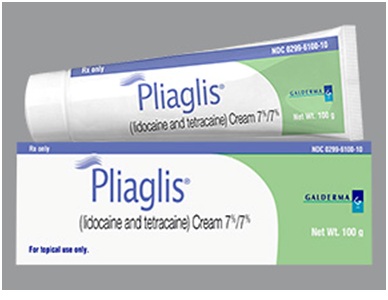


Indication: PLIAGLIS ® (lidocaine and tetracaine) Cream 7% / 7% is indicated for use on intact skin in adults to provide topical local analgesia for superficial dermatological procedures such as dermal filler injection, tattoo removal, laser therapy, and laser facial skin resurfacing.
Contraindications: PLIAGLIS ® Cream is contraindicated in patients with a history of sensitivity to lidocaine, tetracaine, or local anesthetics of the amide or ester type, and is also contraindicated in patients with sensitivity to para-aminobenzoic acid (PABA). In clinical studies, the most common local reactions observed were erythema (47%), skin discoloration (16%), and edema (14%). Patients exhibiting symptoms of methemoglobinemia have been shown to be associated. with the use of tetracaine local anesthetic. The most common systemic adverse events are headache, vomiting, dizziness, and fever. PLIAGLIS ® Cream should be used with caution in patients with severe hepatic disease. When using PLIAGLIS ® cream concurrently with other local anesthetic agents, the potential for additive systemic toxic effects dependent on the total anesthetic dose must be considered. Contact with the eyes should be avoided.
Pliaglis ® Cream has a rapid and long-lasting effect. It is known to be the first and only FDA-approved topical anesthetic composed of two potent ingredients, lidocaine and tetracaine, combining these active substances at high concentrations.
Pharmacology for Dentistry
Author: Tara Shanbhag, Smita Shenoy, Veena Nayak
drugs acting on the central nervous system

When local anesthesia is intended in the oral cavity, nose, throat, upper respiratory tract, esophagus, urinary tract, ulcers, burns, etc., tetracaine 2%, lignocaine 2-10%, benzocaine 1-2% are used. They are available as surface anesthetics such as solution, ointment, gel, patch, cream, spray, and lozenge.
Tetracaine is used to reduce the gag reflex. It shows rapid mucosal absorption in the mouth. Due to high systemic toxicity, its use for anesthesia in the oral cavity is limited. The maximum recommended dose applied topically is a 2% tetracaine solution.
In veterinary medicine:
BENZOCAINE/LIDOCAINE/TETRACAINE: CREAM
Benzocaine / Lidocaine / Tetracaine
Topical Anesthesia
The dosage form available for Benzocaine / Lidocaine / Tetracaine is in the form of a Cream, and the formula contains;
Benzocaine 20%
Lidocaine 10%
Tetracaine 20%.
.jpg)
Now looking at the examples above, I do not want to comment too much. We know that the reason for the dosage controversy regarding tetracaine is due to certain abuses; however,
Abusus non tollit usum
Abuse does not preclude proper use. (that is, when something is abused, it should not invalidate its proper use)
When writing this week’s article, the title of my piece was DO NOT DO IT.
Indeed;
First of all, I appeal to those who cause abuse… Do not do it…
Then… To those who take advantage of this abuse and send these notices—which undermine the morale and motivation while economically tormenting our colleagues who struggle to survive under increasingly difficult economic conditions day by day, and whose only concern is to dispense the prescriptions brought to their pharmacies and serve their patients—I appeal to you… Do not do it…
Look, as a consequence of this, you will unfortunately not be able to find any pharmacy to compound Magistral formulations, which are already prescribed and prepared less and less each day due to well-known reasons. An art is on the verge of extinction…
DO NOT DO IT!
Spec. Pharm. Ahmet Nezihi Pekcan
Pekcan Pharmacy – Konya
[email protected]
Tel: (332) 3520657
http://www.majistralformul.com/