Seborrhea of the scalp and hair shampoo used in treatmentThe scalp is the most common body site for seborrheic dermatitis. It is defined as a hyperactive state marked by excessive sebum production by the sebaceous glands. Seborrheic dermatitis is a chronic, relapsing inflammatory skin disease characterized by poorly demarcated, scaly, erythematous (red) patches. It usually appears after puberty and persists for many years with periods of exacerbation and remission. It is more commonly observed in men aged 20–40. Although the etiology of seborrheic dermatitis is not fully understood, factors such as Malassezia yeasts, hormones (androgens), sebum levels, and immune response are known to play a role in the pathogenesis of the disease. Medications, climate variations such as ambient temperature and humidity, dietary patterns, atopy, pressure changes, neurological conditions, microangiopathic vascular changes, alcohol consumption, metabolic changes, fatigue and stress, as well as riboflavin, pyridoxine, and biotin deficiencies can exacerbate seborrheic dermatitis.
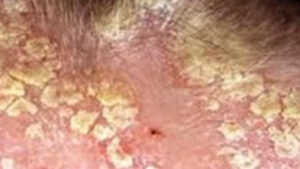
While simple dandruff on the scalp is the most well-known symptom of seborrheic dermatitis, greasy-looking yellow crusts subsequently form on erythematous lesions ranging from the size of a lentil to a coin. These can coalesce to cover larger areas. Seborrheic dermatitis observed on the scalp in infants is referred to as cradle cap. Due to the influence of maternal androgen hormones transferred to the baby, seborrheic dermatitis can occur in infants.
Although the role of sebum in the development of seborrheic dermatitis is recognized, a significant increase in sebum levels or sebum excretion rates has not been observed in patients. It is a disease that predominantly affects areas rich in sebaceous glands. In particular, it affects the scalp, eyebrows, forehead, eyelid margins, mid-facial region, beard area, postauricular area, retroauricular groove, neck, mid-chest, mid-back, intertriginous folds, and the genital area.
Seborrheic dermatitis does not cause hair loss. However, in male pattern hair loss known as androgenetic alopecia, sebum secretion on the scalp increases due to elevated androgenic activity. In this case, the primary condition is androgenetic alopecia, and seborrheic dermatitis accompanies it secondarily.
Although the condition generally responds to topical therapies, it can sometimes exacerbate despite treatment, affecting the patient’s daily life and necessitating systemic medications. The primary point that must be explained to patients is that the disease is recurrent. Even if it resolves with treatment, it may recur. Treatment encompasses resolving the condition as well as preventive measures to prevent relapse or achieve longer disease-free intervals. Various modalities are utilized in the management of the disease.
In this week’s article, we will examine a formulation included in the Spanish National Formulary used in the treatment of seborrheic dermatitis.Rp
Saponified coal tar 10 %
Cetrimide 2 %
Ketoconazole 2 %
Tegobetaine 45 %
Distilled water q.s. 250 c.c.
Substances included in the formula
Coaltar saponificado – Coal tar – Goudron de Houille – Coal tar – Pix Carbonis – Pix Lithanthracis – Steinkohlenteer;It is prepared by the dry distillation of coal. It has a naphthalene-like odor and a burning, pungent taste. It is a dense, near-black liquid. It solidifies upon contact with air. It is slightly soluble in water. While soluble in chloroform and benzene, it is partially soluble in alcohol and ether. Its density gradually increases with exposure to air. It burns with a luminous, sooty flame. Its saturated solution gives an alkaline reaction to litmus. Coal tar is included in the composition of medicated shampoos, soaps, and ointments used to treat dandruff and psoriasis, as well as to kill and eradicate head lice. Soluble extracts (2%) prepared by the dry distillation of coal tar are also used in the treatment of dandruff. Tars and tar oils reduce the thickness of the epidermis. They are antipruritic and exhibit a weak antiseptic effect. They are used topically in the treatment of eczema, psoriasis, dandruff, seborrheic dermatitis, and other skin diseases. Coal tar preparations have largely been replaced by wood tars. Ultraviolet light increases the efficacy of coal tar in the treatment of psoriasis. Some wood tars are included in the composition of expectorant preparations. Tar has also been used in homeopathic medicine.Cetrimide – cetrimida – cetrimidum – zetrimid – cetrimide:It is a white or almost white, voluminous, free-flowing, combustible powder with a characteristic odor. Freely soluble in water, alcohol, and chloroform; practically insoluble in ether. A 2.0% w/v solution in carbon dioxide-free water foams strongly when shaken. It is incompatible with soaps and other anionic surfactants, bentonite, iodine, phenylmercuric nitrate, and alkali hydroxides. Its aqueous solutions react with metals. According to the British Pharmacopoeia (BP), Strong Cetrimide Solution (Strong Cetrimide Solution BP 1993) contains 20–40% cetrimide and up to 10% alcohol or isopropyl alcohol, or both, as a preservative. For use, a 1% aqueous solution is prepared from this concentrated solution. This prepared solution can be sterilized by autoclaving. Sterilized preparations must be used within 7 days after opening and discarded if this period is exceeded. Cetrimide is a quaternary ammonium antiseptic. It exhibits a bactericidal effect against Gram-positive and (at high concentrations) Gram-negative bacteria. However, especially certainPseudomonasspecies andMycobacterium tuberculosisare resistant to quaternary ammonium compounds, including cetrimide. Cetrimide is ineffective against bacterial spores. Its antifungal activity is variable, and it may be effective against some viruses. Like other quaternary ammonium compounds, primarily benzalkonium chloride, it is used for washing and cleansing skin, wounds, and burns. For this purpose, 0.1–1% solutions or 0.5% creams are used. Its solutions are generally prepared by dilution from more concentrated solutions. Cetrimide is often used not alone, but in combination with chlorhexidine. This combination is useful in lotion form for the treatment of acne. Cetrimide and benzalkonium chloride are also included in the formulation of eye drops and solutions used for cleaning hard contact lenses, but they should not be used for the same purpose on soft contact lenses.
In addition, hair shampoos containing 1-3% cetrimide are used against dandruff in cases of seborrheic dermatitis. Cetrimide is also included in the composition of some emulsifying preparations. Cetrimide is a quaternary ammonium antiseptic. Quaternary ammonium salts are used as antiseptics and disinfectants. In general, cationic detergents exert a bacteriostatic effect, but they also exhibit a bactericidal effect when applied at sufficiently high concentrations. They exert their antibacterial effects through their surfactant action by disrupting the permeability of the bacterial cytoplasmic membrane. However, their antimicrobial spectrum is not very broad. They show a stronger effect on Gram-positive bacteria than on Gram-negative bacteria. Their fungistatic activity is low. They are also active against some viruses.Mycobacterium tuberculosisand are ineffective against bacterial spores. It may cause skin irritation.Ketoconazol- Ketoconazole- Ketoconazolum ;Ketoconazole is a white or almost white powder. It is practically insoluble in water; sparingly soluble in alcohol; soluble in methyl alcohol; freely soluble in methylene chloride. Ketoconazole is an imidazole-group antifungal drug. Other antifungal drugs in this group include clotrimazole, fluconazole, itraconazole, miconazole, and many other topical drugs. Among these, ketoconazole is the only drug capable of inhibiting the synthesis of adrenal steroids at doses higher than those required for antifungal activity. Like other antifungal drugs, ketoconazole exerts its effect on the fungal cell membrane. At higher concentrations, ketoconazole also exerts a direct physicochemical effect on the fungal cell membrane, thereby demonstrating a fungicidal effect. Topical ketoconazole does not undergo significant systemic absorption. However, repeated use of its 2% shampoo leads to the absorption of ketoconazole into hair keratin.Tegobetaine- Alkylamido betaine;It is amidopropyl betaine. A light yellow liquid with a characteristic odor, it is included in cleansing and shampoo formulations due to its amphoteric detergent foaming and cleansing properties. It is well tolerated by the skin. Dimethylaminopropylamine is first obtained as a result of the reaction of coconut oil and fatty acids, and tegobetaine is obtained in subsequent reactions. It is used in liquid hygiene products (gels, shampoos, dental hygiene…). It is preferred as a vehicle base for hair formulations with bacteriostatic and fungistatic properties. It gives vitality and shine to the hair.Preparation of the formulationCetrimide is dissolved in boiled and cooled distilled water. Coal tar is mixed with Tegobetaine. Ketoconazole is dissolved with a minimal amount of alcohol and mixed with the coal tar coconut extract shampoo (tegobetaine). By adding the distilled water in which cetrimide was dissolved, the shampoo is prepared to a total volume of 250 cc.
Hair is washed two to three times a week.
Wishing you a good week…SourceLa Formulación Magistral En La Oficina De Farmacia 3.a Parte, Valencia, 1990 (page 176-177)
Spec. Pharm. Ahmet Nezihi Pekcan
Pekcan Pharmacy – Konya
[email protected]
Tel: (332) 3520657http://www.majistralformul.com/