Alopecia areata is currently one of the leading patient complaints encountered by dermatologists. When selecting a therapy, the dermatologist must first
consider the extent of hair loss, the patient’s age, psychological factors, prognostic factors, and the risks and benefits of the intended treatment. This is because, following various treatments applied for this condition, spontaneous remission periods may occur, making the likelihood of recurrence difficult to determine.
Although achieving definitive results following various local treatments is generally challenging, intralesional corticosteroid applications and immunotherapy treatment methods remain among the most effective and current local therapies.
Systemic treatment applications in Alopecia Areata;

Finasteride;
Finasteride is a nonsteroidal anti-androgen that prevents hair loss. By blocking the type II 5-alpha reductase enzyme, it prevents testosterone from converting into dihydrotestosterone, its most active metabolite that weakens hair follicles and causes shedding. The efficacy of finasteride in men has been found effective at a 1 mg dosage; however, its use is limited to men, and its use in women remains controversial. Finasteride is approved for treatment in men over 18 years of age, and its peak effect is observed in men after one year. In women, (Trueb70) demonstrated that finasteride was effective at a dose of 2.5 mg in the treatment of postmenopausal androgenetic alopecia. However, this study was conducted on a very limited number of women, and hyperandrogenic effects are effective at a 2.5 mg dose. (Lorizzo and co-workers 71)
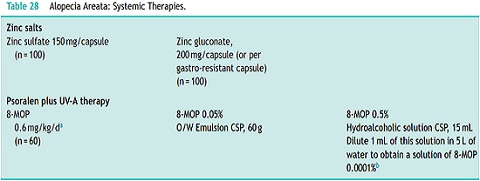
In systemic treatments; systemic corticosteroids, cyclosporine, sulfasalazine, and
methotrexate forms (Table 28) are also widely used.
In the treatment of alopecia areata; promising results have been reported with zinc salt treatments. Formulations containing zinc gluconate, aspartate, and sulfate have been used. (Park and co-workers 85)
Adjuvant therapy is of great importance for patients with alopecia areata. Minerals such as zinc gluconate (200 mg/day) are recommended. While lower serum levels are provided in adjuvant therapy, higher doses are recommended for alopecia areata patients. In addition, commercial vitamin supplements may also be used. If patients need to take these supplements, they should take them after meals against the possibility of developing gastrointestinal intolerance. For this reason, they can be presented in enteric capsules.
Topical applications in Alopecia Areata;

Abbreviations:
CSP= quantity sufficient to make up to,
DMSO= A sterile compounded product (dimethyl sulfoxide); a highly polar substance with exceptional properties for increasing the solubility of organic and inorganic compounds. It is a widely used industrial solvent. It has been reported to exhibit numerous and diverse pharmacological effects such as biological membrane penetration enhancer, anti-inflammatory, local anesthetic, weak bacteriostatic, diuretic, vasodilator, collagen-dissolving, and free-radical scavenger.
W / O=Water in oil.
Substances included in the formulas;
DMSO;
Optionally added to increase corticosteroid absorption.
Although its use in alopecia areata is controversial; there are studies showing that corticosteroids and anthralin are effective in minoxidil formulations through controlled clinical trials (Lacking.73). For this reason, it is widely used. (Table 27).
Benzoyl peroxide;
Benzoyl peroxide has been reported to be beneficial for local use due to its irritant effect. Controlled clinical studies for alopecia areata patches (Trials 73) have shown it to be effective at higher concentrations than those used for acne treatment. It can also be used in pediatric patients.
Dithranol (anthralin);
In a series of case reports with topical dithranol, it was shown to be effective without controlled studies. (Patients 74). Its effect has been reported as immunomodulatory and irritant. Dithranol should be applied overnight at a concentration between 0.25% and 0.5%. Hair follicles stimulated by the irritant effect of dithranol should be exposed to the skin for a shorter duration at other higher concentrations, for example, at a 1% dose.
To minimize side effects, the short-contact option is preferred. Formulations should be prepared oily. In such formulas, ointments with an oily external phase should be prepared; pure petrolatum or Lassar’s paste is frequently preferred as the oily phase. Thus, the irritant effect of dithranol can be controlled at the application site, and salicylic acid included in the formula will enhance its efficacy by preventing the degradation of dithranol through its antioxidant effect.
Topical corticosteroids;
Although potent corticosteroids have limited efficacy and their use is controversial, studies have reported that they are ineffective as monotherapy but effective in multifocal alopecia areata. (Widespread 75). In hydroalcoholic gels or semi-liquid vehicles, it is possible to facilitate focal application of the formula. Corticosteroids combined with minoxidil may exhibit a synergistic effect.
(Tosti and co-workers76) reported a positive response in alopecia areata types termed totalis or universalis treated with 0.05% Clobetasol propionate. In formulation applications, folliculitis may particularly occur in universalis patients. Telangiectasia and atrophy may also be observed, although rare.
These problems can be overcome using gel vehicles rather than emulsion forms.
Minoxidil;
It may be possible to create more potent formulations with topical corticosteroids, anthralin, and retinoic acid, which contribute to the known effects of minoxidil.
Additionally, in a study conducted with 3% topical minoxidil, minoxidil was found to be more effective in 63% of patients compared to 5% and 1%. (Reported 77). However, this effect has not been confirmed. Further studies are required.
Prostaglandin analogues;
Latanoprost 0.005% and bimatoprost 0.03% are being tested in treatment.
They are known to be effective in alopecia areata, especially seen on eyelashes, and are used by applying to the eyelid margin.
Diphenylcyclopropenone;
It is a preferred treatment method for adults for immunotherapy purposes and can be applied to a maximum of 50% of the scalp. The approach in this treatment is to periodically apply Diphenylcyclopropenone, considered a potent allergic contact dermatitis agent, to the scalp in order to trigger local sensitization. As one of the most effective non-mutagenic substances, diphenylcyclopropenone is used in 2% solution formulations because it is more stable in acetone against UV light.
For 2% solution use, diphenylcyclopropenone is prepared in an organic solvent (Acetone or petrolatum).
To determine the minimum concentration capable of eliciting a mild erythema response, the dose is gradually increased starting with applications of a very low concentration (0.0001%). Application can generally begin once a week, and depending on treatment response, it may be applied 2 or 3 times a week. With this approach, it has been proven effective in 50% to 60% of cases. However, relapse is common. To obtain an effective result, treatment should be continued for at least 6 months.
Photochemotherapy (PUVA);
There are uncontrolled studies investigating its efficacy, and response rates have been reported in combination with topical or oral psoralen. Some authors have published success rates of 80% to 82% for the treatment. (Low83)
As a compounded preparation in this treatment, a capsule containing psoralen is prepared for the patient at a dose of (0.6 mg/kg). Topical psoralen 0.0001% solution is used. (1 g/L)
For easy application over the affected area, 8-MOP can be prepared in a hydroalcoholic solution at rates of 0.5% in 5 L water or 0.05 L.
Psoralens are tricyclic furocoumarins found in the structure of many plants. However, today they can also be produced synthetically in laboratories.
The most commonly used psoralen is 8-MOP. Less commonly, 5-MOP and 4,5,8-TMP are also used.
8-MOP is easily absorbed after oral administration, distributed throughout all tissues and body fluids, and metabolized in the liver.
8-MOP is administered at 0.6 mg/kg, and 1–3 hours after ingestion—that is, when it peaks in plasma—the patient is exposed to UVA.
7–8 hours after 8-MOP ingestion, plasma levels return to normal, and after 12–24 hours, it is completely excreted in the urine.
PUVA therapy should be the treatment of last resort due to high recurrence rates and the risk of skin cancer.
Conclusions;
In the treatment of alopecia areata, the impact of extemporaneous formulations has increased significantly. It is a fact that the role and importance of extemporaneous formulations in dermatology are growing day by day. Based on the reality that formulations are modified according to the individual’s specific condition—in other words, personalized—we must recognize that physician-pharmacist communication is critical to the success of treatments administered to patients. In personalized formulas to be prescribed for the patient, it is essential for the physician to discuss the chemical agents in the extemporaneous formula with the pharmacist regarding their interactions, physical properties, incompatibilities, and formulation characteristics that will improve patient adherence when drafting the prescription.
With effective physician-pharmacist communication, there is no doubt that treatment quality will increase while costs decrease in terms of public health and public interest.
Now, both worldwide and in our country;
Communication between dermatologists and pharmacists—the masters of the art of therapy—is of paramount importance in the development and standardization of extemporaneous formulations in dermatology.
Wishing you a pleasant week…
References
1. Consejo General de Colegios de FARMACEUTICOS de España. La formulación magistral: una opción de futuro en España. FARMACEUTICOS. 2010; 360: 52 — 9.
2. USP Pharmacopeia. 35th ed. Monograph 795. Rockville, USA: United States Pharmacopeial Convention Inc; 2011.
3. Consejo de Europa. Resolución CM / ResAP (2011) 1. Exigencias relativas a la garantía de calidad y de inocuidad de los medicamentos preparados en las farmacias para las necesidades especiales de los pacientes. Estrasburgo, enero. [Cited 2012 February 23]. Http://www.cofares.es/File aspx? Key = FILES & Log = true & id = 23601
4. Ministerio de Sanidad, Consumo. Ley 29/2006 sobre garantías y uso racional del medicamento y productos sanitarios. BOE. 2006; 178.
5. Ministerio de Sanidad, Consumo. Real Decreto 175/2001 sobre Normas de correcta elaboración y control de calidad en formulaciones magistrales y preparados oficinales. BOE. 2001; 65.
6. Umbert P, Llambí F. Aporte de la formulación a la terapéutica actual. In: Umbert P, Salleras M, Sánchez-Regaña M, editors. La formulación en la dermatología del 2010. Barcelona: Acofarma Distribución SA; 2008. p. 15 — 7.
7. Llambí F. Desabastecimientos, formulación y criterios sanitarios. El FARMACEUTICO. 2011; 11: 35.
8. Llambí F. Nuevos vehículos en formulación dermatológica. In: Umbert P, Salleras M, Sánchez-Regaña M, editors. La formulación en la dermatología del 2010. Barcelona: Acofarma Distribución SA; 2008. p. 39 — 44.
Specialist Pharmacist Ahmet Nezihi Pekcan
Pekcan Pharmacy – Konya
[email protected]
Tel: (332) 3520657
http://www.majistralformul.com/