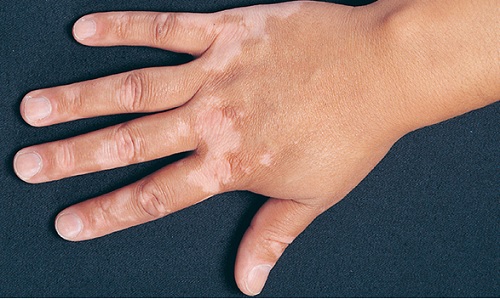
Khellin INN in the treatment of vitiligoVitiligo can be defined as a disease characterized by unpigmented, white patches of varying sizes on normally appearing skin areas, often showing a symmetrical distribution and with borders usually delimited by hyperpigmented areas. The hair in the affected area is also often white. The affected area of the skin is completely devoid of melanin pigment, and pigment cells, melanocytes, are not found in this region.
Khellin, used in the treatment of vitiligo, is an important component of the Ammi visnaga plant. The plant is used in folk medicine for various diseases. Khellin and visnagin are an organic heterocyclic compound and a furanochromone commonly found in ethnomedical formulations in Asia and the Middle East. (dimethoxy-4,9-methyl-oxo-5 5-H-furo [3,2-G] -4H)
Both compounds possess anti-inflammatory and analgesic properties. Their main effect is vasodilatory. They also play roles as bronchodilator agents, anti-asthmatic agents, and cardiovascular drugs. Therefore, modern medicine utilizes these compounds or structurally related derivatives for the treatment of vitiligo, bronchial asthma, and renal colic.
Kelina- Khellin- Khelline- Khellinum- Visammin;
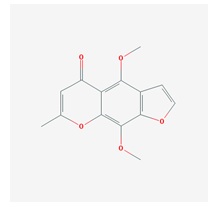
Khellin is a white crystalline powder. It is soluble in water, ether, methyl ethylene glycol, acetone, isopropanol, methanol, and chloroform. It should be stored in light-protected containers.
Khellin has been tested in the treatment of vitiligo in combination with Ultraviolet A light. (Martindale, Extra Pharmacopoeia, 30th ed, p1024)
It is a chromone chemically similar to psoralen, which forms the basis of PUVA. Clinically, it is safer and less harmful than Psoralen regarding cellular DNA damage. Khellin stimulates melanocyte activation, proliferation, migration, and melanogenesis. (Carlie, Ntusi et al., 2003).
In a study conducted; twenty-eight patients with vitiligo were treated with a novel photo-chemotherapeutic regimen using khellin, a furanochromone, as a photosensitizer in combination with ultraviolet A (UVA) irradiation. Twenty-five patients received oral khellin and three patients were treated with topical khellin. Treatments were administered three times a week. Unlike psoralens, khellin with UVA did not induce skin phototoxicity, but resulted in repigmentation similar to psoralens. Treatment success was dependent on the number of treatments. More than 70% repigmentation was achieved in 41% of patients who received 100 to 200 treatments. This success rate is comparable to that obtained with psoralens. Seven patients experienced a mild elevation in liver transaminases in the early treatment phase and their treatments were discontinued. No long-term internal organ or skin toxicity was observed. The main advantage of khellin is that it does not cause phototoxic skin erythema and can therefore be considered safe for home treatment. Due to its photochemistry, it can be regarded as less hazardous than psoralens in terms of mutagenicity and carcinogenicity.
It is used topically in concentrations of 0.1-4% for the treatment of vitiligo. Solutions prepared at 2% in 90% acetone and 10% propylene glycol are used in therapy. Patients with vitiligo can apply these solutions by spreading them onto the areas with vitiligo plaques and then exposing them to sunlight. This treatment should be carried out for four months with three weekly applications and approximately 90 minutes of sunlight exposure.
Despite their frequent use, the potential toxic properties of visnagin and khellin are not favorable. Many natural compounds modulate the expression and activity of cytochrome P450 1A1 (CYP1A1), well-known for its bioactivation of pro-carcinogens.
Khellin formula featured in the Spanish National Formulary;
Rp.
Kelina 3%
Gel add 30 g
Preparation of the formula:
Hydrogel used in the formula can be a commercially available neutral gel or can be prepared as a carbopol gel. Khellin is dissolved in alcohol and added to the previously prepared gel. It must be stored in an opaque bottle.
This formula is also indicated in alopecia areata through UVA radiation or sun exposure. It is applied topically before sunbathing followed by 10-15 minutes of sun exposure.
Source:
1-J Am Acad Dermatol. 1988 Apr;18(4 Pt 1):693-701.
Treatment of vitiligo with khellin and ultraviolet A.
Ortel B1, Tanew A, Hönigsmann H.
2-La Formulacion Magistral en la Oficina de Farmacia valencia, 3. Parte Valencia, 1990
3-RxMediaPharma®2018 Interactive Drug Information Source, 2018
Specialist Pharmacist Ahmet Nezihi Pekcan
Pekcan Pharmacy – Konya
[email protected]
Tel: (332) 3520657
http://www.majistralformul.com/