Dear Colleagues,
Skin hyperpigmentation resulting from the harmful effects of the sun, which emerge as the weather warms up, is among the topics I receive the most emails about.
The formula that forms the subject of my article this week is widely known in France under the name TRIO DEPIGMENTANT TYPE KLINGMANN and is prepared as a magistral formulation in pharmacies.(KLIGMAN’S TRIPLE DEPIGMENTING FORMULA)
First, let us briefly touch upon the main topics regarding skin spots.
Melasma
Melasma Gravidarum: Seen during pregnancy. It is also referred to as the mask of pregnancy. Melasma is mostly seen in women. Its prevalence in men is 10%. Melasma is more common in individuals with darker skin tones. They are generally brownish patch-like pigmentations on the upper cheeks, nose, and edges of the lips that expand over time. It occurs due to excessive melanin production in the skin. Although its exact cause is not definitively known, birth control pills, hormonal changes, and sun exposure are known to cause the condition. Melasma may disappear after pregnancy or persist for years or a lifetime.
In the treatment of melasma, sunscreens with a protection factor of over 30 against both ultraviolet A and ultraviolet B rays should be used. In addition, physical sunscreens containing titanium dioxide and zinc oxide, which physically reflect sun rays, can also be used.
Sunscreens should be used not only on sunny days, but regularly every day, provided they are applied twice a day. One is also exposed to ultraviolet light while walking on the street, driving, and sitting behind a window. Creams, cleansers, or makeup products that could irritate the skin should not be used as they can worsen melasma. If melasma began with the use of birth control pills, stopping the medication may resolve the melasma. The use of birth control pills can be continued by using skin-lightening creams. There are many skin-lightening creams used in the treatment of melasma. Rather than damaging melanocytes (the cells that give skin its color), these medications are effective by reducing the pigment production of melanocytes. The most widely used among these medications is hydroquinone. Formulas containing hydroquinone should be applied twice daily and must always be used in combination with sunscreens. In this article, we will examine the formula containing hydroquinone.
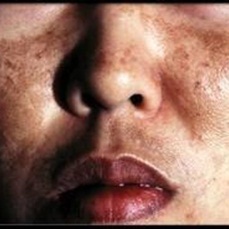
Melasma universale: Skin pigmentation that appears with aging.
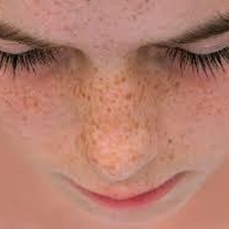
Freckles: Lentigo-Lentigines; benign pigmented spots mostly seen on the face, chest, and arms. It is an accumulation of melanin pigment resulting from sun exposure, predominantly seen in fair-haired or red-haired individuals. Freckles appear as a result of the body’s natural response to protect the skin from ultraviolet sun rays. During cold months, since sun rays are ineffective, the body does not require such strong protection; therefore, freckles are generally seen abundantly in spring and summer months. As in melasma, hydroquinone is also used in its treatment.
Returning to our formula;
Rp.
Hydroquinone …………………………………2.0 g.
Acide retinoique ……………………………….0.02 g.
Acetate de dexamethasone …….0.02 g.
Acide ascorbique …………………………….0.10 g.
Ethanol a 90 ou 95 % v/v ……………… 5.0 g.
Huile de ricin ………………………………… 5.0 g.
Eau purifiee ………………………………….. 13.00 g.
Onguent hydrophile ………………………. 15.0 g.
Let us examine the active ingredients included in the formulation;
Hydroquinone-quinol-hydrochinon; Also known by its synonyms, it is an active substance used to produce depigmentation (loss of pigment in the cell) in the skin. It exerts its effect by reducing the content of melanocytes in the skin. Regular use for weeks is required for it to be effective. Its effect is temporary. Spots may reappear 2 to 6 months after discontinuing the treatment. The application area of the preparation must be protected from the sun. In addition, the use of sunscreen creams is essential. Contact with the eyes and mucous membranes should be avoided. Application to extensive areas should be avoided as it may cause systemic toxicity. It may induce mild erythema and/or a transient burning sensation on the skin. It must not be applied to broken skin. It should not be used in children, during pregnancy, and during lactation. Its use in cosmetic preparations was banned in Europe on March 1, 2000; since January 2001, products containing hydroquinone can only be prepared upon medical prescription. Hydroquinone can be used up to a maximum concentration of 5% in prescriptions.
Retinoic acid-Tretinoin-Vitamin A acid; It is a natural derivative of vitamin A. When applied topically, it is effective in reducing wrinkles, mottled hyperpigmentation, rough texture, and laxity in mild photodamaged skin. While brown spots on the skin disappear within 6 to 8 weeks, the effects of tretinoin may subside upon discontinuation of treatment. Systemic absorption may increase when applied for long periods and over large skin surfaces. Like hydroquinone, it should not be used during pregnancy, lactation, and in children. Retinoic acid should be present in formulas at a maximum concentration of 0.10%.
Acetate de dexamethasone-dexamethasone; It is a corticosteroid with a depigmenting effect. While it is considered a secondary depigmenting agent in this formula, its inclusion in the formula also aims to prevent potential inflammation caused by retinoic acid. Dexamethasone should be present in the formula at a maximum concentration of 0.10%.
Acide ascorbique-Vitamin C-Ascorbic acid; Its depigmenting effect is clinically debatable. The reason for its preference in the formula is due to its antioxidant property. It should be present in formulas at a maximum concentration of 0.20%.
Ethanol should be prepared as 90% or 95% v/v; it is included in the formula as a solvent.
Huile de ricin -Oleum ricini; Known as castor oil, this oil, which belongs to the class of officinal oils, is primarily composed of ricinoleic acid. It is included in this formula as an excipient.
Eau purifiee-Eau distillee; Distilled water is used as a solvent in the formula.
Onguent hydrophile: Hydrophilic ointment is the water-loving ointment base referenced as Basiscreme DAC in the formula named HYDROPHILIC DILTIAZEM HYDROCHLORIDE CREAM 2% AGAINST FISSURES/CRACKS dated 18/03/2013 . By benefiting from this article, you can prepare the hydrophilic ointment that forms the main vehicle in the formula.
Preparation of the Formula: Hydroquinone and Retinoic acid are substances that oxidize easily. Therefore, they should be stored in tightly closed containers protected from sunlight, heat, and air, and should be prepared in small quantities.
When preparing the formula, avoid using metal utensils; glass or porcelain utensils should be preferred.
In a beaker, the three active ingredients are wetted with alcohol. The three active ingredients are melted in a slightly warmed water bath with the help of a magnetic plastic stirrer. Dissolution will not be complete. At this stage, castor oil heated to 65 °C is added to the solution. Stirring is continued until the active ingredients dissolve and the mixture becomes clear. The hydrophilic ointment we prepared must be added to the solution while stirring gently, taking care to prevent the formation of air bubbles. In another container, by dissolving the Ascorbic acid in Distilled water, we must add it to the formula containing the hydrophilic cream prepared in the other beaker and stir until homogenized. In the end, we obtain a glossy, light yellow cream.
Points to consider; Since this cream is an unstable mixture, it should be kept out of contact with air as much as possible, preserved in a cool place, and protected from light; a dark brown appearance indicates that it has oxidized. The mixture must certainly be renewed after one month. Treatment should continue for at least twelve weeks, the cream should be applied morning and evening, and the cream must not come into contact with the eyes and mucous membranes.
Hands must be washed thoroughly after application. It should particularly be kept in mind that nails may become discolored due to hydroquinone.
I would like to thank my esteemed colleague Pharm. Tercan Ünal for providing this formula and Atty. Cüneyt Yatkın for his contributions to its translation.
Wishing you a great week…
Spec. Pharm. Ahmet Nezihi Pekcan
Pekcan Pharmacy – Konya
[email protected]
Tel: (332) 3520657
http://www.majistralformul.com/