Our topic this week is IODINE TINCTURE, or as it is widely known in our country, TINCTURE OF IODINE.
While speaking of iodine tincture, you will also find LUGOL’S SOLUTION, prepared by dissolving iodine in water, at the end of the text.
We all know these formulas very well and remember them as preparations we certainly made in our school laboratories and later in our pharmacies.
Iodine tincture falls into the class of preparations whose primary solvent is alcohol (SPIRITUS) and which are obtained directly by the liquid dissolution method.
It was first used for preoperative skin antisepsis in 1908 by the surgeon named ANTONIO GROSSICH.
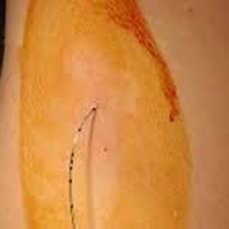
TINCTURE OF IODINE reduces 99.88% of bacteria present on the skin. Following skin disinfection, it maintains asepsis for approximately 4 hours and 40 minutes. When applied to hands contaminated with Gram-negative bacteria, disinfection is achieved in a short time.
It should not be used in patients with iodine hypersensitivity or non-toxic goiter. It must not be applied directly to damaged skin surfaces, as excessive iodine absorption through the wound may occur in this case.
Contact with the eyes should be avoided. Its use should be avoided if there is extensive skin damage, as excessive absorption may occur from the wound site. It should not be used for prolonged periods in newborns, infants, pregnant women, and thyroid patients. In solid state, it has a corrosive effect on the skin. Its use is also harmful particularly in advanced-degree burns.
Iodine tincture-Teinture d’iode-Tinctura iodi-Turkish Codex (1954)
Formula:
Iodine ………………………7 parts
Potassium iodide ………3 parts
Ethanol (90%) …….. 90 parts
Preparation:
The ethanol given in the formula is (90%). When preparing the formulation, (96%) ethanol is used. The amounts of (96%) ethanol and water required to dilute (96%) ethanol to (90%) are calculated and weighed. On the other hand, iodine (weighed on a watch glass) and potassium iodide are thoroughly triturated together in a glass mortar and dissolved in the calculated amount of water for the formula. The (96%) ethanol is gradually added to it.
This preparation must contain 6.8-7% (w/w) potassium iodide.
Iodine solution (alcoholic)-Teinture d’iode- Iodi solutio spirituosa-Tinctura iodi- Turkish Pharmacopoeia (1974)
Formula:
Iodine …………………….. 20 g
Sodium iodide ……….25 g
Ethanol (50%) ……….. q.s. for 1000 ml
Preparation:
Iodine is weighed on a watch glass. It is mixed with sodium iodide in a glass mortar. It is dissolved in ethanol and brought to the desired volume.
The preparation contains 2% (w/v) iodine (1.95-2.05) and 2.5% (w/v) sodium iodide (2.45-2.55).
Storage:
It should be stored tightly closed in amber glass bottles with glass stoppers.
Iodine solution (aqueous)-Iode solutio aquosa-Solutio lugoli-Turkish Pharmacopoeia (1974)
Formula:
Iodine …………………… 50 g
Potassium iodide ……100 g
Distilled water ………………q.s. for 1000 ml
Preparation:
Since polyiodide forms more quickly in concentrated solution, after iodine and potassium iodide are weighed on a watch glass, they are triturated together in a glass mortar. They are completely dissolved with 100 ml of water added gradually. It is made up to 1000 ml by adding water. The preparation contains 5% (w/v) iodine (4.9-5.1).
Storage:
It should be stored in tightly closed amber bottles below 35 °C.
It is used internally in thyrotoxicosis and externally as a germicide (disinfectant).
GENERAL INFORMATION
If iodine tincture is prepared without potassium or sodium iodide, iodine reacts with water in the medium as follows:
I2 + H2O ——–> HI + HIO
Iodine and the formed hypoiodous acid act on ethyl alcohol to produce organic iodine compounds such as ethyl iodide, ethylene iodide, acetaldehyde, etc. In this way, the free iodine concentration drops and the antiseptic value decreases. Furthermore, HI produces an irritating effect. Sodium iodide prevents these reactions because it retains free iodine by forming a polyiodide complex.
I2+Na ————> NaI3
When storing iodine tincture, the bottle must be sealed with a glass or bakelite stopper. Tincture coming into contact with a cork stopper may form organic and inorganic compounds, leading to deterioration of the tincture. It is generally agreed that light does not have a significant effect on its shelf life. It should be stored in tightly sealed glass-stoppered bottles. Placing it in an amber bottle is recommended.
Wishing you a good week…
References
Ankara University Faculty of Pharmacy Publications. General and Industrial Pharmaceutical Technology I (Prof. Dr. Enver İzgü)
Calculations in Drug Formulation (Prof. Dr. Şükran Geçgil)
Turkish Pharmacopoeia 1974
Turkish Codex 1954
Specialist Pharmacist Ahmet Nezihi Pekcan
Pekcan Pharmacy – Konya
[email protected]
Tel: (332) 3520657
http://www.majistralformul.com/