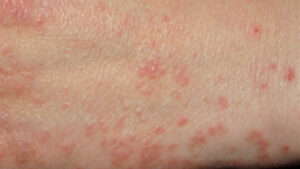
Scabies treatment with 10% crotamiton emulsionDear Colleagues, this week we will examine together a preparation in emulsion form containing 10% crotamiton, which is included in the Belgian Magistral Formulary and can also be easily applied to hairy areas of the body.Formula:
Rp.
Crotamiton 20 g
Liquid paraffin 40 g
Cetomacrogol 8 g
Distilled water ad. 200 g
Ingredients in the formula:
Crotamiton- Crotam- Crotamitonum:Crotamiton is a topical scabicide and antipruritic. It is used in the treatment and eradication of scabies. It has also been used for the treatment of pruritus (itching). It was first introduced as a medication in 1949 and was approved by the FDA in the USA in 2007. Crotamiton possesses scabicidal and antipruritic properties. The drug’s mechanism of action is unknown. It exerts a toxic effect against the scabies mite. Its antipruritic action is thought to result from its counter-irritant activity. Crotamiton is applied topically to the skin. The pharmacokinetic profile of the drug and its systemic absorption following topical application have not been studied.
Crotamiton is contraindicated in patients with hypersensitivity to the drug. If severe irritation or sensitization develops, crotamiton treatment should be discontinued and appropriate medical treatment should be administered. Crotamiton is for external use only. It should not be applied to wounded or inflamed skin areas. Accidental systemic exposure must be avoided. In case of ingestion, immediate medical assistance should be obtained. Oral and ocular exposure may cause ophthalmic irritation. In case of ocular exposure, the eyes should be thoroughly flushed with plenty of water and medical assistance sought.
Maximum Dose Limits;
Adults: In scabies treatment, once daily, a total of two applications 24 hours apart. In pruritus treatment, generally applied once daily (can be repeated as needed).
Elderly: In scabies treatment, once daily, a total of two applications 24 hours apart. In pruritus treatment, generally applied once daily (can be repeated as needed).
The safety and efficacy of crotamiton have not been established in adolescents, children, infants, and neonates. Its use in scabies treatment in infants under 2 years of age is not defined in the medical literature. Due to the availability of more effective agents, crotamiton is primarily considered an alternative treatment option.
Adolescents: Safety and efficacy have not been established. In off-label use, once daily, a total of two applications 24 hours apart.
Children: Safety and efficacy have not been established. In off-label use, once daily, a total of two applications 24 hours apart.
Infants > 2 months: Safety and efficacy have not been established. In off-label use, once daily, a total of two applications 24 hours apart. < 2 months: Safety and efficacy have not been established. Neonates: Safety and efficacy have not been established.
The FDA pregnancy risk category for crotamiton is Category C. It should be used in pregnant women only if clearly needed. There are no animal reproduction studies. It is not known whether crotamiton causes fetal harm or affects reproductive capability.Light liquid paraffin- Paraffin, dünnflüssiges [Ph.Eur]- Paraffin, light liquid [BP]- Mineral oil, light [NF]:According to the European Pharmacopoeia (Ph. Eur. 7), Light Liquid Paraffin (Paraffin, Light Liquid) is a purified mixture of liquid saturated hydrocarbons obtained from petroleum. It is a transparent, colorless, oily liquid that shows no fluorescence in daylight. Its relative density is between 0.810 and 0.875. Its viscosity is 25–80 mPa·s. It is insoluble in water; slightly soluble in alcohol; miscible with hydrocarbons. It should be protected from light. According to the United States Pharmacopeia (USP 35), Light Mineral Oil is a purified mixture of liquid hydrocarbons obtained from petroleum. It may contain a suitable stabilizer. It is similar to mineral oil, but has a lower kinematic viscosity. It should be stored in airtight containers. It must be protected from light.
Paraffin is a lubricant laxative used via the oral and rectal routes. It is the only laxative recommended against fecal hardening. Light liquid paraffin is also included in the composition of some preparations containing other laxatives such as cascara, magnesium hydroxide, or phenolphthalein. Apart from these, liquid paraffin is also used topically as an ointment base, emollient, skin cleanser, and ophthalmic lubricant. Both liquid paraffin and light liquid paraffin are used for the same indications.Emulsifying wax- Anionic emulsifying wax- Emulsifying wax:Emulsifying waxes are used as emulsifying and stiffening agents in pharmaceutical preparations and cosmetic products. Emulsions containing 2% anionic emulsifying wax are fluid, while those containing 10% are viscous. Anhydrous ointment bases are prepared using 3–30% anionic emulsifying wax along with soft and liquid paraffins. When emulsifying wax is added to cocoa butter at a concentration of 10%, a suppository base with a melting point of 34°C is obtained. Non-ionic emulsifying wax is generally used in creams at a concentration of 15%. However, there are also creams in which it is used at concentrations as high as 25%. In addition, it enters into the composition of anhydrous ointment bases. It has been reported that emulsifying ointment containing emulsifying wax together with hard and liquid paraffin provides highly effective protection against sun rays on clinically normal skin.
Anionic emulsifying wax, which is included in the British Pharmacopoeia (BP), contains cetostearyl alcohol and sodium lauryl sulfate or similar sodium salts of sulfated higher primary aliphatic alcohols. Non-ionic emulsifying wax listed in the United States National Formulary (USNF) contains cetostearyl alcohol and a polysorbate. Cetyl and stearyl alcohols have been reported to be non-toxic. Sodium lauryl sulfate is known to cause skin irritation at high concentrations. Non-ionic emulsifying wax has been suggested to be non-irritating.
Anionic emulsifying wax occurs as a white or pale yellow waxy solid or flakes. It has a faint, characteristic odor. It becomes plastic when heated. It is practically insoluble in water, but can form an emulsion; soluble in alcohol, ether, and chloroform; soluble in fixed oils and liquid paraffin when heated.
Non-ionic emulsifying wax occurs as a white or off-white waxy solid or flakes. When heated, it becomes a clear and almost colorless liquid. It has a characteristic, faint cetostearyl alcohol-like odor. It is freely soluble in propellants, chloroform, ether, and hydrocarbons; soluble in ethanol (95%); insoluble in water, but can form an emulsion.
Anionic emulsifying wax is incompatible with cationic compounds (quaternary ammonium compounds, acriflavine, ephedrine hydrochloride, antihistamines, and other nitrogenous compounds), salts of polyvalent metals (aluminum, zinc, lead, and tin), and thioglycolates. It is compatible with numerous acids above pH 2.5. Non-ionic emulsifying wax, on the other hand, is incompatible with tannin, phenol and phenolic materials, resorcinol, and benzocaine. It may reduce the antimicrobial efficacy of quaternary ammonium compounds.Preparation of the formula:Weigh the active ingredients separately. In a 400 ml beaker, heat 20 g of crotamiton, 40 g of liquid paraffin, and 8 g of cetomacrogol emulsifying wax at a temperature of approximately 70 °C until completely melted. Boil purified water in another beaker and cool to a temperature of approximately 70 °C. Pour the hot water into the oil phase while stirring continuously. Quickly pour the resulting emulsion into a 300 ml amber glass bottle. Shake gently for 1 minute. When preparing the formula, do not forget that the total weight must be brought up to 200 g with water and delivered to the patient after cooling by shaking gently.
It can be stored for 2 months at a temperature between 15 °C and 25 °C. The bottle must be shaken before use.
Even if the treatment is effective, symptoms and scabies lesions may persist for several weeks. The patient should be informed about this to avoid unnecessary reapplication of the preparation. It should not be used concurrently with other topical medications. In case of accidental ingestion, gastric lavage should be performed and symptomatic treatment provided. There is no specific antidote. Application: Take a warm bath and dry the skin thoroughly; apply the emulsion to the entire body except the face and scalp. Use the emulsion once daily in the evening for 3 to 5 days. The patient may take a bath after the third day of treatment before reapplying the emulsion. After the treatment ends, the patient should take a bath and change underwear, bedsheets, and pillowcases.
Wishing you a good week…
Source:
1- Therapeutisch Magistraal Formularium. Uitgave 2010
2- RxMediaPharma® 2016 Interactive Drug Information Resource
Spec. Pharm. Ahmet Nezihi Pekcan
Pekcan Pharmacy – Konya
[email protected]
Tel: (332) 3520657http://www.majistralformul.com/