Suppository calculations and preparation
Suppositories are solid dosage forms prepared in various weights and shapes for administration into body cavities such as the rectum, vagina, and urethra, which melt, soften, or dissolve in body fluids. They can be used for protective purposes in local tissues or as carrier systems for therapeutically active substances used systemically and locally. Suppositories can also be used as sustained-release formulations in the long-term treatment of chronic diseases.
The shapes of suppositories are generally conical or cone-like. Those that are egg-shaped or spherical are called Ovules (Ovula, Pessaries=Pesse, Globuli) or vaginal suppositories. Those in the form of rods are called bougies (Bacillum – bougie-cereoli-styli) and urethral suppositories.
Suppositories are classified into different groups according to their route of administration. According to USP 24, rectal suppositories are preparations administered via the rectum, usually weighing 2 g for adults and half this amount for children. Drugs with systemic effects, such as sedatives, tranquilizers, and analgesics, are administered via this route. Vaginal suppositories, according to USP 24, are spherical or oval-shaped suppositories weighing approximately 5 g, administered into the vagina.
Suppositories have many advantages in drug administration. The most important of these is increasing drug bioavailability by avoiding the hepatic first-pass effect. Drugs absorbed from the lower parts of the rectum pass directly into the systemic circulation. This increases the bioavailability of certain drugs by up to 100% compared to oral administration. In addition, the rectal route is preferred depending on the drug’s own physicochemical properties or when drug administration through other routes is unsuitable for the body. It is preferred for drugs that cause gastrointestinal side effects and irritation when taken orally, are unstable at gastric pH, or are sensitive to enzymatic degradation. The rectal route is used for certain antibiotics that are poorly absorbed after oral administration or disrupt the balance of intestinal flora by causing harmful alterations. Small polypeptides degraded by enzymatic activity in the upper gastrointestinal tract are administered via the rectum. In addition, bad-tasting drugs can also be given rectally.
An ideal suppository base should be non-toxic and non-irritating to mucous membranes, compatible with the active substance, melt or dissolve in body fluids, and maintain its stability during storage of the preparation. Rectal suppository bases are generally classified into two groups: fatty (oleaginous) bases and water-soluble or water-miscible bases. According to USP 24, suppository bases are classified as cocoa butter, gelatin-glycerin base, hydrogenated vegetable oils, polyethylene glycols, and polyethylene glycol fatty acid esters.
Fatty bases;
Cocoa butter is a base obtained from natural sources that melts at body temperature and is particularly suitable for rectal suppositories. Since cocoa butter does not cause irritation, it is suitable for suppositories used in local irritations, particularly in the treatment of hemorrhoids. It provides rapid release of the active substance. It is not suitable for vaginal and urethral use as it does not mix with mucous secretions. When preparing suppositories, cocoa butter should not be heated above 35-380C to prevent suspended active substances from settling under the effect of heat. This is because suspended active substances settle more easily in overheated cocoa butter, leading to variations in the active substance content among suppositories prepared in the same batch. A cavity may also be observed in the center of the finished preparation due to contraction. Suppositories containing cocoa butter should be stored in well-closed containers below 300C.
Due to the disadvantages of cocoa butter, newer substances such as synthetic triglycerides have been used in suppository preparation. Hydrogenated vegetable oils are included in this group. Hydrogenated palm kernel oil, peanut, coconut, sunflower, hazelnut, cottonseed, soybean, and olive oils can be given as examples. Synthetic or semi-synthetic triglycerides consist of fatty acids containing 12-18 carbon atoms. Examples of these substances commonly used as suppository bases include adeps solidus, suppocire, massupol, lasupol, massa estarinum, witepsol, and wecobee types. Semi-synthetic bases cause less chemical irritation and less mechanical damage to the rectal mucosa. They also impart lubricating properties to the suppository.
Witepsol H 15 is the most practical type. It is of German origin. Its melting point is 33.5-35.5 0C. Its congealing point is 32.5-33 0C. It can be heated and worked with above its melting point. It can form emulsions with aqueous solutions just below 36 degrees. However, the added liquid should not exceed one-fourth of the weight of the base. Its main drawback is its rapid solidification and low viscosity at body temperature. When working at high temperatures, the substances inside may settle.
Water-soluble or water-miscible bases;
The vast majority of these bases consist of polyethylene glycols or glycol-surfactant components. Release from these bases depends on the dissolution rate of the base rather than its melting. Therefore, temperature-related issues encountered during manufacturing, transportation, and storage are minimal. The high melting points of these bases must be taken into account when working with heat-sensitive active substances. Another problem observed with water-soluble or dispersible bases is that high-molecular-weight polyethylene glycols in particular delay the release of the active substance. Suppositories with different melting points and solubilities are prepared with mixtures of polyethylene glycols having molecular weights of 1000, 4000, or 6000. Chemically stable and physiologically inert, the commercial names of these substances are Carbowax and polyglycol.
Polyethylene glycols are suitable bases for suppositories because they mix with body fluids. In USP 24, it is recommended that labels for polyethylene glycol suppositories instruct moistening before use. Thus, the sensation of pain resulting from moisture absorption due to their hygroscopic properties is prevented.
Glycerin-gelatin base is mostly used in vaginal suppositories. To prepare a firm suppository suitable for rectal use, the amount of gelatin must be increased. Glycerin-gelatin base is prepared by dissolving or dispersing the active substance in an amount of water equal to 10% of the finished suppository weight. Preservatives such as methylparaben and propylparaben should be added to glycerin-gelatin suppositories. Since suppositories prepared with glycerin-gelatin base dissolve quite slowly, it may take considerable time to achieve the blood levels required for systemic effect.
Glycerinated gelatin is used as a vaginal suppository (Ovule, Globuli) base. Due to its gradual dissolution in body secretions, it is particularly the most suitable base for antiseptic substances. Its composition and preparation vary according to different Pharmacopoeias. It can be successfully used for substances such as boric acid, bromides, solid extracts, chloral hydrate, iodides, iodoform, and ichthammol. Special precautions must be taken when used with substances that precipitate gelatin, such as tannin and mercurochrome.
The Turkish Codex (1984) provided the following formula for Glycerinated Gelatin base:
Gelatin 2 parts
Water 4 parts
Glycerin 10 parts
The T.K. generally recommends this formula for Ovules. It provided a different formula for ichthammol ovules.
Ichthammol Ovule T.K.
Globuli cum Ichtammoli
Gelatin 7 parts
Water 28 parts
Glycerin (concentrated) 60 parts
Ichthammol 5 parts
Ichthammol mixed with 10 g of glycerin is added to the melted base and poured into molds.
Working with Glycerinated Gelatin base requires considerable technical skill. The following formula from U.S.P. XVIII is a helpful guide:
Drug + Purified water (to make 10 g together with the drug)
Glycerin 70 g
Gelatin 20 g
The drug is weighed in a tared container, water is added until the total weight reaches 10 g, and mixed. Glycerin is added and mixed, then gelatin is added. It is heated with stirring in a water bath until the gelatin is completely dissolved, then poured into chilled molds. Since gelatin-glycerin mixtures are highly affected by moisture, they must be stored below 350C in tightly closed containers and wrapped in cellophane paper.
Glycerin suppositories;
Suppositories containing 50-90% glycerin are prepared to utilize both the emollient and laxative/stimulating effects of glycerin. These are generally used to increase peristalsis in the large intestine, particularly in children. There are three types of glycerin suppositories based on their preparation:
1- Those prepared with glycerin and cocoa butter.
2- Those prepared with glycerin, gelatin, and water.
3- Those prepared with glycerin and soaps.
1- The following formula is given in the T.K. for glycerin suppositories prepared with cocoa butter:
Cocoa butter 50 g
Concentrated glycerin 50 g
Anhydrous lanolin 1.25 g
It is prepared by the molding method. However, although the capacity of cocoa butter to hold glycerin is increased in this combination thanks to lanolin, it is still not sufficient. Suppositories may exudate glycerin upon standing.
2- Those prepared with Gelatin-Water-Glycerin
Base formulas generally used in the preparation of ovules (globules) are used. There is no single standard formula.
Example;
Glycerin Suppository
Suppositoires a la Glycérine F.K.
Ovula cum Glycerino
Gelatin 10 g
Water 30 g
Glycerin 60 g
Glycerin Suppository
Glycerin Suppositories B.P
Gelatin 14 g
Glycerin 70 g
Water q.s. 100 g
Although these suppositories show better efficacy than those prepared with cocoa butter, they are generally not sufficiently rigid.
3- Soap-Glycerin suppositories:
They are used to benefit from the stimulating effect of both soap and glycerin. Sodium stearate is also used instead of soap.
All glycerin suppositories are hygroscopic. Immediately upon preparation, they should be wrapped in aluminum foil or cellophane paper and stored in tightly closed containers.
Soap Glycerin Suppository
Glycerin Suppositories U.S.P. XV
Glycerin 91 g
Sod. Stearate 9 g
Water 5 g
Melted by heating at 115-1200C and poured into warm molds.
Preparation of suppositories;
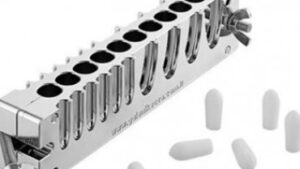
They are prepared by compression or fusion (melting) method. The fusion method involves dispersing or dissolving the active substance in the melted base mixture, followed by pouring into molds and cooling. The finished product is removed by opening the mold. Suppository molds made of aluminum alloy, brass, or plastic, containing anywhere from six to several hundred cavities, are available for preparing suppositories of different shapes and types. Since suppositories are generally prepared on a weight basis, the drug displaces a portion of the base depending on their specific gravities. When formulating, the displacement value (displacement factor) of the base by the active substance must be calculated. This procedure is performed when an insoluble drug is dispersed in the base. If the drug and the base have nearly the same density, the drug displaces an equal amount of base. If the drug is heavier, it displaces proportionally less base.
The amount of base to be used is calculated using the following formula:
M=F- (f x S)
M= required amount of base
F= capacity of the suppository mold
f= displacement factor of the active substance
S= amount of active substance in one suppository
The displacement factor is a calculated value specific to the active substance and the base used. Tables providing displacement factors are available. Its calculation is performed as follows:
f= weight of active substance / weight of displaced base
As antioxidants in suppositories, butylated hydroxyanisole (BHA), butylated hydroxytoluene (BHT), ascorbic acid, as well as antioxidant mixtures with citric acid to chelate metals, are used.
References:
1- Prof. Dr. Özgen ÖZER (Pharmaceutical Technology)
2- Prof. Dr. Enver İzgü (General and Industrial Pharmacy II)
Specialist Pharmacist Ahmet Nezihi Pekcan
Pekcan Pharmacy – Konya
[email protected]
Tel: (332) 3520657
http://www.majistralformul.com/