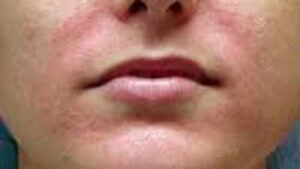
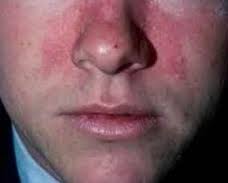
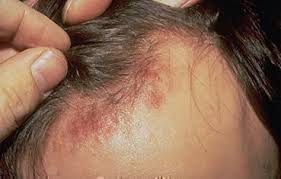
Seborrheic eczema is a type of eczema seen in oily areas of the skin (facial midline, chest, scalp) whose exact cause is unknown. The term seborrheic dermatitis is also used interchangeably with seborrheic eczema. Seborrhea is the excessive secretion of sebum by the skin. Dandruff is a condition that develops without redness on the scalp. In seborrheic dermatitis, however, there is redness and flaking. It is a common disease that is easily treated. It tends to exacerbate during periods of stress, alcohol intake, immunosuppression, and also in the winter and spring months. A red, scaly, itchy rash develops on the scalp, eyebrows, eyelids, ears, and the middle of the chest. In addition, skin folds such as the umbilicus, buttocks, armpits, inframammary folds, and groin can also be involved. It is chronic and may flare up periodically. Seborrheic dermatitis is frequently seen in individuals with oily skin, and acne and psoriasis often accompany the disease process. A fungus-like organism is believed to cause seborrheic dermatitis. This disease is frequently seen across 3 age groups. In some infants, seborrheic dermatitis appears only in the diaper area and can be confused with other clinical conditions. In treatment, certain medicated shampoos, corticosteroid creams and lotions under physician supervision, antifungals, pimecrolimus cream, and systemic antifungals when necessary are used.
In this article, we will examine a formula included in the Spanish National Formulary and used in the treatment of Seborrheic Dermatitis.
Rp.
Alcohol 700 150 ml.
Bioazufre fluido 5 ml.
Monoacetato de resorcina 2 g.
Ac. Salicilio
Hidrocortisona / a.a. 1 g.
Propilenglicol 10 g.
Substances included in the formula
Aethanolum- Alcoholum- Ethanolum- Spiritus vini;
In ancient times, it was called the “water of life” and believed to be a cure for practically every disease. An important property of alcohol is that it is an excellent solvent frequently used in most pharmaceutical formulations. While ethyl alcohol is active at 60-90% concentration, a 70% concentration (vol/vol) exhibits optimal efficacy for skin antisepsis. Conversely, when the concentration drops below 50%, it loses its activity to a large extent. Alcohol exerts its effect by coagulating proteins and dissolving lipids. Since protein denaturation requires a certain amount of water, the antimicrobial effect of absolute (96%) alcohol is weak.
Aqua- Water- Wasser- Eau;
In pharmacy, when water is mentioned, distilled water is understood. Today, demineralized water is also used. Water distilled twice is called bidistilled water.
Bioazufre fluido- Liquid Bio-sulfur- Liquid sulfur;
(Liquid sulfur, polysorbate 20), this mixture (2% sulfur, Peg-30, Castor oil 99-98%) is a hydrophilic derivative of an unsaturated fatty acid of sulfur and is a form containing approximately 2% sulfur. It is used in the treatment of excessive sebum and dandruff on the skin and scalp. It is in the form of a viscous dark brown liquid with a characteristic odor, and is soluble in water, alcohol, and their mixtures. By penetrating the skin and scalp, it prevents excessive sebum secretion. It is used topically for oily, acne-prone skin problems and blackhead formations on the skin. Dryness of the skin may occur with long-term use. If applied within shampoos on the scalp, application two days a week is recommended. It is available for use in the form of hydroalcoholic lotions, liquid emulsions, shampoos, masks, and hair conditioners.
Dibromsalicylii- Resorcine- Dihydroxybenzene- Resorcinol;
It is a white crystalline substance with a characteristic odor. Its color turns red under the influence of air and light. It has a pungent taste. It is soluble in 1 part water and 1 part alcohol, as well as in ether, glycerin, and benzene, while insoluble in chloroform. It is incompatible with acetanilide, camphor, chloral hydrate, menthol, and phenol. Resorcinol is used as an antiseptic and disinfectant. Externally (ointment 10-20%, solution 0.1%), it is used in psoriasis, acne, seborrhea, eczema, and other skin diseases. It has a keratolytic effect, and application to very large surface areas should be avoided. M.D. is 0.50-1.5 g.
Acidum salicylicum- Salicylsäure- Acide salicylique- Salicylic acid:
It consists of white crystals. It dissolves in 500 parts water, 15 parts boiling water, 27 parts alcohol (99%), 2 parts ether, 80 parts olive oil, 100 parts glycerin, and 55 parts chloroform. Salicylic acid accelerates desquamation. It exhibits a mild fungicidal effect. Salicylic acid is a beta hydroxy acid (BHA) with the chemical formula C6H4(OH)CO2H. This colorless, crystalline organic acid is generally used as a plant hormone. It is a product of salicin metabolism. It possesses chemical properties similar to acetylsalicylic acid, commonly known as aspirin. It is used in the treatment of fungal species such as tinea barbae, tinea capitis, and tinea cruris. In dermatology, salicylic acid is often combined with lactic acid to treat warts and corns. The exact mechanism of action of salicylic acid and lactic acid in wart treatment is not fully known. It is thought to be due to the mechanical removal of wart virus-infected epidermal cells as a result of their keratolytic effects. They are also effective against corns through their keratolytic activities.
Cortisol- Hidrocortisona- Hydrocortisone;
It is a corticosteroid in the form of a white to off-white crystalline powder. It is only slightly soluble in water and sparingly soluble in alcohol. It dissolves in alcohol at 1:40 and in acetone at 1:80; slightly soluble in chloroform; very slightly soluble in ether. It is used for the temporary relief of minor skin irritations, itching, and rashes caused by eczema, dermatitis, insect bites, poison ivy, soaps, detergents, and cosmetics, as well as for the temporary relief of itching resulting from many other causes.
Propylene glycol- Methylethylene glycol- Methyl glycol- Propylene glycol
It is an excipient used for various purposes in pharmaceutical preparations. It is used as a vehicle for cosmetic products. Due to its moisturizing property, it is used instead of glycerin in topical moisturizing preparations. Propylene glycol can cause local irritation on the skin and mucous membranes. It is miscible with water, acetone, alcohol, and chloroform; soluble in ether; immiscible with fixed oils, but sometimes dissolves essential oils. It should be stored in a cool place and in airtight containers. It should be protected from light and moisture.
Preparation of the formula;
Based on volume values, in order to obtain 150 ml of 700 alcohol from the 960 alcohol available in our pharmacies, we should know that we need to take 109 ml of 960 alcohol and add 41 ml of boiled and cooled distilled water to it. Resorcinol, salicylic acid, and hydrocortisone are dissolved in 109 ml of 960 alcohol. We complete the formula by adding bio-sulfur, propylene glycol, and the calculated 41 ml of distilled water that we set aside to adjust the alcohol concentration to 700.
Wishing you a good week…
Source
La Formulacion Magistral en la Oficina de Farmacia valencia, 1981
Tel: (332) 3520657
Fax: (332) 3512816