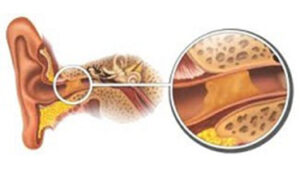
Dear Colleagues; as is known, there are two types of glands in the skin covering the inner surface of the external ear canal: “Ceruminous” and “Sebaceous”. When the secretions of these two glands mix together, a yellow substance called “Cerumen” is formed. Cerumen mixes with the desquamated keratin layer of the skin lining the external ear canal and coats the wall of the canal, thereby protecting the external ear canal against microbes. To summarize, Cerumen (Earwax) or Bouchon; consists of a mixture of secretions from the sebaceous and sweat glands of the skin in the outer 1 cm of the external auditory canal and epithelial debris. Cerumen (Earwax) or Bouchon is not dirt in the true sense. It is a secretion of the skin in the external auditory canal.
In some people, this substance, when present in excessive amounts, can occlude the external ear canal. This resulting plug is dirty yellow in color and may cause itching and/or mild hearing loss. In order to remove cerumen, the ear must be irrigated by a physician. Some people try to relieve this obstruction and clean the ear with sharp objects inserted into the external ear canal. Such improper actions often lead to perforation of the tympanic membrane (eardrum).
Ear secretion is intended to protect the skin in the external auditory canal from infections and traps dust and other particles coming from outside. It is expelled toward the auricle (pinna) through the outward movements of the skin in the external auditory canal. Thick ear secretions, being in dusty environments, or factors that prevent the discharge of the secretion lead to accumulation.
Ear secretion is beneficial because it protects the ear canal and forms a temporary protective liquid layer. The absence of ear secretion causes dryness of the external ear canal and associated itching. As long as earwax (Cerumen) is present in normal amounts, it is healthy and is a substance with protective, lubricating, and antibacterial properties.
Under ideal conditions, there is no need to clean the ear. In most cases, the ear canal cleans itself; this occurs through a natural mechanism where skin and debris are slowly swept outwards from the eardrum to the auricle. Old ear debris is continuously swept toward the outside of the ear, where it dries and falls off. This process occurs rather slowly. Long-standing earwax usually dries out and thins; with the help of chewing and jaw movements, it is transported outward from the eardrum and falls out.
Ear debris can accumulate excessively, occluding the external auditory canal to the point of impairing hearing. In this case, the physician cleans the ear using an aspirator, special instruments, or irrigation. Prior to this cleaning procedure, it may be necessary to use medications to soften the accumulation. In such a situation, softening drops such as “glycerin” can be used.
Since cerumen is secreted in the outer portion of the external auditory canal, that is, away from the eardrum, under normal conditions it does not cause any discomfort. However, in some patients, due to excessive secretion, narrowness of the external auditory canal, and the patient’s habit of cleaning the ear with objects such as cotton swabs, earwax accumulates along the external auditory canal and can reach the eardrum. This condition is called Impacted Bouchon or Impacted Cerumen.
Symptoms of impacted cerumen (earwax plug) include;
1. Ear pain, a feeling of fullness and blockage in the ear
2. Partial or progressively increasing hearing loss
3. Tinnitus, ringing or noise in the ear
4. Ear itching, foul-smelling ear discharge, and dark-colored ear discharge
5. Dry cough
and can be summarized as such.
Hydrogen peroxide is an antiseptic and disinfectant agent with oxidizing and deodorizing properties. This effect decreases in the presence of organic matter. Its antibacterial and antiviral activity is weak. It is used for wound cleansing. It is effective in removing cerumen (earwax) from the ear.
When used in the ear (risk of tympanic membrane granulation), it cannot be used for more than one week. It may cause discoloration of clothing.
Looking at our formula;
Rp.
Hydrogen peroxide 30 3.0 g
Distilled water q.s. 30 g
Substances included in the formula;
Hydroperoxide – Hydrogen peroxide – Eau oxygénée – Hydrogenii peroxidum – Wasserstoffsuperoxid ;
Aqueous solutions of hydrogen peroxide decompose slowly upon standing or by the effect of alkali. Light, agitation, and heat accelerate this decomposition. Incompatibility also causes decomposition. Hydrogen peroxide solutions are incompatible with organic substances, reducing agents (substances prone to oxidation), certain metals, metal salts, alkalis, iodides, permanganates, and other oxidizing agents. Its solutions should not be stored for extended periods. Concentrated solutions cause irritation to the skin and mucous membranes. Such solutions should not be used without the necessary dilution. Concentrated solutions produce irritating burns that lead to the formation of a white scar on skin and mucous membranes. The pain it causes disappears within approximately 1 hour. Continuous use of hydrogen peroxide as a mouthwash may cause temporary hypertrophy of the lingual papillae (papillae linguales). Injection or instillation of hydrogen peroxide into closed body cavities is dangerous. 3% hydrogen peroxide solutions used as a mouthwash have been reported to cause oral ulcers. The antiseptic effect of hydrogen peroxide depends on the rapid release of oxygen when applied to tissues, and therefore on the oxidative effect of oxygen. For this reason, its antiseptic activity is limited to the very short period during which oxygen release continues. In addition, the antimicrobial effect of the released oxygen is reduced by organic substances present in the environment.
Hydrogen peroxide exhibits a mild local hemostatic effect. This effect has been explained through various mechanisms. Thermal injury to the tissue where it is applied, release of intimal lipid deposits, air embolism, formation of fibrin thrombi, or causing vasoconstriction in small arterioles are the main mechanisms proposed to explain its hemostatic effect.
Hydrogen peroxide is an oxidizing substance used as an antiseptic, disinfectant, and deodorant. It shows weak antibacterial activity; it is also effective against viruses, including HIV. In wound cleansing, the effervescent (foaming) effect produced by the oxygen solution is likely more important than the antimicrobial effect. Hydrogen peroxide solutions up to 6% are used for cleansing wounds and ulcers. Creams containing 1.5% stabilized hydrogen peroxide are also used for the same purpose. Hydrogen peroxide is not effective alone on intact skin. However, it is used together with other disinfectants in antisepsis of the hands, skin, and mucous membranes. Hydrogen peroxide is also included in the World Health Organization (WHO) list for HIV disinfection. Keeping medical and surgical instruments in a 6% hydrogen peroxide solution for 30 minutes is sufficient for disinfection.
A 1.5% solution of hydrogen peroxide is used as a mouthwash for the treatment of acute stomatitis and as a gargle for deodorizing purposes. 6% solutions should not be used for this purpose. Its use in combination with topical corticosteroids may provide greater efficacy. Gels prepared for the same purpose are also available.
Ear drops containing hydrogen peroxide are used for removing earwax. Such ear drops should preferably be freshly prepared by diluting a 6% hydrogen peroxide solution with 3 parts water.
Bandages contaminated with blood can be cleansed with hydrogen peroxide solutions. In addition, hydrogen peroxide is used in the form of a 3% solution for the disinfection of soft contact lenses. Concentrated hydrogen peroxide solutions (27% and 30%) are used in preparing more dilute solutions.
Ear irrigation is contraindicated in patients with a perforated tympanic membrane. It should not be administered in chronic otitis. The preparation should be protected from light and stored at 20– 80 C. The storage period is one week.
Dosage;
After applying a few drops to the ear, wait for half an hour and repeat this procedure three times. Then irrigate the ear with lukewarm water. It should not be used for more than one week.
ATTENTION! Such solutions should not be applied to tissues without dilution. It is dangerous to inject or instill hydrogen peroxide into closed body cavities without an outlet.
Wishing you a good week…
Source: Belgische Farmacopeecommissie/ Therapeutisch Magistraal Formularium. Uitgave 2010
Spec. Pharm. Ahmet Nezihi Pekcan
Pekcan Pharmacy – Konya
[email protected]
Tel: (332) 3520657
http://www.majistralformul.com/