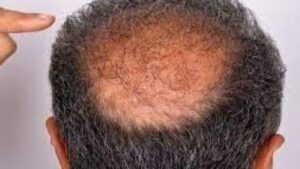
Androgenetic alopecia / Treatment options with magistral formulations in hair lossDear Colleagues, androgenetic alopecia is a condition characterized by hair loss that occurs under the influence of androgens in genetically predisposed individuals and can be observed in both sexes.
Young patients, individuals with early-onset, progressive hair loss, and single men tend to be more distressed by hair loss. Men outside these groups make greater efforts to seek treatment when they lose a strong and positive body image. Recent quality-of-life studies demonstrate that AGA has major impacts on the quality of life in both men and women.
In men, it leads to reduced self-confidence, stress, anxiety, depression, and social inadequacy. AGA also has both social and psychological effects on women. It has been observed that these individuals lose their self-confidence, desire to camouflage thinning hair, feel embarrassed by the concern that others will notice their hair loss, envy women with healthy hair, and experience difficulty styling their hair. AGA is a cosmetic issue. In addition to affecting patients psychologically, actinic damage occurs on the scalp of these patients as a result of ultraviolet radiation exposure. An increased incidence of myocardial infarction and benign prostatic hyperplasia has been observed in men with AGA. These associations need to be confirmed by further studies, as AGA would gain much greater significance if such a relationship is verified.
In this article, we will examine the treatment options with magistral formulations applied in the management of androgenetic alopecia, which is recognized as one of the leading causes of hair loss.TREATMENT OF AGA IN MEN;1) In the treatment of mild to moderate AGA, the primary step should be to prevent the progression of hair loss and strive to reverse miniaturization.Finasteride;It is a synthetic 4-azasteroid derivative of testosterone. It specifically inhibits the type 2 5α-reductase enzyme. Daily use of 1 mg oral finasteride has been shown to reduce scalp and systemic DHT levels in men with AGA. In double-blind, placebo-controlled clinical trials conducted in recent years, daily use of 1 mg oral finasteride for at least 12 months was shown to halt the progression of hair loss and lead to a significant 32% increase in hair count compared to patients using a placebo. To evaluate the efficacy of finasteride treatment, therapy must be continued regularly for at least 6 months. Minoxidil;The exact mechanism of action of minoxidil, the first drug approved for the treatment of AGA in men and women, is not fully known. Minoxidil is the best-known drug in this category and the first medication approved by the FDA for use in AGA. It was determined that the drug, used orally in the treatment of hypertension, caused hypertrichosis (abnormal hair growth all over the body) with local application. Information on how it promotes hair growth remains insufficient. In AGA (Androgenetic alopecia), blood flow in the scalp decreases. Minoxidil promotes hair development by increasing blood flow in the scalp. Research shows that minoxidil acts directly on follicular matrix or dermal papilla cells. While a 2% solution applied topically was found to be effective in men and women, studies have shown that using a 5% solution is more effective in men. It requires continuous use. It should be applied at least twice a day. Its effect begins in 6 months, and the maximum response is achieved in 1 year. Topical minoxidil is not effective on hair in the temporal region. Its side effects include irritant or allergic contact dermatitis, as well as diffuse hypertrichosis due to systemic absorption or contamination.Minoxidil and Tretinoin;Tretinoin is a retinoid that regulates the growth and differentiation of epithelial cells. There are studies showing that the treatment is effective when minoxidil (5%) is combined with tretinoin (0.025%). Because topical tretinoin causes irritation, it is not a frequently preferred treatment.
2) Hair prostheses are among the options in the treatment of severe AGA. Real or synthetic hair can be used. Surgery is a second option in the treatment of severe AGA. Transplantation, scalp reduction, rotation flaps, punch grafting, and single follicle transplantation are among the surgical options. AGA TREATMENT IN WOMEN;1) Topical minoxidil and antiandrogens can be used in mild to moderate cases. Contraception must be used as it causes feminization of the male fetus during the premenopausal period. Due to this potential risk, the use of finasteride in women is not approved. In double-blind, placebo-controlled studies, the use of finasteride in the postmenopausal period was not found to be effective. The use of finasteride has been shown to be effective in 4 cases with AGA accompanied by hyperandrogenism. Minoxidil;Topical 2% minoxidil has been found effective in the treatment of AGA in women in clinical studies. In a double-blind, placebo-controlled clinical study conducted with 5% minoxidil, 5% topical minoxidil was shown to be more successful than 2% topical minoxidil in the treatment of AGA in women. Since clinical studies on the use of minoxidil in the treatment of AGA in women have yielded differing results regarding the efficacy of the treatment, further studies with long-term follow-up are required. Antiandrogens Antiandrogen therapy leads to a decrease in plasma testosterone and DHT levels by reducing ovarian-derived androgen synthesis and increasing SHBG levels.Antiandrogens;These are medications used topically and systemically that reduce androgen production, affect androgen metabolism, or inhibit androgen activity in target areas such as endocrine-sensitive hair follicles.
Because systemic antiandrogens reduce circulating testosterone, which is necessary for normal male sexual function, the use of these medications is limited to women. Cyproterone acetate;Cyproterone acetate (CPA) is an androgen receptor antagonist and the most potent known antiandrogen. There are studies showing that it arrests hair loss, but does not cause active growth.
In the treatment of AGA, it is recommended to be used at 25-100 mg/day during the first phase of the menstrual cycle. Its combined use with ethinylestradiol is common. CPA inhibits the progression of hair loss. According to some authors, CPA therapy is more effective when the serum ferritin level is above 40µg/l. When used at doses of 100 mg and above, CPA exhibits hepatotoxic effects. Spironolactone;Spironolactone directly inhibits the interaction of androgens with the androgen receptor. It is an aldosterone antagonist. By competing at the receptor level in hair follicles, it blocks the binding of androgens to receptors. It is used in doses of 100-200 mg/day. Women taking spironolactone should avoid pregnancy and have an annual cervical smear and mammography. It reduces the levels of cytochrome P-450-dependent enzymes (17β-hydroxylase and desmolase) required for androgen synthesis. There are studies showing that it arrests hair loss, but does not induce active growth. Side effects of systemic antiandrogens include menstrual irregularities, breast tenderness, hyperkalemia, nausea, and depression.estrogens;Estrogens exert an antiandrogenic effect indirectly by increasing circulating SHBG levels. When SHBG increases, free testosterone decreases and gonadal androgen synthesis declines. Although estrogens slow down the progression of AGA, there are no studies demonstrating that they induce hair growth. Topical estrogens include 17α-estradiol, 17β-estradiol, and estradiol benzoate. They should be applied to the scalp once daily. Irritation and contact dermatitis are among their side effects.
2) Medical treatment can be attempted in the management of severe AGA. The combination therapy of topical minoxidil and oral antiandrogens is the best alternative to choose at this stage. Hair transplantation can be considered as an alternative in female AGA patients who do not benefit from medical therapy.
Vehicles used in scalp formulations;
Although hydroalcoholic solvents are traditional carriers, they are frequently used on the scalp today. Variations of hydroalcoholic solutions can be easily formulated. For example, isopropyl myristate is used as an emollient, solvent, carrier, and skin penetration enhancer in topical pharmaceutical preparations and cosmetic products. Furthermore, dimethicones are liquid silicones. Due to its water-repellent properties, dimethicone is included in the composition of pharmaceutical preparations used to protect the skin against water-soluble irritants. Propylene glycol is an excipient used for various purposes in pharmaceutical preparations. It is especially used as a solvent and carrier for drugs that are unstable or insoluble in aqueous media. It is a better solvent than glycerin. Propylene glycol can cause contact dermatitis, pruritus, and dryness as a result of local irritation on the skin and mucous membranes. It has been reported to cause hypersensitivity reactions.
Therefore, it is possible to resolve the issue for potential scalp irritations by prescribing o/w emulsions.
In certain conditions such as psoriasis and seborrheic dermatitis, hydroalcoholic-based solutions may exert a drying effect and lead to hyperkeratotic lesions. If a hydroalcoholic solution exerts a drying effect, this problem can be resolved using emulsions and officinal hair oils.
Moreover, in such cases, vehicles formulated with high-quality cosmetic lipids and cyclomethicone are preferred alongside traditional herbal hair oils.
Application rates of therapeutic agents in scalp diseases;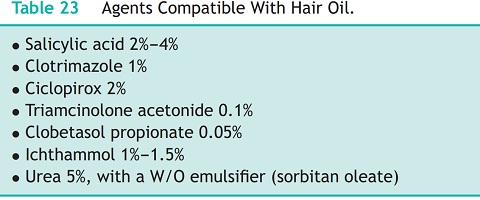 Formulation applications with Minoxidil;
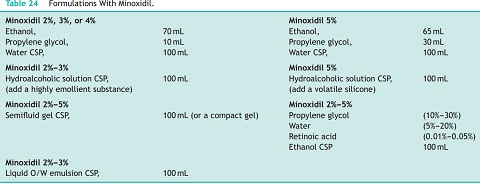 Today, topically applied minoxidil and antiandrogens continue to be the reference treatment worldwide in the management of Androgenetic Alopecia, the most common scalp disorder.
It has been proven that 2% and 5% minoxidil lotion applied daily to a dry scalp for 16 weeks is effective in maximizing hair growth on the scalp.
Contact with the product may cause dermatitis and irritation. Less frequently, it causes allergic reactions. Propylene glycol sometimes triggers allergic reactions. In particular, hypertrichosis (abnormal hair growth all over the body) may develop. This adverse side effect, seen especially in women, usually disappears 4 months after discontinuing treatment. To prevent these side effects, it is important to avoid touching the face with the hands after applying minoxidil and to wash hands immediately. However, hypertrichosis does not always result from direct contact; it can also occur due to low levels of minoxidil entering the systemic circulation.
While 5% topical minoxidil acts more effectively and rapidly, the rate of adverse events may slightly increase. For women, only the 2% formulation is approved for topical application. A 5% minoxidil concentration has been found to be significantly more effective in women, but the incidence of facial hypertrichosis is quite high. Commercial 2% and 5% forms of minoxidil are available. By adding different active ingredients at various concentrations to these formulations, combinations can be prepared for use in the treatment of diseases such as seborrheic dermatitis, psoriasis, and scalp eczema. Thus, local solutions can be created both for cosmetic purposes and for the treatment of scalp diseases. For patients with contact dermatitis, hydroalcoholic solutions can be used as a vehicle instead of propylene glycol.
(Tables 24 and 25).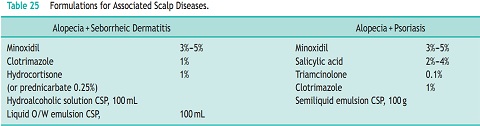 While 3% formulations of Minoxidil are used abroad, 2% and 5% forms are available in our country. As an alternative to hydroalcoholic vehicles, liquid o/w emulsions and sprays can alternatively be used. The combined use of minoxidil with topical retinoids shows a synergistic effect, enhancing hair growth while simultaneously increasing scalp absorption. This interaction (Shin and coworkers67) demonstrated in their studies. While 5% minoxidil solution is applied twice daily, applying solutions containing tretinoin (0.01%) once daily is sufficient. The combination therefore eliminates the necessity of twice-daily use.
Although anecdotal reports exist, the efficacy of topical combinations of minoxidil with other hormones has not been proven.
Different authors recommend a combination of 0.03% estradiol valerate, 0.025% progesterone, 2% to 5% spironolactone, and 1% and 3% canrenone, while arguing that a 0.05% combination of topical finasteride is not beneficial for hair growth. Blume-Peytavi and coworkers reported what they noted as a surprising finding, explaining that when the active substance latanoprost 0.1%, currently applied topically to the eye to lower intraocular pressure, was applied twice daily for 24 weeks in androgenetic alopecia, they observed increased hair density. It is hoped that in the near future, this substance will be incorporated into a suitable vehicle and used on the scalp.
Wishing you a good week…
To be continued…
Exp. Pharm. Ahmet Nezihi Pekcan
Pekcan Pharmacy – Konya
[email protected]
Tel: (332) 3520657http://www.majistralformul.com/