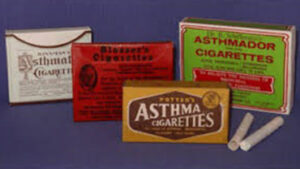
CIGARETTAE ANTIASTHMATICAE – Anti-asthmatic CigarettesAsthma is a chronic disease characterized by shortness of breath resulting from non-microbial inflammation of the airways. The severity of asthma can vary from patient to patient and, from time to time, within the same patient. The cause of shortness of breath in the patient is the narrowing of the airways, proportional to the contraction of the muscles in the airways, swelling of the mucosa, and an increase in local secretions. The most common symptoms of asthma are coughing, wheezing or a whistling sound in the chest, shortness of breath, and a feeling of tightness in the chest. Asthma can develop at any age. Asthma can be hereditary. It is thought that modern lifestyles, such as changes in housing, diet, and a more hygienic environment, may contribute to the development of asthma. Smoking during pregnancy increases the likelihood of the child developing asthma. Being in smoking environments also increases the probability of developing asthma. The presence of irritants in the workplace can lead to a person developing asthma. Environmental pollution can worsen asthma symptoms, but it has not been proven to cause asthma. The fundamental rule in asthma treatment is to adjust the dosage and type of medication according to the severity of the disease.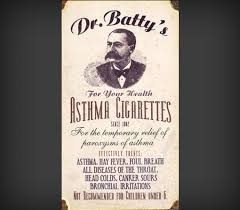 I would like to note that the cigarettes included in the formula presented in this article do not contain nicotine. Until recently, asthma cigarettes were an option that offered long-term hope and relief for many asthma patients. Inhaling smoke to control asthma symptoms was a preferred treatment option in the earliest traditions of medicine (Greek, Roman, and Ayurvedic). Prior to the 19th century, the use of asthma cigarettes was quite popular in Western medicine.
Scottish-born physician in Madras, Dr. James Anderson, experimented with a treatment containing stramonium. He shared his findings with his friend and colleague Dr. Sims, who wrote about the subject in the medical press. Following the articles published on this topic, asthma cigarettes began to be widely used by patients. However, there were numerous problems. First, although the inhalation of atropine was beneficial in alleviating symptoms, inhaling smoke as part of the therapy was hardly helpful for asthma disease itself. In particular, due to the general perception of smoking as “healthy,” many asthma patients were encouraged to use tobacco. Second, because the dose of stramonium contained in the cigarettes could not be standardized, a risk of atropine overdose arose. Overdose resulted in patients experiencing palpitations accompanied by hallucinations. Sadly, Dr. Sims died of an overdose just one year after publishing his report in the press. In the early 20th century, as the allergy theory of asthma etiology gained prominence, the therapeutic use of cigarettes began to decline. However, physicians had few alternatives to recommend to their patients. The advancement of the pharmaceutical industry led to the discovery of purer forms of atropine, hyoscine, and scopolamine. The clinical use of adrenaline, theophylline, and aminophylline in the 1920s and 1930s caused asthma cigarettes to become less favored. Ultimately, the development of inhaled bronchodilators in the 1950s and 1960s, along with salbutamol in the 1960s—and the use of “Ventolin,” which remains a cornerstone of therapy today—put an end to the prominence of asthma cigarettes.
By 1985, asthma cigarettes had been removed from the shelves of all US stores. However, while asthma cigarettes are no longer used in Western countries, their use still continues in third-world countries.Rp.
Folium stramonii 50 g
Folium belladonnae 25 g
Folium hyoscyami 25 g
Kalii nitras 5 g
Aqua 15 g
Alcoholum 10 g
Ingredients in the formula:
Folium stramonii- D. stramonium- Jimsonweed- Thornapple- Devil’s snare:It is an annual plant frequently found in our country. Its leaves are petiolate, large ovate, with slightly indented margins or pointed lobes. The calyx is long, angular tubular, and deciduous, but its basal part remains at the base of the fruit. The capsule is erect and prickly. Its leaves, Folia Stramonii T.K., contain hyoscyamine and atropine. Cigarettes prepared from the leaves and flowers are effective against shortness of breath.Folium belladonnae- Belladonna leaf- Deadly nightshade (Atropa belladonna L.) leaf:It is a tall, perennial herbaceous plant that grows in moist forest understories in Europe and along the Northern Black Sea region in our country. Its leaves are ovate, pointed, soft, and its flowers are solitary in the leaf axils, bell-shaped, and brownish-purple in color. The fruit is a cherry-sized, black, and shiny berry. (In berry-type fruits, the entire pericarp is fleshy. The seed-like grains it contains are true seeds. The exocarp is thin and membranous. The mesocarp and endocarp are fleshy (grapes, tomatoes, etc.). Some berry types bear different names due to their characteristics). At the base, there is a star-shaped 5-lobed calyx. Its leaves, Folia Belladonnae T.K., and roots, Radix Belladonnae, contain the alkaloids atropine and hyoscyamine. The plant’s name originates from “Bella-Donna”, meaning beautiful woman in Italian. This is because the plant’s sap was instilled into the eyes by women to make their pupils appear large and attractive. Atropine found in the plant’s composition exhibits a mydriatic effect and dilates the pupils. It is used in vagotonia and gastric indigestion.Folium hyoscyami – Henbane – Black Henbane (Hyoscyamus niger L.) – Hyoscyamus leaf [BP2000]:It is a species encountered in almost every region of our country, along roadsides, and in fields. Its leaves are sessile, large, ovate, and lobed; the corolla is a dull yellow color with purple reticulate veins. The fruit calyx is constricted in the middle and swollen at the base. The herbal drug contains hyoscyamine and scopolamine alkaloids. Due to the scopolamine in its composition, it exhibits sedative and analgesic effects. The roots and leaves of the plant are also used for the same purpose. Formerly used as a folk medicine, its leaves were mixed with tobacco to treat shortness of breath. Poisonings, particularly in children, are observed as a result of ingesting its seeds and roots. It is known to be abused due to its hallucinogenic effects. It may cause dry mouth, decreased sweat gland secretion; flushing, dryness, and increased temperature of the skin; accommodation disorders, mydriasis, tachycardia, constipation, urinary retention, triggering of glaucoma attacks, hallucinations, and muscle contractions at high doses. Although approved by Commission E—responsible for the preparation and licensing of herbal preparations in Germany—for spasms in the gastrointestinal tract based on clinical trial results, its use in therapy is discouraged due to severe adverse effects that may manifest even at low doses.Kalii nitras- Potassium nitrate- Potassio (nitrato de) [Ph. Eur. 4]:Potassium nitrate occurs as colorless crystals or a white crystalline powder. It is freely soluble in water. Potassium nitrate has oxidizing properties. Because it contains potassium, it produces a lilac-colored flame upon combustion. For this reason, it is used in fireworks and in many formulations, such as amateur rocket propellants and smoke bombs obtained from a mixture of sugar and potassium nitrate. In addition, it is added to tobacco blends before rolling cigarettes to ensure even burning of the tobacco. Potassium nitrate is found in some toothpastes used for sensitive teeth. Recently, the use of potassium nitrate in toothpaste has increased for the treatment of sensitive teeth.Aethanolum- Alcoholum- Ethanolum- Spiritus vini:In ancient times, it was called “water of life” and was believed to be a cure for practically every ailment. An important property of alcohol is that it is an excellent solvent frequently used in most pharmaceutical formulations. While Ethyl Alcohol is effective at a concentration of 60-90%, a 70% concentration (vol/vol) demonstrates optimal efficacy for skin antisepsis. Conversely, when the concentration drops below 50%, it largely loses its activity. Alcohol exerts its effect by coagulating proteins and dissolving lipids. Since protein denaturation requires the presence of some water, the antimicrobial effect of absolute (96%) alcohol is weak. Official USP alcohol has a minimum purity of approximately 99.6% v/v. It has a characteristic odor and taste, and is miscible in all proportions with water, ether, or chloroform.Preparation of the formula:Folium stramonii, Folium belladonnae, and Folium hyoscyami are ensured to be of as uniform particle size as possible. They are impregnated with a solution of potassium nitrate prepared in a mixture of water and alcohol. They are finely chopped and rapidly dried. Then, they are filled into filtered cigarette tubes. Each cigarette should contain 1 g of substance.Presentation:Medicated cigarettes (maximum 30 pieces)
For external use.Main Action – Usage:Used as a respiratory antispasmodic.Warnings:TOXIC COMPOUNDS
Folium stramonii 200 mg – 600 mg
Folium belladonnae 100 mg – 300 mg
Folium hyoscyami 200 mg – 600 mg
Wishing you a good week…
Source:
1- TEB Formulary
2- RxMediaPharma®2016 Interactive Drug Information Source
3- Pharmaceutical Botany (Prof. Dr. Asuman BAYTOP)Spec. Pharm. Ahmet Nezihi Pekcan
Pekcan Pharmacy – Konya
[email protected]
Tel: (332) 3520657
http://www.majistralformul.com/