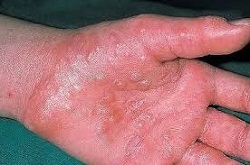
Dear Colleagues; Eczema, a generic term used for acute or chronic inflammatory conditions typically characterized by redness (erythema), formation of fluid-filled blisters (papule and vesicle formation), scaling, thickening and hardening (lichenification) on the skin, occurring in successive stages in most cases, and considered one of the most common skin diseases in the world, is a disorder regarding whose causes and definitive cure the medical world cannot speak definitively. In eczema, the skin mounts a defense and responds through inflammation due to endogenous or environmental factors. It is a condition that leads to itching, rashes, redness, dryness, and cracking of the skin. There are various types of eczema such as nervous, allergic, seborrheic (oily skin), and contact eczema. The most common type is allergic eczema, also known as ‘atopic dermatitis’, and it is predominantly thought to be hereditary. Patients usually exhibit similar symptoms. Swelling, irritation, and itching on the skin are the most common complaints.
While some types of eczema, such as contact eczema, occur due to a single trigger, other types of eczema may arise from the combination of many factors. Eczema seen in children may resolve on its own over time; however, there is no definitive cure for adult eczema. Eczema can be kept under control by avoiding the factors that trigger the disease. This week, we will examine together a preparation prescribed in the treatment of eczema, sourced from the Serbian National Formulary.
Rp.
Pix Juniperi 3.00 g
Resorcinolum 3.00 g
Benzocainum 0.50 g
Zinci oxydum 6.00 g
Tritici amylum 3.00 g
Glycerolum, 85 % 12.00 g
Adeps lanae 72.50 g
.jpg)
Substances included in the formula
Juniper tar- Goudron de cade- Pix cadi- Pyroleum juniperi- Wacholderteer- Huile de cade;
Juniper tar (pix juniperi oxycedri) is obtained from the trunk and branches of the prickly juniper plant widely grown in Anatolia. It is a syrupy, reddish-black liquid with a pungent, distinctive odor and an aromatic, burning taste. Juniper tar contains essential oil, resin, cadinene (a triterpene), and phenol derivatives (guaiacol and cresol derivatives). The drug, which has antiseptic properties, is applied directly to the skin or used in the form of an ointment. It is also used externally in the treatment of eczema and psoriasis. It is beneficial in the treatment of seborrhea, eczema, psoriasis, and dandruff, scaling, and itching on the hairy scalp. It is commonly incorporated into the composition of shampoos prepared for this purpose. Juniper tar (Cade oil) is obtained by dry distillation of the wood of the juniper (Juniperus oxycedrus) tree from the Pinaceae family. It is a syrupy, dark brown liquid with a bitter taste and pungent odor. It contains guaiacol, ethylguaiacol, cresol, and cadinene. It is very slightly soluble in water; soluble in alcohol at a ratio of 1:9; soluble in ether at a ratio of 1:3 leaving small residue behind; partially soluble in petroleum ether; and miscible with amyl alcohol, chloroform, and glacial acetic acid. Juniper tar (Cade oil) should be stored in airtight containers. It should not be exposed to excessive heat. It must be protected from light.
Benzocaine- Anesthesine- Benzocaina- Anaesthesinum;
Benzocaine is a short-acting ester-type local anesthetic. Benzocaine occurs as colorless or white crystals or as a white, odorless crystalline powder. Its melting point is between 88–92°C. Solubility according to the British Pharmacopoeia (BP): Very slightly soluble in water; freely soluble in alcohol, chloroform, and ether. Solubility according to the United States Pharmacopeia (USP): Soluble in water 1:2500, in alcohol 1:5, in chloroform 1:2, and in ether 1:4; soluble in dilute acids; soluble in almond oil and olive oil at 1:30 to 1:50. Benzocaine and tetracaine have a higher potential to cause contact allergy compared to other local anesthetics. Benzocaine is applied by rubbing onto the skin. It is minimally absorbed from the site of application; therefore, undesirable systemic side effects are relatively rare. Its onset of action is rapid and seen within 1 minute. Its duration of action is about 15–20 minutes. Benzocaine is metabolized in the liver. Its metabolites undergo elimination via the kidneys.
Dibromsalicylii- Resorcine- Dihydroxybenzene- Resorcinol;
It is a white crystalline substance with a characteristic odor. Its color turns reddish under the influence of air and light. It has a burning taste. Soluble in 1 part water and 1 part alcohol, as well as in ether, glycerin, and benzene, while insoluble in chloroform. It is incompatible with acetanilide, camphor, chloral hydrate, menthol, and phenol. Resorcinol is used as an antiseptic and disinfectant. It is used externally (ointment 10–20%, solution 0.1%) in psoriasis, acne, seborrhea, eczema, and other skin diseases. Application over very large surfaces should be avoided. Maximum Dose (M.D.) is 0.50–1.5 g.
Zinc oxide- Zinci oxide- Oxyde de zinc;
It is an active substance with astringent properties known for its mild antiseptic characteristics. It is used in eczema, burns, diaper rash, and skin damage due to friction. Zinc oxide ointment contains 20% zinc oxide, and zinc oxide paste contains 25%. Zinc oxide is not absorbed through the skin, and because it is insoluble in water, it is applied in the form of powder, ointment, or paste.
Starch- Amylum- Tritici amylum- Oryzae amylum;
Starch is named corn, potato, wheat, or rice starch depending on the source from which it is obtained. Starch is used as a binder, diluent, and disintegrant in solid pharmaceutical dosage forms, primarily in tablets. It is practically insoluble in cold water and cold alcohol. It possesses adsorbent properties.
Glycerol- Glycerine- Glycerol-85 %;
Glcerin is a clear, colorless or very pale, hygroscopic, syrupy liquid that is odorless or has a very slight odor and a sweet taste. Miscible with water and alcohol; slightly soluble in acetone; practically insoluble in chloroform, ether, fixed oils, and essential oils. Aqueous solutions give a neutral reaction to litmus. According to the United States Pharmacopeia (USP), the pH of Glycerin Oral Solution, USP is between 5.5 and 7.5. Strong oxidizing agents form explosive mixtures when combined with glycerin.
Lanolin- Graisse de laine- Adeps lanae- Refined wool fat- Lanae cera- Lanoleine T.K.;
Obtained from sheep’s wool. It is pale yellow in color and has an ointment consistency. Soluble in ether, petroleum ether, chloroform, and boiling absolute alcohol. It absorbs twice its weight in water. It is an emulsifier. It forms a water/oil emulsion. In anhydrous form, its consistency is quite stiff. With the addition of water, a pasty structure is formed. It absorbs water by its weight. It is easily absorbed by the skin and is odorless. It is used as an ointment base. The base designated as lanolinum by the Turkish Pharmacopoeia (T.K.) contains 13 parts lanolin, 3 parts liquid paraffin, and 4 parts water.
Preparation of the formula- Modus operandi
Benzocaine, resorcinol, wheat starch, and zinc oxide are mixed in a glass mortar until homogeneous. Glycerin is added to this mixture to form a paste-like mass, to which anhydrous lanolin, previously warmed in a water bath, is added gradually with thorough mixing. The preparation is completed by adding the juniper tar to the formulation.
Usage
Used in keratosis (any lesion resulting from excessive growth and thickening of the horny layer of the epidermis due to keratinization disorder) and in the repair of epithelial tissue. In eczema, it is applied once daily to the affected area of the skin and the ointment is allowed to remain on the skin for at least one hour.
Storage
Should be stored in well-closed and light-protected amber glass bottles at room temperature not exceeding 25°C.
Wishing you a pleasant week…
Source: Farmaceutsko drustvo Srbije
Tel: (332) 3520657
Fax: (332) 3512816