Dear colleagues,
We particularly remember pharmaceutical preparations containing this active ingredient, which we stock in our pharmacies in cream, ointment, and ampoule forms, under the brand name Bepanthen®.
By the end of this article, we will see together that we can easily prepare it in our pharmacies in the form of a mouthwash, cream, and ointment whenever we wish, using existing laboratory facilities.
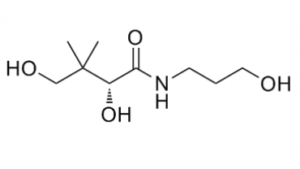
Dexpanthenol is the alcohol form of pantothenic acid, a factor of the vitamin B complex. Pantothenic acid is widely found in foods. Cereals and legumes are the richest dietary sources of pantothenic acid. Dexpanthenol is absorbed more rapidly and in greater amounts than pantothenic acid; this is of particular importance for topical application. We will examine this active ingredient, preferred for its epithelializing and cicatrizing effects on mucosa and epithelial tissue, along with its preparations included in German standard formulas (NRF/SR).
Dexpanthenol-Lösung 5 % (NRF 7.3.)
Dexpanthenol 5.00 g
Natriumbenzoat 0.15 g
Wasserfreie Citronensäure 0.10 g
Gereinigtes Wasser to 100.00 g
Substances included in the formula;
D-panthenol – Dexpanthenol – Pantothenyl alcohol – Pantothenol – Dexpantenol – Provitamin B5;
Dexpanthenol is a clear, odorless or slightly characteristically scented, hygroscopic, and viscous liquid. It is freely soluble in water, alcohol, methyl alcohol, and propylene glycol; soluble in chloroform and ether; slightly soluble in glycerol. It may crystallize upon prolonged standing.
Dexpanthenol should be stored at room temperature below 30°C and in tightly closed, airtight containers. Dexpanthenol is a parenterally administered gastrointestinal stimulant. Pantothenic acid, which is a component of Coenzyme A, takes part in various metabolic processes. It facilitates the acetylation that enables the conversion of choline to acetylcholine. Pantothenic acid plays an important role in the formation and maintenance of the normal function of epithelial tissue. Dexpanthenol is the alcohol form of pantothenic acid, a component of the vitamin B complex. Dexpanthenol is also used prophylactically to prevent postoperative ileus. It is also indicated in conditions of weakened gastrointestinal activity. A true deficiency state for pantothenic acid has not been characterized. Nevertheless, D-pantothenic acid or its racemic form is added to multivitamin preparations as calcium or sodium salts or as dexpanthenol. Pantothenic acid is widely distributed in foods. Cereals and legumes are the richest dietary sources of pantothenic acid.
Pantothenic acid enters into the composition of coenzyme A. Coenzyme A, in the form of acetyl-coenzyme A, plays a role in many metabolic processes in the body. Carbohydrate metabolism, acetylcholine synthesis, cholesterol synthesis, oxidative degradation of lipids, steroid hormone synthesis in the adrenal cortex, and the acetylation and biotransformation of drugs and other xenobiotics in the liver are the main ones among these. In addition, it plays a role in the citric acid cycle and heme synthesis in the form of succinyl-coenzyme A. Dexpanthenol is administered orally, parenterally, and topically. After absorption, it is converted into pantothenic acid in the liver and joins endogenous vitamin stores. When applied topically in pharmaceutical forms such as ointments, lotions, and similar preparations, it is rapidly absorbed through the skin. Pantothenic acid is essential in the organism for the formation and regeneration of skin and mucosa. Pantothenic acid binds to plasma proteins in the blood, primarily beta-globulins and albumin. In healthy adults, it is present in whole blood at a concentration of approximately 500-1000 µg/l and in serum at 100 µg/l. Pantothenic acid is not metabolized in the human body; therefore, 60-70% of an oral dose is excreted unchanged in the urine, and the remainder in the feces. The amount of pantothenic acid excreted in the urine is 2-7 mg per day in adults and 2-3 mg in children.
Sodium benzoate – Benzoate de sodium – Natrii benzoas – Sodii benzoas – Sodium benzoate;
Sodium benzoate is available as a white, odorless or almost odorless, granular or crystalline powder or flakes. According to the British Pharmacopoeia (BP), it is a slightly hygroscopic substance. Solubility according to BP: Freely soluble in water; sparingly soluble in alcohol (90%). Solubility according to the United States Pharmacopeia (USP): Soluble in water 1:2, in alcohol 1:75, and in 90% alcohol 1:50. Benzoates are absorbed from the gastrointestinal tract. In the liver, they combine with glycine to form hippuric acid. The resulting hippuric acid is rapidly eliminated in the urine. Sodium benzoate irritates the gastric mucosa, thereby increasing the secretion of bronchial mucous glands reflexively and/or through direct action. For this reason, it is included in the composition of many cough formulations. Sodium benzoate is a substance with mild expectorant action. Benzoates also exhibit antibacterial and antifungal activity. Their antimicrobial activity originates from undissociated benzoic acid. Due to these properties, they are used as antimicrobial preservatives in pharmaceutical preparations and foods.
Wasserfreie Citronensäure – Citric acid – Acide citrique – Anhydrous citric acid – Zitronensäure;
Citric acid and sodium citrate are orally administered alkalinizing agents. Preparations containing citric acid are used to dissolve kidney stones, alkalinize urine, and prevent the obstruction of urinary catheters. Citric acid is a component of citrated anticoagulant solutions; it is also present in preparations used for gastrointestinal disorders and the treatment of metabolic acidosis. On the other hand, due to its mild astringent effect, citric acid helps relieve the irritant effect of expectorants. Therefore, it is also included in the composition of certain combinations used in cough treatment. Furthermore, solutions containing citric acid at a 1:500 ratio are used as oral and foot disinfectants.
Citric acid is also used as an excipient in pharmaceutical technology for the preparation of effervescent granules, solutions, and syrups. Anhydrous citric acid should be stored in airtight containers.
Gereinigtes Wasser – Distilled water
Preparation of the formula;
After dissolving the calculated amount of citric acid and sodium benzoate in boiled and cooled distilled water, dexpanthenol is added. The formula should not exceed 100 g.
It is used in the topical treatment of oral cavity inflammations such as stomatitis or uninfected minor wounds. Also used in the treatment of broad skin lesions, scalp, and hair-bearing skin, this solution, when used in the oral cavity, must be used as a solution diluted with boiled and cooled water, and the oral cavity should be rinsed with water after application several times a day.
No evidence has been found indicating a risk to the patient during pregnancy and lactation. Fetotoxic effect is considered a very remote possibility. In rare cases, allergic skin reactions have been reported following application.
To be continued…
Wishing you a good week…
Tel: (332) 3520657
Fax: (332) 3512816