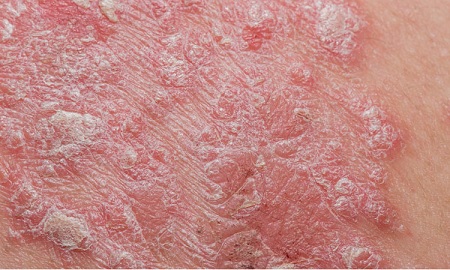
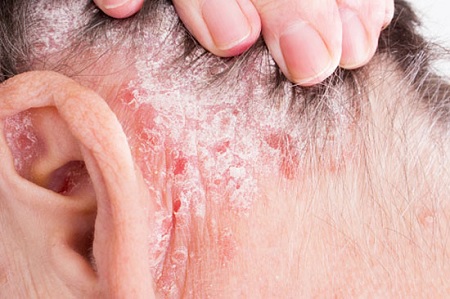
Psoriasis is a chronic skin disease whose exact cause is not fully known. It is a skin disease characterized by red patches covered with silvery scales. Psoriasis is a common skin condition featuring severe flare-up periods and stages of remission. The most common sites of occurrence are the elbows, knees, trunk, and scalp. It can cause pitting or ridged elevations in the nails. Periods when psoriasis flares up present with pustules, skin cracking, itching, minor bleeding, or joint pain. It is not a contagious disease and is believed to stem from a genetic predisposition. It has forms ranging from mild to severe. Although it cannot be completely cured, effective results can be achieved by applying treatment during flare-ups. In mild cases, coal tar soaps, shampoos, cleansers, and ointments, as well as bath oils, are used. In treatment-resistant cases where the scalp is affected, lotions containing tar and phenol are used. In cases of psoriasis that disrupt normal life, methotrexate, a medication used in cancer treatment, may be used; however, this strictly requires medical supervision. In severe cases, phototherapy is also utilized.
Dear Colleagues, this week we will examine together this formulation featured in Allen’s Compounded Formulations and used in the treatment of psoriasis. In psoriasis, where there are not many treatment options, this formula has been shown to be safe and effective.
Gel formula containing Zinc Pyrithione and Clobetasol Propionate;
Rp.
Zinc pyrithione 200 mg
Clobetasol Propionate 50 mg
Sodium Lauryl Sulfate 500 mg
Hydroxypropyl Cellulose 1.75 g
Propylene Glycol 10 ml
Isopropyl Myristate 10 ml
Alcohol USP qs 100 ml
Ingredients in the formula:
Pyrithion zink [INN; ASK]- Zinc pyrithione- Pyrithionum zincicum [INN]:
Zinc pyrithione (C10H8N2O2S2Zn, MW 317.68) is an off-white powder that is practically insoluble in water and slightly soluble in alcohol. The mechanism of action of zinc pyrithione has not been fully elucidated. According to one view, it exhibits bacteriostatic and fungicidal effects. According to another view, it exhibits a cytostatic effect due to reducing the turnover rate of epidermal cells.
Its effect may be due to non-specific toxicity to epidermal cells. It binds strongly to both hair and the outer layers of the skin.
Zinc pyrithione is used in the treatment of simple dandruff of the skin and dry or oily types of seborrheic dermatitis. For this purpose, it is applied at a 2% concentration. It is included in the formulation of anti-dandruff shampoos. It has also been used in the treatment of pityriasis versicolor (tinea versicolor). Magnesium pyrithione salts are also used for the same purposes.
Clobetasol propionate- Clobetasolpropionat [DAC 1997]- Clobetasol 17alpha-propionate [INN]- Clobetasol, propionato de:
Clobetasol propionate is a cream-to-white, odorless, crystalline synthetic fluorinated powder. It is practically insoluble in water; slightly soluble in alcohol; soluble in acetone, dimethyl sulfoxide, chloroform, methyl alcohol, and dioxane; slightly soluble in ether. Its solubility is 2 mg/mL in water and 10 mg/mL in alcohol.
It is classified as an anti-inflammatory corticosteroid used for the relief of inflammatory manifestations of moderate to severe corticosteroid-responsive dermatoses. It appears to induce the synthesis of enzymes required to decrease inflammation, suppress mitotic activity, and cause vasoconstriction. It should be stored in tight, light-resistant containers.
Clobetasol is the most potent topical corticosteroid and is only used for short-term treatment. When used for prolonged periods, it may lead to systemic side effects, including suppression of the hypothalamic-pituitary-adrenal (HPA) axis due to systemic absorption.
Like all topical corticosteroids, clobetasol exhibits anti-inflammatory, antipruritic, and vasoconstrictive effects. In the treatment of allergic conditions, they reduce the allergic responses of certain cell types associated with the allergic response, such as mast cells and eosinophils.
Clobetasol is applied topically as a cream, gel, ointment, or topical solution. When topical corticosteroids are applied to the skin, their percutaneous absorption depends on many factors, including the vehicle used in formulating the pharmaceutical dosage form and the integrity of the epidermis. The absorption of topically applied clobetasol increases in damaged, inflamed, or occluded skin areas or in areas where the skin is thin, such as the eyelids, axillae, and face.
Sodium lauryl sulfate- Sodium lauryl sulphate [BP; P.Cx.79]- Laurylsulfate de sodium [DCF; FP]:
Its molecular weight ranges between 50,000 and 1,250,000. It is available as a slightly yellow, odorless, and tasteless powder. The pH of a 1% w/v aqueous solution is 5.0–8.5; it softens at 130 °C and chars at 260–275 °C. 1 g dissolves in 2 mL of water, 2.5 mL of ethanol, and 5 mL of propylene glycol; it is practically insoluble in glycerin, oils, and hot water. It dissolves in water in a 1:10 ratio yielding an opalescent solution; partially soluble in alcohol; practically insoluble in chloroform and ether. It occurs as a white or pale yellow powder or crystals with a faint characteristic odor.
Sodium lauryl sulfate is used as an anionic surfactant in pharmaceutical formulations and cosmetic products. It is an effective detergent and wetting agent in both acidic and alkaline environments. It is also used in medicated shampoos, toothpastes, and skin-cleansing preparations. It is not used in parenteral preparations. It may cause irritation to the skin, eyes, mucous membranes, upper respiratory tract, and stomach. Prolonged exposure to dilute sodium lauryl sulfate solutions may cause skin dryness and cracking; contact dermatitis may develop. Inhaling it over prolonged periods may cause lung damage. Sodium lauryl sulfate is a mixture of alkyl sulfates. According to the British Pharmacopoeia (BP), it is a mixture containing not less than 85% sodium alkyl sulfates and not more than 8% sodium chloride and sodium sulfate combined.
Sodium lauryl sulfate is a stable substance under normal conditions. However, in solutions at pH 2.5 or below, it hydrolyzes to form lauryl alcohol and sodium bisulfate. It reacts with cationic surfactants, resulting in a loss of activity. Its aqueous solutions with a pH between 9.5 and 10 can corrode steel, copper, brass, bronze, and aluminum. It is incompatible with salts of polyvalent metals such as aluminum, lead, tin, or zinc, certain alkaloid salts, and acids below pH 2.5. It precipitates with lead and potassium salts.
Hydroxypropyl cellulose- Hydroxypropyl cellulose- Hydroxypropylcellulosum:
Hydroxypropyl cellulose is one of the important excipients used for various purposes in pharmaceutical preparations. In tablets, it is generally used as a binder and film-coating agent. A 5% solution is commonly used for film coating. It is also used as a matrix material in tablets prepared as modified-release systems. Low-substituted hydroxypropyl cellulose (L-HPC) is utilized as a disintegrant in tablets.
Hydroxypropyl cellulose is a white or slightly yellow, odorless, and tasteless powder. It dissolves in cold water, glacial acetic acid, anhydrous alcohol, chloroform, methyl alcohol, propylene glycol, and a methyl alcohol-methylene chloride mixture yielding colloidal solutions; it is sparingly soluble in acetone; practically insoluble in hot water, ethylene glycol, and toluene. The pH of its 1% aqueous solution is between 5.0 and 8.5. Aqueous solutions of hydroxypropyl cellulose are stable at pH 6–8 in tightly closed containers. At low pH values, a decrease in viscosity may occur due to acid hydrolysis. The rate of hydrolysis increases in parallel with rising temperature and hydrogen ion concentration. Above 45 °C, the viscosity drops rapidly and the polymer is not soluble at this temperature; this situation is reversible upon cooling the preparation. Aqueous solutions are also sensitive to ultraviolet light and will degrade upon exposure over several months. At high pH, it can also lose its polymeric nature through alkali-catalyzed oxidative degradation, which likewise results in reduced viscosity. Viscosity also decreases when it undergoes enzymatic degradation. The enzymes causing this degradation are produced by microorganisms in the environment. Therefore, an antimicrobial preservative must be added to hydroxypropyl cellulose solutions intended for prolonged storage. Degradation of the polymer may also occur under the influence of ultraviolet light. Thus, a slight decrease in viscosity may be observed in aqueous solutions exposed to light for several months. It is incompatible with potassium permanganate.
Propylene glycol [BP; DCF; FP; INCI; NF; P.Cx.79; USP]- Propylenglycol [ASK; Ph.Eur.]- Methyl ethylene glycol- Methyl glycol:
Propylene glycol is an excipient used for various purposes in pharmaceutical preparations. It is used as a solvent and vehicle, particularly for drugs that are unstable or insoluble in aqueous media. It is a better solvent than glycerin. It is an excellent solvent for corticosteroids, phenols, sulfonamides/sulfate-group drugs, barbiturates, vitamins A and D, alkaloids, and local anesthetics. In addition to being used as a stabilizer in vitamin preparations, it is also useful as a plasticizer and preservative. It is used as a carrier for emulsifying agents in cosmetic products and the food industry. It is preferred over ethanol for carrying flavoring agents. Due to its humectant property, it is used in place of glycerin in topical moisturizing preparations. Propylene glycol may cause local irritation to the skin and mucous membranes. Hypersensitivity reactions have been reported. Particularly in patients with renal failure, it may cause hyperosmolality, lactic acidosis, and central nervous system depression. The estimated acceptable daily intake of propylene glycol has been reported as up to 25 mg per kg of body weight.
Propylene glycol is a clear, colorless, odorless or practically odorless, hygroscopic liquid with a slightly characteristic taste. It is miscible with water, acetone, alcohol, and chloroform; soluble in ether; immiscible with fixed oils, but dissolves some essential oils. It should be stored in a cool place in airtight containers. It must be protected from light and moisture. At elevated temperatures, it tends to oxidize to give degradation products such as propionaldehyde, lactic acid, pyruvic acid, and acetic acid. It is incompatible with oxidizing agents such as potassium permanganate. It is recommended not to use it as a solvent in ear drops containing chloramphenicol.
Isopropylis myristas- Isopropyl ester of myristic acid- Myristic acid isopropyl ester:
Isopropyl myristate is used as an emollient, solvent, vehicle, and skin penetration enhancer in topical pharmaceutical preparations and cosmetic products. It is included in the composition of semi-solid vehicles. It is an important excipient used in the preparation of bath oils, makeup products, hair and nail care products, creams, lotions, lip preparations, shaving preparations, suntan preparations, skin lubricants, deodorants, otic suspensions, and vaginal cream formulations.
Isopropyl myristate is a clear, colorless, practically odorless, mobile, oily liquid. It congeals at around 5 °C. It is miscible with acetone, chloroform, ethanol, ethyl acetate, fats, fatty alcohols, fixed oils, liquid hydrocarbons, toluene, and waxes. It is practically insoluble in glycerin, propylene glycol, and water. It should be stored in well-closed containers in a cool, dry place, protected from light. Isopropyl myristate is incompatible with hard paraffin. When these two substances are combined, a granular mixture is formed. It is also incompatible with strong oxidizing agents.
Preparation of the formula:
The required amounts of ingredients in the formula are calculated and weighed. The powders are mixed with propylene glycol and isopropyl myristate. Alcohol is slowly added to the mixture and brought to the required volume.
The preparation must be kept away from the eyes and out of the reach of children. Keep away from open flames and store in a cool place. The formula can be stored for 6 months.
Wishing you a great week…
Specialist Pharmacist Ahmet Nezihi Pekcan
Pekcan Pharmacy – Konya
[email protected]
Tel: (332) 3520657
http://www.majistralformul.com/
References:
1-Allen’s Compounded Formulations.
2-RxMediaPharma®2019 Interactive Drug Information Source