Compounding formula option in the treatment of chronic eczema and psoriasis (NRF 11.46.)Dear colleagues, this week we will examine together this formula prescribed in Germany, especially for chronic dry eczema and psoriasis. In this formula, which is included in the German standard prescription formulas and contains coal tar as the active ingredient, peanut oil and coconut oil are used as carriers.
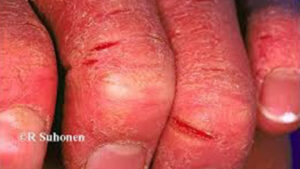
As is known, eczema is a generic term used for acute or chronic inflammatory skin conditions typically characterized by redness (erythema), the formation of fluid-filled blisters (papule and vesicle formation), scaling, thickening, and hardening (lichenification), mostly occurring in successive stages. It may sometimes be accompanied by hyperpigmentation, itching, and burning. This clinical condition, generally known as ‘atopic eczema/dermatitis’, is not a single disease, but a combination of several diseases with common features. A more appropriate term designating this is atopic eczema/dermatitis syndrome (AEDS). Its subgroup associated with allergic asthma and rhinoconjunctivitis should be named IgE-associated AEDS.Formula;
Rp.
Steinkohlenteer 5.0 g
Hydriertes erdnussöl 85.0 g
Mittelkettige triglyceride 5.0 g
Polysorbat 60 5.0 g
Ingredients in the formula;
Coal Tar- Goudron de Houille- Coal tar- Pix Carbonis- Pix Lithanthracis- Steinkohlenteer;It is prepared by the dry distillation of coal. It has a naphthalene-like odor and a pungent, burning taste. It is a dense, near-black liquid. It solidifies upon contact with air. It is slightly soluble in water. While soluble in chloroform and benzene, it is partially soluble in alcohol and ether. Its density gradually increases with exposure to air. It burns with a bright, sooty flame. Its saturated solution reacts alkaline to litmus. Coal tar is included in the formulation of medicated shampoos, soaps, and ointments used to treat dandruff and psoriasis, as well as to kill and eradicate head lice. Soluble extracts (2%) prepared by the dry distillation of coal tar are also used in the treatment of dandruff. Tars and tar oils reduce epidermal thickness. They are antipruritic and exhibit weak antiseptic action. They are used topically in the treatment of eczema, psoriasis, dandruff, seborrheic dermatitis, and other skin diseases. Coal tar preparations have largely been replaced by wood tars. Ultraviolet light enhances the efficacy of coal tar in the treatment of psoriasis. Some wood tars are included in the composition of expectorant preparations. Tar has also been used in homeopathic medicine.Hydrogenated peanut oil – Oleum Arachidis hydrogenatum – Peanut (Arachis hypogaea L.) oil – Peanut oil;Peanut (Arachis hypogaeaL.), legumes (Fabaceae) family, containing 45-60% oil, 20-30% protein, 18% carbohydrates, vitamins, and mineral substances in its seeds, is a valuable plant utilized in various ways, particularly in the oil industry and snack production, with its stems used as hay and hulls used in diverse manners. Peanuts are mostly consumed as snacks. For this purpose, peanut seeds are offered for consumption either in the shell or after cracking the shell and separating the seeds, then roasted to remove the raw peanut flavor and simultaneously increase shelf life. According to the European Pharmacopoeia (Ph Eur. 7), refined peanut oil (Arachis Oil, Refined; Arachis Oil BP2012) is obtained from shelled peanut seeds. A suitable antioxidant may be added. It is a clear, yellowish viscous liquid consisting mainly of glycerides of oleic and linoleic acids and a small amount of other acids. Approximately 2oC. It is very slightly soluble in alcohol; miscible with petroleum ether. It should be stored in well-filled containers. It must be protected from light. The fatty acids contained in peanut oil have positive effects on the blood lipid profile. Replacing dietary saturated fatty acids with more frequent consumption of unsaturated fatty acids helps increase the level of HDL cholesterol, known as good cholesterol, and decrease the levels of LDL cholesterol, known as bad cholesterol, triglycerides, and lipid oxidation. Positive effects on the cardiovascular system can be observed. Some studies indicate an inverse relationship between the frequency of peanut consumption and body mass index.Medium-chain triglycerides- Neutral oil- Triglycerida mediocatenalia- Triglyceridöl, mittelkettig, pflanzlich- Mittelkettige triglyceride;Medium-chain triglycerides are used as emulsifiers, suspending agents, and solvents in pharmaceutical preparations. They have good spreadability on the skin and do not affect skin respiration. In addition, their penetration through the skin is good and they exhibit a strong emollient effect on the skin. Other important characteristics include not forming a visible film layer on the skin, being a good solvent, and possessing high compatibility and stability against oxidation.
Medium-chain triglycerides are prepared from the oil obtained by extraction from the hard and dried parts of the endosperms of the plant Cocos nucifera L. (Palmae). They are obtained by fractionating the fatty acids resulting from the hydrolysis of fixed oil and subsequently esterifying them. Therefore, medium-chain triglycerides can be defined as a mixture of saturated fatty acid triglycerides. They contain not less than 95% of saturated caprylic and capric acids. It is a colorless or light-yellow oily liquid. It is practically insoluble in water; miscible with alcohol, methylene chloride, petroleum ether, and vegetable oils. It should be stored in completely filled and well-closed containers, protected from light. Due to incompatibility with polystyrene, high-density polyethylene, and polyvinyl chloride, the use of low-density polyethylene, polypropylene, glass, or metal materials is recommended for packaging medium-chain triglycerides. It is a white oily mass obtained by cold pressing from the dry solid parts of the fruits of the COCOS NUCIFERA L. (PALMAE) plant. I believe it might be easier to remember if I mention that this oil, which is the source of medium-chain triglycerides, is called COCONUT OIL. Known as a pleasant-smelling natural cosmetic product, coconut oil is known to be used locally, primarily for hair loss, as well as for numerous skin conditions (eczema, psoriasis, skin wounds and scars, dermatitis, etc.).Polyoxyethylene 60 sorbitan monolaurate- Tween 60- Polyoxyethylene 20 sorbitan monostearate;Polysorbates are nonionic surfactants used as emulsifiers in the preparation of stable oil-in-water pharmaceutical emulsions. They are used as solubilizing agents for a variety of substances, including essential oils and fat-soluble vitamins (such as vitamins A, D, and E). They are also used as wetting agents in oral and parenteral suspension formulations. The estimated acceptable daily maximum intake for polysorbates 20, 40, 60, 65, and 80, expressed as total polysorbate esters, has been reported as 25 mg per kg of body weight. Polysorbate 60 is a mixture of partial stearic acid esters of sorbitol and its anhydrides. Each mole of sorbitol and its anhydrides is copolymerized with approximately 20 moles of ethylene oxide. The stearic acid used in esterification may also contain other fatty acids (especially palmitic acid). It is a yellow-orange oily liquid, semi-gel, or yellowish-brown gelatinous substance. Above 25°C, it is a clear liquid. It has a faint, characteristic odor. It is miscible with water, anhydrous alcohol, methyl alcohol, ethyl acetate, and toluene. It is practically insoluble in liquid paraffin and fixed oils.
Polysorbates are stable in the presence of electrolytes, weak acids, and weak bases. Strong acids and bases can cause saponification.Preparation of the formula;After coal tar is mixed with polysorbate 60, the formulation is completed by adding the carrier oils.
In this formula, the active ingredient, coal tar, is used at a concentration of 5%. In the treatment of chronic eczema and psoriasis (psoriasis vulgaris), it is used in concentrations ranging from 2% to 20%, depending on the progression of the disease.
It is applied once daily in the evening as a thin layer to small, affected skin areas. The shelf life of the formula is 1 year in an aluminum tube.
Wishing you a great week…References;1- Standardisierte Rezepturen (NRF/SR)
2- RxMediaPharma®2016 Interactive Drug Information Resource
Specialist Pharmacist Ahmet Nezihi Pekcan
Pekcan Pharmacy – Konya
[email protected]
Tel: (332) 3520657http://www.majistralformul.com/