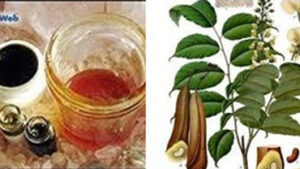
The Peru balsam tree (Myroxylon balsamum (L.) Harms var. pereirae) is a tree belonging to the legume family (Leguminosae), cultivated in Central America (particularly in El Salvador) and South America. Peru Balsam, a thick, black liquid, is obtained from the trunk of the plant. This crude drug, which appears dark orange in thin layers, contains resin, essential oil, cinnamic acid, and benzoic acid. Peru balsam exhibits a mild antiseptic effect due to the cinnamic and benzoic acids in its composition. Diluted with an equal amount of castor oil, it has been used in the treatment of bedsores and chronic ulcers. In the form of topical preparations, it is used against eczema and pruritus. It has been reported to be particularly effective as an antiseptic and cicatrizant in burn treatment. It is also included in the composition of certain rectal preparations that provide symptomatic relief for hemorrhoids. Furthermore, it has been incorporated into the formulation of various preparations used in the treatment of respiratory tract congestion.
(Click the link below for the article on this topic previously published in this column in 2013: http://eczacininsesi.com/index.php?yon=majistral&id=30)
In fact, both Peru and Tolu balsam are obtained from species of the Balsam tree (Myroxylon tree). The Balsam tree literally means fragrant wood in Greek. It is also known as Quina/Balsamo. The difference between Tolu balsam and Peru balsam fundamentally stems from their methods of production and aroma profiles. Tolu balsam has a slightly sweeter and fresher aroma and, as its name suggests, is produced from the species Myroxylon toluiferum H.B.K. (=Myroxylon balsamum var. balsamum). In contrast, M. balsamum (L.) Harms and Myroxylon pereirae are used in the production of Peru balsam.
Synonyms;
Myroxylon balsamum (L.) Harms var. pereirae (Royle) Harms – Myroxylon pereirae (Royle) Klotzsch
Perubalsambaum- Toluifera pereirae (Royle) Baill:
A thick, blackish liquid that does not harden upon exposure to air. It is characterized by an agreeable aroma and a bitter taste obtained through incisions in Myroxylon balsamum. Practically insoluble in water and partially soluble in ether and turpentine spirit, it is completely soluble in 90° alcohol and chloroform. It has a mild antiseptic effect and is diluted equally with castor oil. Its density is 1.140 – 1.170 g/ml. It predominantly contains benzoate and 45-70% esters.
It predominantly contains benzoate and 45-70% esters. It also contains benzyl cinnamate and free acids. Demonstrating mild antiseptic properties, Peru balsam is known not only for its wound-healing effect but also for its antiparasitic, antipruritic, scabicidal, keratoplastic, analgesic, and anti-inflammatory effects.
It is mostly used topically in pharmaceutical forms such as tinctures, solutions, ointments, emulsions, and the like. In treatment, it is diluted in equal amounts with castor oil.
It is used in the form of ointments for bedsores and chronic ulcers, eczema, and itching, as well as on superficial wounds and burns. Likewise, in the treatment of scabies, Peru balsam containing approximately 50% benzyl benzoate is used topically because it causes less irritation; it is also used for anal and perineal fissures, cracked nipples, dermatitides due to its keratoplastic effect, in hemorrhoid treatment in the form of suppositories and ointments, and in respiratory disorders due to its expectorant and cough-suppressing effects.
In ointments, it is formulated with castor oil or a lipophilic surfactant to prevent phase separation.
Dosage: While used topically at rates up to 12.5%, it can be used at rates of 10-20% in the treatment of scabies.
Side effects: May cause skin sensitization.
Precautions: Since it is irritating, it is recommended for topical use only.
Storage: It should be protected from light in tightly closed containers. It is photosensitive.
FORMULA 1:
Scabies ointment for children
Rp.
Peru Balsam 10%
Castor oil 10 g
Lanolin 15 g
Vaseline q.s. 100 g
Preparation of the formula:
Vaseline and lanolin are mixed in a water bath at low heat. Peru balsam and castor oil are mixed and added to the lanovaseline base.
FORMULA 2:
Cream for cracked nipples
Rp.
Peru Balsam 1%
Bismuth subnitrate 10%
Benzocaine 2%
Vitamin A 60,000 IU
Vitamin D 8,000 IU
Cream q.s. 50 g
FORMULA 3:
Ointment for bedsores and leg ulcers
Rp.
Peru Balsam 1%
Filament Vaseline q.s. 100 g
FORMULA 4:
Peru balsam ointment containing borax
Rp.
Peru Balsam 15 g
Borax 5 g
Filament Vaseline 80 g
FORMULA 5:
Paste for bedsores
Rp.
Peru Balsam 1%
Benzoin Tincture 5%
Zinc Oxide 40%
Sweet almond oil q.s. 100 g
FORMULA 6:
Peru Balsam oil
Rp.
Peru Balsam 50 g
Castor oil 50 g
FORMULA 6:
Rp.
Peru Balsam 30 g
Zinc Oxide 10 g
Tannic acid 5 g
Camphor 10 g
Glycerin 50 g
Wishing you a great week…
Spec. Pharm. Ahmet Nezihi PEKCAN
Pekcan Pharmacy – Konya
References:
1- Martindale, Guía completa de consulta farmacoterapéutica, 1ª ed. (2003).
2 – Formulación magistral de medicamentos, COF de Vizkaia, 5ª ed. (2004).
3 – Monografías Farmacéuticas, C.O.F. de Alicante (1998).
4- Formulario básico de medicamentos magistrales, M. ª José Llopis Clavijo y Vicent Baixauli Comes (2007).
5 – Formulario Magistral del C.O.F. de Murcia (1997).
6 – Fitoterapia. Vademecum de Prescripción. Plantas Medicinales. Ed. Masson. 3ª ed. (1998).
7 – Formulario médico farmacéutico, PharmaBooks, 2010
8 – La Formulacion Magistral en la Oficina de Farmacia valencia, 1981
Spec. Pharm. Ahmet Nezihi Pekcan
Pekcan Pharmacy – Konya
[email protected]
Tel: (332) 3520657
http://www.majistralformul.com/