Dear colleagues, this week we will examine a formula prescribed by physicians in Spain, used in the treatment of a painful type of wart primarily occurring on the soles of the feet, known as verruca plantaris.
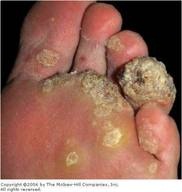
Warts are a common complaint among children and adults. A plantar wart is a lesion about 1 cm wide, or it can be even larger. Sometimes smaller warts may surround a larger wart; this is called a mosaic wart.
Verruca plantaris is a painful type of wart that forms on the sole of the foot. These types of warts, flattened under pressure and surrounded by cornified epithelium, are quite common. It is a contagious epithelial tumor with well-defined borders, flesh-colored, often round and raised, with a dry and rough surface, caused by the proliferation of epidermal cells on the skin surface due to human papillomavirus. At least 60 different types of human papillomavirus are known causative agents of warts. All warts are caused by the human papillomavirus.
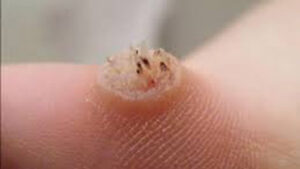
A wart is more superficial compared to a corn. The surface of the wart is dotted with black spots, which are blood vessels nourishing the wart. It is slightly lighter than the skin color. A corn or callus may form over the wart. The patient complains of feeling as though they are stepping on a stone. Unless manipulated or stepped on, a wart generally does not cause pain. It can also spread to other parts of the foot and body. If there are any cracks, scratches, or wounds on the skin, this allows the virus to penetrate beneath the skin. Excessive moisture or extreme dryness causes the skin to crack, thus allowing the virus to enter.
Warts are commonly transmitted to people in crowded places such as swimming pools, showers, and locker rooms. Children are at greater risk because they spend more time in school locker rooms and swimming pools..
*Medications containing salicylic acid, which are also available in our pharmacies, can be beneficial. Care should be taken to apply these solutions only onto the wart, and individuals with diabetes or circulatory problems should avoid using such medications.
*If the wart is kept covered, the rate of spread is halted.
*The callus formed around the wart may need to be removed by a specialist physician for the medication to take effect.
In this formulation, while lactic acid is included as a caustic and antiseptic, it is combined with a keratolytic, antifungal, and bacteriostatic agent (salicylic acid) and PODOFILM® for mitotic inhibition in the treatment of plantar warts.
Rp.
Lactic acid 5 g
Salicylic acid 5 g
Podophyllin 1 g
Flexible collodion 30 g
Substances in the formula
T.K. – Acidi lactici- Acide lactique Milchsäure- Lactic acid:
Lactic acid is a colorless or light yellow, hygroscopic, odorless syrupy liquid with an acidic taste. Lactic acid is miscible with water, alcohol, and ether, and is practically insoluble in chloroform. It is a corrosive poison. Lactic acid is applied topically. Lactic acid should be stored at room temperature below 30°C and in tightly closed airtight containers.
Acidum salicylicum- Salicylsäure- Acide salicylique- Salicylic acid:
It consists of white crystals. It is soluble in 500 parts water, 15 parts boiling water, 27 parts alcohol (99%), 2 parts ether, 80 parts olive oil, 100 parts glycerin, and 55 parts chloroform. Salicylic acid accelerates desquamation. It exhibits a mild fungicidal effect. Salicylic acid is a beta-hydroxy acid (BHA) with the chemical formula C6H4(OH)CO2H. This colorless, crystalline organic acid is generally used as a plant hormone. It is a product of salicin metabolism. It possesses similar chemical properties to acetylsalicylic acid, known as aspirin. It is used in the treatment of fungal species such as tinea barbae, tinea capitis, and tinea cruris. In dermatology, salicylic acid is often used in combination with lactic acid for the treatment of warts and corns. The exact mechanism of action of salicylic acid and lactic acid in wart treatment is not fully known. It is thought to be related to the mechanical removal of epidermal cells infected with the wart virus as a result of their keratolytic effects. They are also effective against corns through their keratolytic activity.
Podophyllum- Podofilino- Podophyllinum- Podophyllum rhizome – Wild mandrake;
Podophyllin is a topical cytotoxic agent. It is used in the treatment of genital warts and other papillomas. It is recommended as an alternative to cryotherapy in the treatment of external genital/perianal warts, vaginal warts, and urethral meatus warts. Podophyllin resin exhibits antimitotic activity and is primarily used in the treatment of anogenital warts (condyloma acuminata). For this purpose, 15% (Indian podophyllin) or 25% (American podophyllin) solutions prepared in alcohol or tincture of benzoin are left on the warts for 1–6 hours and then washed off. This treatment is applied once weekly for approximately 6 weeks. If successful results are not achieved within this period, an alternative treatment should be considered. An alcohol or alcoholic gel containing 0.5% podophyllotoxin or a 0.15% podophyllotoxin cream is used in a similar manner. Podophyllin was approved by the FDA in the USA in 1945. In Turkey, its topical preparation Podofilm was approved on April 3, 2008, for the treatment of benign epithelial lesions such as venereal warts (condyloma acuminata), common warts (verruca vulgaris), granuloma inguinale, and benign papillomas such as plantar warts.
Flexible collodion- Collodion elastique- Flexible collodion- Collodion élastique T.K.:
Flexible collodion is used for covering small cuts and abrasions and as a vehicle for drugs intended to exert a prolonged local action. Flexible collodion is prepared by adding castor oil to collodion. In the T.K. (Turkish Pharmacopoeia), it is formulated as Collodion 97 g, Castor oil 3 g.
It is highly flammable and must be stored in tightly closed containers away from fire.
Preparation of the formula:
The calculated amount of salicylic acid is triturated with an equal amount of lactic acid in a glass mortar, and podophyllin resin is added to form a paste. Finally, acting quickly due to its volatility and tendency to evaporate, flexible collodion is added and stirred until it becomes a homogeneous mixture; the preparation is packaged in a dark glass bottle with a red label and “for external use only / do not drink” warning labels.
Storage:
Stored for 4 weeks at room temperature below 30 degrees in a tightly closed dark glass bottle.
Source: La Formulación Magistral en la Oficina de Farmacia 2.a parte Valencia, 1985
Wishing you a good week…
Exp. Pharm. Ahmet Nezihi Pekcan
Pekcan Pharmacy – Konya
[email protected]
Tel: (332) 3520657
http://www.majistralformul.com/