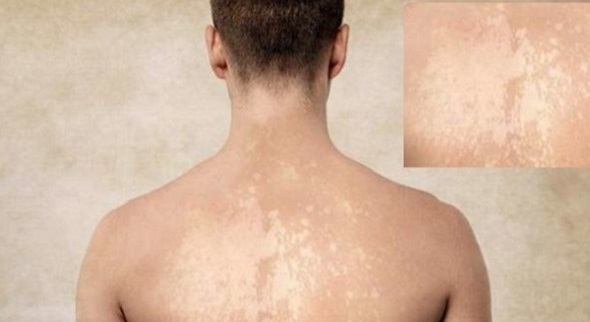
Tinea versicolor (pityriasis versicolor) is a fungal infection of the skin caused by the overgrowth of a fungal species that normally lives on the skin due to various factors, typically appearing as light or rarely dark patches matching skin tones on the trunk, back, and arms.
The fungus called Malassezia, which causes tinea versicolor, is normally found on everyone’s skin. However, tinea versicolor develops only in some individuals as a result of the overgrowth of this fungus.
Tinea versicolor starts as small spots on the skin. Over time, these expanding spots may merge to affect larger areas. There is fine scaling on the lesions. The patches are generally lighter in color than the surrounding skin, but sometimes they can be darker. They may appear white, pink, brown, or flesh-colored. It can affect any area of the skin, but is most commonly located on the back and upper trunk. The patches may cause itching. Although tinea versicolor is a fungal disease of the skin, it is not contagious; it does not spread from person to person.
Sodium thiosulfate; its solutions are used against various dermatoses. In pityriasis versicolor, its 20-25% aqueous solutions are applied to the skin 1 or 2 times a day over an extended period due to their antifungal properties.
Formula:
Sodium thiosulfate 20%
Alcohol 960 10%
Glycerin 6%
Distilled water q.s.p. 100 g
Ingredients in the formula:
Sodium thiosulfate- Thiosulfate sodium- Sodium hyposulfite- Dinatriumthiosulfat [IUPAC]- Natriumthiosulfat [ASK]:
Sodium thiosulfate is a relatively non-toxic substance primarily used in the treatment of cyanide, cisplatin, and nitroprusside poisoning. It is also used for the treatment of extravasation of cytotoxic agents such as cisplatin, dacarbazine, mechlorethamine, and mustine. Topical preparations of sodium thiosulfate are used for the treatment of acne and tinea versicolor. It consists of colorless monoclinic crystals with a bitter taste, which deliquesce in moist air and effloresce in dry air. It is stable at normal temperatures, soluble in water, and insoluble in alcohol. It should be stored in well-closed containers and in a dry place. It is incompatible with heavy metal salts, oxidizing agents, and acids.
Preparation of the formula:
Sodium hyposulfite is dissolved in a calculated amount of distilled water. The calculated amount of glycerin is added. It should be stirred with a glass rod, followed by the addition of the calculated amount of alcohol, and then stored in an amber-colored glass bottle. Shake well before use.
References:
1- Formulación magistral en la oficina de farmacia 3.a parte, Valencia, 1990
2-RxMediaPharma®2021 Interactive Drug Information Resource
Specialist Pharmacist Ahmet Nezihi Pekcan
Pekcan Pharmacy – Konya
[email protected]
Tel: (332) 3520657
http://www.majistralformul.com/